Wednesday, August 13, 2008

Paradise Regained

We're home in Takoma Park now, but we have plenty of wonderful memories of our very peaceful vacation.

Despite the initial setback in our blueberry-picking plans, we succeeded on our second attempt.

We spent the morning of perfect weather hiking about an hour or so along a wide mountain path and found ourselves at an open area where several trails meet. Blueberry bushes filled the central area and lined the paths.


Although I ate at least half the berries I picked today, David had a bit more self control and filled his quart-sized container with small intensely-flavored fruit.


After our lovely morning walk, we got in the car and started back down the mountain. We pulled over at a few scenic lookouts, including Looking Glass Rock...


...and Looking Glass Falls.


* * *


While we took pictures of the beautiful mountain views, an Asheville reporter took pictures of us taking pictures for a report the local newspaper was doing on the popularity of photography by tourists along the Blue Ridge Parkway. So I thought it would only be fair to take a picture of him. Unfortunately, I did not take a picture of him taking a picture of us taking pictures....

Tuesday, August 12, 2008

Trying

Recently I found a wonderful group of bloggers, the APLS:


My first reaction was to think that, while I loved peeking into all the blogs listed in the membership roles, I could not call myself an Affluent Person Living Sustainably.

Green Bean had already thought of the issues I had:

1. The label of "affluent" is sometimes an awkward or embarrassing one, sort of like "smart" was when I was a young nerd. Am I really affluent? Well---certainly not compared with some of our friends with a lot more money to burn than we have. But, well, at the same time: yes. We own a house with a safe mortgage and low payments, we save without struggle for our son's college and our retirement, we live both comfortably and beneath our means. But even for folks who feel like they may just be squeaking by, check out this calculator to put things in global perspective. If you are reading this post, I'll bet you will easily fall into this category of affluence as defined by the global scale.

2. Can I really say I am living sustainably? Absolutely not. On the other hand, do I work towards it, complete with all the missteps and mistakes, on a daily basis? While I certainly can't claim that I am doing nearly as much as I need to do, one of the things that is most powerful about the group is that it allows other people who are interested in making changes and trying to do better to find each other, to inspire each other, to challenge each other, to feel like a community.

As Green Bean writes, "There is something special about those of us who want to live with less in a society that urges us to live with more." No matter whether we have the cash for it or not, this society tells us that hope comes in a bottle and happiness comes in a jar, that we can buy a better life.

Instead, APLS are learning that we must, for the sake of our families and communities and planet, make choices that can help us build a better world instead of individually living large. Some of those choices may feel like hardships. Some choices require thinking in order to make the change but don't require any feeling of sacrifice. Other choices may feel like pure joy once we can make that first step forward.

It is not the doing but the trying that defines us as APLS.

* * *

As I recognized that I do qualify for the APLS label, I started playing out what sustainability means. Of course, many other participants started thinking about the same question.

Most of us in the basket of APLS are probably thinking about living sustainably as individuals and as families. As I chatted with David as we hiked through the Blue Ridge mountains picking wild blueberries, we started chatting about the fact that we could never be truly sustainable without the entire interactive globe working together towards a just future. Whatever steps we might be making towards a better life, it requires systematic change to produce true sustainability.

As I was mulling over these questions, I was reading Richard Heinberg's Peak Everything: Waking Up to the Century of Declines. One of his chapters outlines the meaning of "sustainable" fairly rigorously:

1. A society can avoid collapse by finding replacement resources. But in a finite world, the number of possible replacements is also finite.
2. Population growth and/or growth in the rates of consumption of resources cannot be sustained.
3. To be sustainable, the use of renewable resources must proceed at a rate that is less than or equal to the rate of natural replenishment.
4. To be sustainable, the use of non-renewable resources must proceed at a rate that is declining, and the rate of decline must be greater than or equal to the rate of depletion.
5. Sustainability requires that substances introduced into the environment from human activities be minimized and rendered harmless to biosphere functions. In cases where pollution from the extraction and consumption of non-renewable resources that have proceeded at expanding rates for some time threatens the viability of ecosystems, reduction in the rates of extraction and consumption of those resources may need to occur at a rate greater than the rate of depletion.

Although Heinberg's axioms might sound abstract, playing them out when we are thinking about our own choices (for personal action as well as political action) leads to some guidance--some of which is a bit more complex than the "just-change-your-lightbulb" kind of advice:

Choosing to reduce our use of resources--those that are not renewable but also even those that are--seems essential. Replacing our old perfectly usable plastic cabinets with brand new beautiful renewable bamboo might NOT be the most sustainable choice, as axiom three points out. Learning to make do with less is almost always the better choice, even if it doesn't satisfy our craving to buy buy buy.

Heinberg's first axiom also really resonates with me. So often we assume some new technology to save us from ourselves. I always swallow hard--in the difficult recognition of truth--when James Kunstler mocks the Google employees who answer his disturbing vision with "Dude, you're so, like, wrong! We've got, like, technology!" Our hopes for easy answers may be met this time with plug-in cars and LED lights--but these are fundamentally only short-time band-aids.

True sustainability requires changing what we see as our prime directive. It cannot be acquisition any longer.

* * *

Heinberg acknowledges that his axioms do not address issues of social equality at all, since he is not trying to "describe conditions that would lead to a good or just society, but to a society that can be maintained over time." I understand his point--but I'm not sure I agree with him that justice (and its corollary peace) is not absolutely required for society to be genuinely sustainable. Likewise, without a strong sense of community, can human society be truly sustainable?

* * *

In the abstract, the meaning of the word sustainable has no relation to everyday challenges. Sustainability is not defined in opposition to some instance of lack of sustainability.

But when it comes down to specifics of our actions, what we define as sustainable is what we do in the face of a known threat. If we know climate chaos as a result of carbon and methane emissions is a threat, we try to address it (as axiom five would have us do). If we're worried about Peak Oil and the depletion of fossil fuels generally, we're going to be responding to axiom four. And so on.

We absolutely need to address these problems in our efforts to live a sustainable life. But I wonder: could we think more creatively if we sometimes stepped aside from our current problems? What if, instead of trying to tinker with what is broken, we tried to imagine a truly equitable and sustainable community? What actions would that require us to make?

Perhaps this will be my question for my atheist version of teshuvah.

Sunday, August 10, 2008

Still Eating

We planned another all-local meal for our vacation Shabbat dinner. The meal was a recap of one we made last year on our North Carolina vacation (with a slight variation): local trout, swiss chard, bright yellow zucchini, onion, and tomato, cooked in a little leftover brown ale. Delicious, especially given that the only seasonings we had access to were salt and pepper. Just goes to show how important fresh ingredients can be.


Dessert? Local blueberries and locally-packaged pecan shortbread (a favorite childhood treat).


* * *

It has been a lovely vacation, but it is coming to an end. We are picking up our son at camp in just a few hours. I am missing him very much and worrying about him in the way only parents can do.

I still have lots of stories about what we’ve seen, heard, read, and knit while on our trip. Because of a very spotty internet connection, I’m a bit behind on the blogging. I am certainly missing reading everybody else’s blogs and I am really looking forward to being home. Perhaps that appreciation of home is the best part of vacation!

* * *

UPDATE: Happily, Son is back with us now--and, after many hours in the car with a stinging insect of some kind, we've finally pulled into a cheap highway motel for the evening. Home tomorrow by lunchtime!

Saturday, August 09, 2008

Paradise Lost

David and I enjoyed picking blackberries on our walk so much that yesterday morning we decided to go on a much longer hike along the Blue Ridge Parkway. The path leads to a blueberry grove. Neither of us brought ideal shoes or paraphernalia for a real hike--but although the walk was long, it was supposed to be on easy terrain. So we put on our sandals and packed our tote bags with water, peanut butter sandwiches (with delicious local blackberry jam), and empty plastic pint containers to hold our day’s collection of berries.

We started to drive up into the mountains--higher and higher, the views getting more and more beautiful. As a person with a significant fear of heights (which I did not seem to have until my child was born), I occasionally leaned away from the window and held my breath when we rounded a curve with an especially beautiful view.

David and I were engrossed in a deep conversation about how hard it might be to turn our town into a transition town, or a post-carbon city, or hub of relocalization. (More on these thoughts another day.)

As we gained even more height, getting close to the highest point, our car started to make a funny grating sound. There was a smell, not terrible but getting worse. And after a half a second, smoke was pouring out from the hood.

We pulled over and opened the hood. I keep telling David thank you for pulling over on a wide safe slightly-inclining shoulder. The last thing I needed was for our car to look like it was about to explode on the edge of a fatally-dangerous cliff--ur, “scenic lookout.”

Perhaps because we are in North Carolina, generous home of my birth, or perhaps because we were on a road that no one travels who is in a hurry to do anything more time-pressing than reach one of those scenic lookouts or find a hiking trail, many many cars and motorcycles stopped to see if the inhabitants could help. With all these offers of assistance and an absolutely beautiful day to boot--sunny and warm but with a cool breeze--things seemed a lot better than they could be.

Not quite as nice as blueberry picking, though.

Neither David nor I know much about cars. Between the glove-compartment guide to our little 11yo Honda Civic and the advice of one kind couple who pulled over very early on, we figured out that the radiator was overheating and that we could add water to both the reservoir (which was completely empty) and the radiator’s main opening. We let it cool down for a long while, added water, let it cool down some more when the water bubbled and steamed out of the opening, then poured in more water.

After we had finished our sandwiches and enjoyed the peaches we brought for desert, we headed back to the road. We started heading the car down the mountain and all seemed well for a few minutes of coasting downhill.

Then we hit a flat spot and David pressed the gas pedal. The temperature marker shot up. Now we were in a busy swath of road in a less ideal (but not mortally dangerous) spot. We were surprised to discover that the radiator reservoir was still full--is it possible even more full than it had been?

Should we call a tow? Where were we, exactly? David pulled out his cell. No reception. Well, we could flag someone down here if we needed to, but surely we can make it to the ranger station at the base of the mountain. It isn’t that far, is it?

Well, each time we pressed the gas pedal, the car would begin its quick climb toward overheating. We’d pull off, open the hood, and let the car cool off for a while before trying to get a few more yards down the road.

Now, I carry books and knitting absolutely everywhere I go. So does David. But because we were using our tote bags to hold our picnic and drinks, we had unpacked our entertainment.

I suppose that, given the choice between words and stitches versus food and water, I’d rather have the latter.

I suppose. Don’t let me think about that choice too long…

Really, I could have gone without food for the day better than I could go without knitting in this time of crisis. We found an old book of ghost stories from the Outer Banks stuffed in the door of the car, I think from a visit to my parents many many years ago. Hey, the Outer Banks are the right state! Sure. We read about the flaming ship of Ocracoke while we waited.

It took us more than four hours to get down the mountain.

We still did not have cell reception when we hit the ranger station, but they were kind enough to let us use their phone.

It was 4:00 on a Friday afternoon. David is expected back at work in Washington on Monday. Could this be fixed by our departure time, or were we going to have to extend our vacation (heartbreak) and have David miss a relatively important meeting (a more serious issue)?

The tow truck arrived in less than 15 minutes. That is pretty much how long it takes to drive from the center of town to where we were if you are speeding. The tower hooked up our little red car and lifted it onto the massive towing bed. David and I crawled into the cab with him and down the mountain we went. He recommended his favorite fix-it shop which stayed open until 5:30. They would try to fix it as soon as we arrived. If they diagnosed a real problem, it might be at least Monday before they could fix it. Yikes.

The owner and his wife and 5yo son were kind and friendly. We asked the young boy what work he did at the shop. He said earnestly, “Oh, I don’t work here. I play here. That’s because I’m still little.” The young boy drew us pictures, threw paper airplanes with us, and told us all about his band-aids. It made me miss our son so much!

The mechanic was very serious. At some point he walked away from the car and a few minutes later came back with a steaming coffee mug. He looked into it with knitted brow, concentrating deeply and pacing as if he were walking a labyrinth.

After a few moments, he picked up a pair of pliers and pulled out a piece he had been soaking in the fluid in the coffee mug.

His frown made it clear that things did not look easy. Soon, the two mechanics together determined that we might “only” need a new radiator, but we might have “busted the head gasket” or something. This would be a huge overhaul costing a lot and taking some time. Keep your fingers crossed.

We called the one car rental place in town in the moments before they closed. “Sorry--no cars right now. Don’t have a thing.” Yikes. Our little cabin in the woods is miles from here, from everywhere. We have to pick up our son at camp on Sunday. We have to have a car. And this one is our only one—here but also at home.

If we were going to have to pay $4000 for an overhaul and wait a week on top of it, would this be the time to finally break down and buy a new car? How long does it take to get a Prius these days…?

The mechanic continued to study our car. I went for a walk and wandered in the conveniently-located local yarn shop (!), independent book store, and natural food store. I was so worried about what we were going to figure out for the next few days that I did not really pay attention even to the yarn. (When is the last time that happened?)

I walked back. They had found a radiator available very nearby, gone to pick it up, installed it, and were testing it.

We played with their very funny young son. When we told the 5yo what a great artist he was, he said in all earnestness, “Oh, I’m not an artist. I’m a KID.”

And suddenly they were taking our little car out for a test ride, up some of the big hills in town. It came back cool and humming--no smoke, no smell, no busted head gasket. Beautiful!

So the day had a happy ending, although all those “there’s-not-a-care-in-the-world” thoughts that we had been cultivating were totally shot.

We arrived back at 8pm with bread, candles, and a bottle of red wine so we could celebrate Shabbat.

But we were zonked. We made some super-quick pasta and drank beer while watching the Olympics opening ceremony. I know it is weird, but our plan is to celebrate Shabbat tonight, instead.

* * *

I think we’re going to try the mountain and the blueberry hike this morning.

This time, I’m packing my knitting.

Shabbat Shalom. Peace.
Thursday, August 07, 2008

Motel Okra

On our drive down to North Carolina, we spent one night in a roadside motel. When we woke up in the morning and walked in the light to the office to turn in our keys and fill up our coffee mugs, I could not believe my eyes:


What a great place to plant this beautiful plant (which yields my favorite vegetable!):

Wednesday, August 06, 2008

Eating Locally in the Mountains of North Carolina

David and I are loving being in our quiet little cabin by the lake. We've been lucky enough to find lots of sources for local food: at an independent snazzy (expensive) grocery called Poppies, at a very inexpensive farmer's market in the town of Brevard with lots of vendors who remind me of home (which was a small town on the other side of the state), at a dirt-cheap little farmstand, and for absolutely free on a berry-covered mountainside trail off the Blue Ridge Parkway.

For a late brunch, we made shrimp and grits with NC shrimp bought at the grocery, grits from Son's camp (and ground by previous campers), and tomatoes bought at a little tent in front of one of the houses down the road from our cabin. The shrimp and tomatoes mixture had a little local butter and the grits were seasoned with local goat cheese.


For dinner, we cooked out on the grill on the back deck. We cooked local ground bison burgers and served them on buns from a local bakery, topping them with tomatoes. Local green beans and roasted corn rounded out the meal--and as a special addition we added a few of our lemon cucumbers that we brought for car snacks.


There is nothing better than roasted corn! Just throw it on the grill for ten or fifteen minutes without any shucking or anything. After it is cooked, the silks peel off incredibly easily.


We washed our meal down with local and organic Pisgah porter:


Dessert? Wild blackberries we picked on a slow easy hike through the mountains. (Note the scale: these are intense little berries in a tiny bowl the size of a saucer, resting on a stool--not big ones in a regular bowl sitting on a table.)

Tuesday, August 05, 2008

Asheville's Charms

Early yesterday afternoon, David, Son and I drove into the very cool little city of Asheville, North Carolina. We had such a wonderful experience here last year that we thought we’d stop again for the day this year.

Lunch was first on our schedule. We started where we started last year: Laughing Seed CafĂ©, a fantastic vegetarian restaurant. After a late on-the-road dinner last night where I ate nothing particularly good for me, it was a pleasure to look over the menu and see beautiful vegetable after beautiful vegetable. And when my choice arrived, the taste of the seasonal veggies, black beans, and rice with a sesame-ginger sauce was out of this world—yet totally grounded as well. Highly recommended.

My favorite part of the meal is something I ordered last year as well: a fresh basil martini!


Last year we had the incredible fortune to completely fortuitously run into my brother and his girlfriend at this restaurant. We had no idea they’d be in the state and they had no idea we would be here.

This year, we planned things a bit and my brother joined us for lunch. Son absolutely glows whenever he sees one of his uncles (David has one brother as do I), and my brother’s wacky humor and ability to be as silly as a 9yo definitely helped make up for the 8 hours in the car Son had just had to live through.

* * *

We spent the afternoon exploring the galleries and shops in town.

I love all the street art in Asheville.


My favorites stores, of course, were the knitting stores and the amazing book store.

At Purl’s, which has moved since last year, I especially loved the handmade pottery buttons. Pictures to be inserted sometime soon.

At Earth Guild, I experienced a pang of serious lust for Kromski rigid heddle loom in the largest size. I managed to resist any really major purposes, but we came out with some black dishcloth cotton to make martini-glass dishcloths as well as some lovely natural dark brown alpaca laceweight.

My brother and I also loved going in the small Scottish store and admired all the Clan Cameron stuff. The store also displays many gorgeous sweaters that left me itching to start yet another sweater. (But... um... I have three sweaters on the needles at the moment, all very different from each other. Three, despite the hot weather. Details when we return to Takoma Park. And my plan is to cast on a new lace shawl tomorrow, to boot.)

* * *

The local independent book store has a knack for putting every book on my bulging nightstand either in the front window or on the front table. Every book in those locations that is not on my nightstand obviously belongs on my nightstand, right?

One thing that David found in a special display was especially exciting to me: my book! (Feel free to check out the link in the sidebar.)


The store has a great selection of buttons, magnets, and bumper stickers of the liberal persuasion. My favorite:

McCaint

* * *

Although we wanted to eat a locavore meal at the Early Girl CafĂ© like we did last year, we didn’t think to make reservations early in the day and the wait for dinner—a wait we would be spending with a child already saying he was about to pass out from hunger—was going to be at least 90 minutes. Perhaps we can return next week after camp is over.

So we went to a Middle Eastern place around the corner with good food, good live music, and a belly dancer that Son embarrassedly said reminded him of a veela. (My boy is growing up!)

* * *

After dinner, we said goodbye to my brother and headed off to our little cabin by the lake in Brevard. In the dark as we pulled our little car into what we hoped was really a parking spot, I started thinking how much I need this quiet week. As much as I love my son, we’ve had a more intense few months lately than we’ve ever had before. I am increasingly impatient with him, and he is quite verbal in his response. I hope this week will be not only a break for both of us but a time where I can contemplate how to make things better—and come back at the end of the week to enjoying the parenting of my amazing child .

Sunday, August 03, 2008

On the Way Out

We are about to head out of town for the mountains of North Carolina. Son is going to spend the week at the same camp he went to last year, where they grow 75% of their own food and where I went when I was a girl. David and I are renting a cabin about a mile away--where we will knit without interruption, read without interruption, and talk without interruption. And anything else we can think of. (Any suggestions?)

* * *

Leaving gardens at the beginning of August is insane. In order to prepare, we did a sweep and picked everything fruiting--whether it was ripe or not.

This photo, taken by our Son, is called "The Back"--in honor of the little postage stamp of native soil you see as well as the view of Papa's bottom:


We picked an enormous amount given how small the plots are. Here is a wee sampling:


The lemon cukes are delicious and beautiful.


* * *

After harvesting, we put up food like we were preparing for the winter in one weekend.

We made 8 half-pints of peach jam, 3 quarts of dried tomatoes, and and 4 pints of bread-and-butter cucumbers from seconds we picked up on the farm tour. We sheared all our basil and made pesto to freeze. We dried our hot peppers (which we will grind later), and put aside another quart of dried mint for tea.

Then this morning's post-garden haul: 10 pints of green tomato pickle, 3 pints of pickled green beans, 4 pints of bread-and-butter zucchini, and 4 pints of pickled lemon cukes (seasoned with lemon verbena).


I'm so sick of that steaming-hot canner--but I love looking at the colorful jars we produced today!

* * *

Local lunch in the midst of all of this preserving, eaten while we were too preoccupied to take pictures:

We sauteed loose sausage from "our" farm with the first of our baby eggplants, some zucchini, and a tomato. Simple--but perfectly sustaining.

Friday, August 01, 2008

Day at the Farms

This year's county farm tour was a two day event for us.

On Saturday, David and Son headed out while I enjoyed some quiet work at home. In addition to bringing home plenty of vegetables, they got the opportunity to visit our county's beautiful alpacas:


* * *

They also picked a couple of quarts of the most luscious blackberries I've had--well, since we picked at the same place last year. Blackberry jam is my all-time favorite spread for my toast, but after I had one of these, I knew it would be impossible to pass up enjoying them fresh this time.


* * *

On Sunday, I joined them. We picked up some more bulk veggies--including tomatoes for drying. Then we headed off for the relatively new winery in the county.

And here we had our local meal of the week. David and I sat on the open terrace, under a shady umbrella, enjoying an official wine tasting as well as a plate of silver goat cheese from a neighboring farm. The wine was excellent, the cool breeze a lovely change from the last few steamy days, and the sophistication factor immense (especially after Son headed off with a few other kids to play in the vineyard). Peace.

Yes--I realized after I returned home (still a-glow from the wine-tasting) that I had violated my July rules without even realizing it. Sigh. Delicious, all the same. And local.

Wednesday, July 30, 2008

Let Go of the Shore and Gather Yourselves


To my fellow swimmers:


There is a river now flowing very fast.

It is so great and swift

And there are those who will be afraid.

They will try to hold on to the shore.

They will feel that they are being torn apart

and will suffer greatly.

Know that the river has its destination.

The elders say we must let go of the shore.

Push off into the middle of the river.

Keep our eyes open and our heads above water.

And I say,

See who is in there with you and celebrate!

At this time in history we are to take nothing personally.

Least of all ourselves. For the moment that we do,

Our spiritual growth and journey comes to a halt.

The time of the lone wolf is over.

Gather yourselves!

Banish the word “struggle” from your attitude and vocabulary.

All that we do now must be done in a sacred manner

And in celebration.

We are the ones we have been waiting for.


--The Hopi Elders

Tuesday, July 29, 2008

Knitters Pack Lunch

Check out what the almost-too-clever Jennifershmoo is making (and get the links to the patterns) over at Vegan Lunch Box!

Monday, July 28, 2008

Hope: our next step

Frankly, I don't want that version of America to survive -- the America of chain stores, and muscle cars, and grown men obsessed with video games, drugs, and pornography, and women decorated like cannibals, and the vast, crushing purposelessness of it all. I have no doubt we're heading into a convulsion that will wring much of this junk and dross into the backwaters of history. We're capable of being something better than this, of putting our time on earth to better use, including a more respectful treatment of the land we inhabit. This year and the next will be the years of letting go, and out of that we'll commence a re-becoming.

James Howard Kunstler

Sunday, July 27, 2008

Homegrown Mess

Our dinner came completely from our own garden.

To emphasize the DIY nature of the meal, we cooked it in our solar oven--making this almost a zero-carbon meal (except, of course, that fact that all the food was previously living and made of carbon).

We dug our very first little tiny pearls of new potatoes, then added our first-of-the-season tomato, a zucchini and a yellow squash, a few green beans, a chioggia beet, some yellow-stemmed chard, and a little basil.

It isn't the prettiest dish we've ever made, but I have never been prouder:

Tuesday, July 22, 2008

A Gardener's Dilemma

I killed my carrots. Every single one of them.

It is a principal of gardening that you scatter tiny vegetable seeds in the spring, watch to see how many germinate and come to life, and then...

...murder half of them.

It is only through thinning out half the seedlings that the others have room to live. Carrot seeds are so small that it is almost impossible to plant them individually. If I didn't just scatter the tiny seeds, I might not spend the effort to plant them at all, to bring them to life.

We can even eat all our thinnings. How different is that from bringing produce to adulthood just to nourish us? Facilitating life and managing death purely to nourish ourselves is what annual vegetable gardening is all about. I have absolutely no moral qualms about snuffing the life of produce.

Or do I? Those poor carrot seedlings, so dainty and so slow to germinate.... I left them too long without thinning them, hoping for them to become strong enough to make it to adulthood. I just could not thin them. "Thin" them--what a pathetic word to convey the taking of life prematurely. (Good grief. Taking the life MATURELY doesn't bother me.)

So the carrots strangled themselves, wrapping themselves in each other's roots, unable to spread out.

* * *

Today's lesson from the garden:

There are times we have to make choices in order to move forward.

When I was 18yo, everything seemed open to me.

Each step I made toward one future simultaneously closed the door to another.

Soon, I had limited my options. Things that had been possible before were no longer there.

It is exactly through those limitations that we move further into the light, into life.

Sunday, July 20, 2008

Local Summer Eating

This week we made a delicious Cream of Purslane soup--made with the most abundant backyard weed vegetable in our garden. After steaming the greens, we pureed them with local cream (but you could use yogurt instead if you had some in the fridge), stock made from the week's vegetable peelings, and a little bit of salt and pepper, and garnished with backyard basil. We only discovered how much we love purslane a few years ago--and it serves a starring role in many a summer dish.


We continued the meal with zucchini (from our garden) cooked down in pureed tomatoes that we canned ourselves a few weeks ago. South Carolina rice, the grain that often anchors our homegrown vegetable dishes, served as the base.


For dessert we had a handful of blackberries. David and Son had gone for a bike ride to the adjoining neighborhood/town of Silver Spring right before dinner--and they passed the lovely little backyard farm of an older neighbor who sells fruits and veggies from his yard. The berries were tart and plump--my very favorite fruit and a marker of the height of summer.

Wednesday, July 16, 2008

AC-CENT-TCHU-ATE

You've got to accentuate the positive
Eliminate the negative
Latch on to the affirmative
Don't mess with Mister In-Between

* * *

Sometimes a book comes along at just the right moment.

For me, today's book is Food Not Lawns: How to Turn Your Yard into a Garden And Your Neighborhood into a Community.

I spent yesterday complaining about happy-happy talk--but now I finally get what my partner David was trying to explain to me after he read my post.

He kept saying that stating things in the positive made it possible to move toward what you want to build. And I kept saying that the difference between saying you don't want to hurt something versus you do want to help it doesn't make any difference in how one decides to act.

So he goes to work and Son and I sit on the couch to read next to each other.

I pick up Heather Flores's book and just roll my eyes one (last) time as I start this quote: "Much of the work [done by activists] was about stopping something--logging, mining, violence, et cetera--and not much seemed to focus on starting real alternatives."

Yes, yes, whatever--I think. "But we must respond to the crises of logging, mining, violence, et cetera. That is what often produces true change!" I want to whine at the author.

But then, I got it, understood what she was saying. I sat up. My eye-rolling suddenly stopped and I heard Melinda telling me to stop complaining and start finding solutions.

Yes--that is it! One must define the problem, often in the negative, and then try to move forward with it. Not abandon it and not ignore it--but solve it. Sometimes the solution to changing the world is working hard to stop something. That is a positive step all by itself.

If one gets too stalled, either in the negatives or the positives, one cannot make a difference. You can cry all day, you can whistle Dixie--or you can actually work (even if it is just on ideas). As Flores says in her book, "Dreams of industrial collapse became prayers for communities feeding and healing themselves."

* * *

So I'm all for accentuating the positives of the future--but in crafting that future, we absolutely can't "eliminate the negative" as Disney would have it in the song.

We cannot abandon our efforts for positive change. But building that better future happens not through dreams or hope alone. It happens because of analysis of the past and present, analysis of plans. It happens because of hard work in the dirt, because sweat and mosquitoes don't stop you. (Hrumph. They stopped me today.) Dreams only become reality when we get past the simplicity of both the positives AND the negatives and on with the real building of what we want and need, as individuals and as a community.

So just call me Mister In-Between.

Monday, July 14, 2008

Happy-Happy-Happy, all the time

I have a whole list of happy, uncontroversial posts running around in my head, and a few even on my list of I-Can't-Believe-I-Haven't-Posted-That-Yet items.

Instead, I'm thinking about how much we avoid talking about the negative in this culture, even when we're living in its midst.

* * *

I listened to a few minutes of a fantastic radio discussion yesterday--and I am currently downloading the program to my iPod for some listen-while-knitting "entertainment." On the show, one scholar suggested that atheism was an unacceptable idea because it defined by the negative rather than suggesting what one does believe (as secular humanism does).

I found myself highly troubled by this correction. For those of us who do not believe in God, it IS precisely this "negative" idea that is at the core of any effort to behave honestly.

Don't get me wrong: I'm not at all saying that real believers are dishonest. I am saying that when a person (read "Purloined herself") says she believes in God (or maybe even when she goes through rituals that imply belief?), even though she knows in her heart of hearts that she really doesn't believe--but that so-called belief is socially expected, or socially expedient, or reassuring--she is not living an honest life. It is not helping her become a better person.

It is when we force ourselves to confront the fog and the voids in our lives that there is the most potential to grow.

(Yes, well... I am still waiting for that growth personally--but I, um have faith that it is on its way one of these days.)

The fact that I believe in our duty to other humans and the earth, and in equality of all people, and more-or-less in the inherent goodness of our hearts (despite all the real-life complications in human hearts) makes me a humanist. That is all fine and good--in fact, those beliefs are a big part of who I am. Not surprisingly, I have been able to find other nonbelievers as well as many believers from a great number of religious traditions who all accept similar things and can work together for progressive change--even when we are not coming from the same underpinnings. It is essential that we find each other and work across religion in order to address issues--but that does not mean I have found my own tribe, my own sense of who I am and what I can be openly, when I am in those groups.

No--what really defines my beliefs about religion, about the people in my tribe, is the negative, the absence of God--not the belief in unity with-or-without God.

* * *

This desire not to say anything negative stems, I think, from the Disneyfication of our culture: a complete turning off of the critical mind.

Critical, of course, has two meanings: that you are being negative, and that you are being analytical. At heart, the definitions are linked; the ability to be analytical means you sometimes wind up in negative territory. THINKING can leave you in lots of nots.

* * *

I am part of the facilitation planning committee for a community visioning process. One person suggested that we ask groups to start out with a list of things they were seeking and a list of things they actively wanted to avoid. Very quickly, others jumped in that we did not need to ask for "avoids" and if anyone suggested one, we should help them reframe it as a positive. (Don't want things to harm the environment? Say we want to protect Mother Earth. Don't want jackhammers running at 7AM? Say you want to maintain peaceful mornings.)

All that is true: you can almost always cast the negative in reverse positive terms.

But WHY do we feel called upon to censure the language of avoidance? Why can't we embrace the negative sometimes, even "learn from our mistakes" as they used to say? Everything now has to be sanitized of anything that might suggest failures, complexity, sadness.

We are trading in the authentic for the romantic comedy version of our lives.

* * *

Yes--I wallow way too often in my own private underworld.

Sometime the demons get the better of me. Even when I make sure all the closet doors are firmly closed and the door to the basement is shut and locked, spray lavender on my pillow--the demons still seep out and enter the room.

When I deny they are there, that all is happy-happy, I am literally denying my own life. When we do it as a culture, we are shutting down our brains and losing our true selves to what is real and honest darkness.

Sunday, July 13, 2008

A Very Special One Local Summer #6


We set our table with some fridge-weary kale leaves that we let dry:


For dinner we had grilled portobello mushrooms from Pennsylvania, roasted asparagus spears from New Jersey, baby potatoes from Maryland, lamb shanks from Maryland grilled over fresh rosemary from our neighbor's yard, and slices of gorgeous Chioggia beets pulled from our own garden. Yummy. (Who knew you could get local asparagus, one of my partner's favorite vegetables, in July?!)


To top the meal off, we had a non-local treat: a sour cream chocolate chip pound cake especially requested by the birthday boy.


Happy 40th Birthday, David!

* * *

We began the next day with pancakes made from the remnants of various flours we had been grinding during the month. There was a bit of oat, quinoa, amaranth, winter wheat, and millet. On top of the pancakes we served some homemade cow's milk cheese (like chevre but we made it with cow's milk) and homemade blueberry jam (details coming soon). What a local way to start the weekend!

Friday, July 11, 2008

Obama-vore!

Check out Alice Waters discussing the presidential candidates in the video over at at Grist!

(Due to technical difficulties, I have removed the actual video--but please click through.)

Tuesday, July 08, 2008

Monday, July 07, 2008

Pewter and Bronze

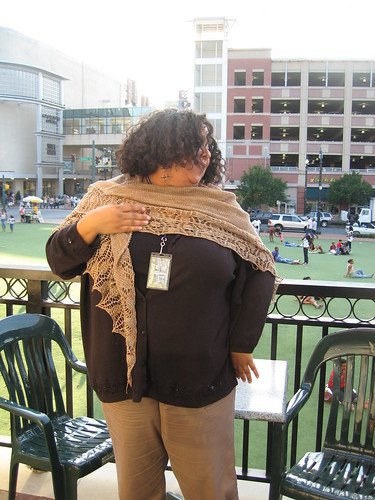
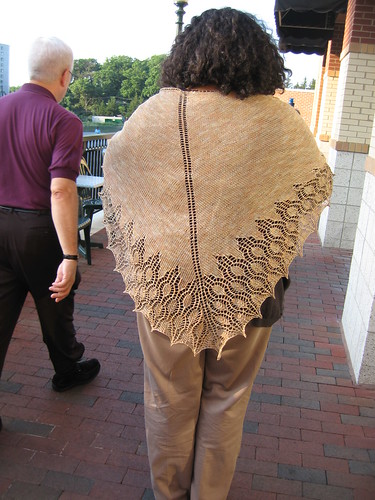
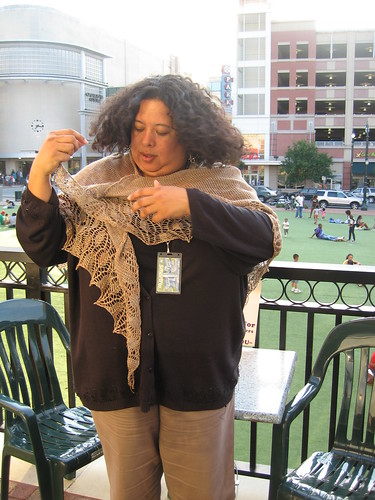
I showed you a corner of the Seraphim shawl as it was blocking, where you could see the radiant yarn (Blue Heron mercerized cotton) and the beautiful beads. I promised some modeling shots...

...so may I present my lovely friend Carol showing off the shawl to its best advantage:


In this last photo, she is posing with Amy's daughter. Thanks, Amy, for lending me your camera!

Sunday, July 06, 2008

One Local Summer #5

My current vegan challenge is only about CAFO animal products, so while we're home, we still eat meat, milk, and eggs--all from "our" farm.

For this week's one local summer meal, we combined leftovers:

A beautiful salad of arugula, salad turnips, and radishes, all from our CSA, topped with fresh peas from the farmer's market...


...and fried rice with leftover with farm steak and South Carolina rice (both above-linked in their original dishes) combined with farm eggs, CSA radish greens, farmers market green onions, and our own garden's swiss chard. A real kitchen-sink meal that left us fully satisfied in almost every way.

Saturday, July 05, 2008

Industrial Vegan...

...or CAFO terroir?

At the Smithsonian Folklife festival, I am struggling with my month-long pledge to myself not to eat CAFO animal products.

I thought about bringing my own food but decided it would be interesting to get something from one of the festival vendors. Surprisingly, there is nothing vegan here that I can find other than Lime Fizz and watermelon. (Note to self: Follow Chile's advice and check first next time. Duh.)

Am I really thinking of getting a ConAgra-owned Tofu Pup from a side stand on the Mall instead of this, which of course is not exactly terroir but is about cultural traditions and it is from an independent restaurant:

Nakey Tshoem
Chicken (shredded), fiddleheads, cheese, chiles, onion, garlic, ginger, and special seasonings served with Bhutanese rice

Ema Datsi
National dish of chiles with cheese, served with Bhutanese rice


Bhutanese cuisine, influenced by those of Tibet and India, links the country's eastern Himalayan environment and traditions, including food production and consumption. Chicken Nakey Tshoem includes nakey, which is a type of fern, and tshoem, which translates literally as "curry," but in Bhutan the name refers not to spiciness but to a hearty stew served with rice. Ema Datsi is the national dish of Bhutan and is the undisputed favorite of the Bhutanese. Its main ingredients are chiles; a fat-free, fresh cheese; and onions. As a side dish, it accompanies almost every traditional meal.


This pledge of mine is not easy.

Friday, July 04, 2008

Happy Independence Day!

Now I am off for a swim!

Photograph by Singlefinlove

Thursday, July 03, 2008

Confined Feeding

Chile can make us do things we've been putting aside for too long.


Her Quit Now challenge asks participants to think about their everyday choices and what they will mean in a peak oil world.

Last month I officially signed up for the challenge of not using the clothes dryer. With one small exception, my family made it through the month with, um, flying colors (or at least waving-in-the-breeze dingy-whites).

I also managed to make the switch from shampoo in bottles to shampoo bars, and from disposable kitchen sponges to hand-knit washrags.

* * *

This month I pledged not to buy bread but to make it myself all the time, using grain we grind ourselves. I love making bread but often don't get it done for any time other than Shabbat.

(Well, we already blew it once. Last night we bought pita to go with our its-too-hot-to-cook hummus and tabbouleh picnic....)

* * *

I made another pledge, one that I've been struggling with intellectually for some time and only sometimes trying to live up to:

I will not eat CAFO (confined or concentrated animal feeding operations) or factory farmed animal products this month.

In the next few weeks, I'll write more about why I chose this action and what my issues with this decision are. But for now, a little history:

I was a most-of-the-time vegetarian for many years.

"Most of the time," you ask? I've always eaten whatever my mother and grandmother put in front of me. And I've always eaten foods culturally important to the people and cultures we visited on trips. (That meant eel in Quebec, pork barbeque in South Carolina, tako poke in Hawaii.)

While I was pregnant, I craved meat and eventually decided to honor that craving and eat all the liver I wanted. For years after my son's birth, I continued to be vegetarian except on the first day of my menstrual period when I ate beef.

We kept a vegetarian house, partly to make it easy for our kitchen to remain kosher. I ate meat out at restaurants during my monthly exceptions.

Then Peter Singer and Erik Marcus entered my life. When I read about how dairy cows and laying poultry worked into the industrial agricultural system, I began to feel that eating no meat but continuing to support the system nonetheless by purchasing milk and eggs was something I could not do. We began to buy soy milk and artificial egg powder, as well as TVP and more tofu and tempeh than we had been eating before in our dairy-and-egg days.

Then, Son had significant reactions to the soy he was eating. We cut out the soy for a brief experiment--and his weight and height both soared instantly. He had been a tiny child--and now I believe it is because his body could not absorb nutrients well because of his food sensitivities. (He is now very average size-wise and doesn't have significant food issues of any type.) I'm not saying that children cannot be fed well on a heavy soy diet--just that this particular child could not due to the reactions of his gut.

After a lot of soul searching, long conversations into the night, and reading in the philosophy section, David and I decided to buy both meat, eggs, and dairy from a nearby farm. I have been extremely pleased with this decision.

I swapped utterly, from keeping to a vegetarian diet at home but eating meat out, to keeping an omnivore's kitchen but eating vegetarian out. Or at least that was my plan. David kept to his word far more than I did.

We never said we'd be vegans when we were out--but a lot of my hair-pulling was from the fact that I truly believe a factory farm is a factory farm. Whether the animal is killed for meat or just de-beaked and de-tailed and crowded beyond belief in a dark warehouse full of its own shit really does not make much difference to me.

Ordering the cheese omelette instead of the burger really doesn't make me feel better about my ability to be a moral person.

The funny thing is that my belief that a factory farm is a factory farm pushes me away from not only animal products produced industrially but PLANT products produced industrially--and that means almost all soybeans and other meat analogs. I'll write more about this in coming posts, but for now...

...I am going to keep my meat eating and my dairy and egg consumption to our own kitchen, where, yes, we will cook animal foods, all from animals living on a farm we have visited, raised by a farmer we know.

* * *

I've already blown it. July 1st at knitting group, I decided to order eggplant fries. I did not ask if they were vegan. Even though I realized they might have some kind of egg dip, I decided they probably did not given that they do not have a thick-batter coating.

What a wimp I am. I'm going to have to learn how to ask again.

Then when I was chatting about it later, I realized they were sprinkled with parmesan cheese. What an auspicious start.

Wednesday, July 02, 2008

Lego my Edgar

Given the combination of my Poe fixation and yesterday's Lego post, I just couldn't let these pass:


Tuesday, July 01, 2008

Plastic Dreams

The heat-plus-humidity stranglehold that gripped my home for the entire weekend has finally let go.

I am left, surprisingly, sad.

* * *

While I cooked breakfast (I fried up pancake batter leftover from the weekend with the first few local peaches), Son found an unopened Lego set in our Random Closet.

Both my parents and David's parents saved our childhoods in attics and basements, so many of Son's too-numerous playthings come from the early 1970s.

The '70s now seem like such an innocent decade. Did people see that at all back then?

Son's Legos, almost all leftover from David's childhood, are stored in a big box. It is an astonishingly large collection of plain blocks in a great variety of sizes.

Almost all of the blocks are red, white, or blue. Clearly, David came of Lego age in 1976.

* * *

1976. I remember drilling my much-younger brother, newly two years old, on how to talk as we watched Walter Cronkite on the television. He learned to whip out, "Bicentennial Minute!" at any opportune moment, saying it at lightening speed in his high lispy tones.

My brother celebrated his very adult birthday this past weekend. I still think of him as nine years old, my son's current age.

Poor brother. He had to deal with having three parents giving him instructions about how to live.

He still does.

* * *

The Lego set Son found in the closet this morning was double-bagged in plastic Publix grocery bags. I have absolutely no memory of this toy, but I would guess it is from Grandma and Grandpa (my in-laws) since Publix is the main grocery chain where they live most of the year.

The set comes with directions. The pieces are not necessarily easy to recognize as Legos. They all share the ability to link to those classic cubes--but now they are just parts of a particular whole, parts that come with instructions that tell you how to put them together, how to play with them.

Following the directions, we make a hard-plastic hot air balloon to take a few little Lego people on an Orient Expedition.

* * *

I lament the passing of the world that now seems to have allowed creativity. When we were children, we were given a chance to make whatever images came into our head. Those red-white-and-blue Legos turned into covered wagons, rockets, Big Foot's footprint, the Mouseketeers, castles, mountains, a hospital... whatever was relevant to our own personal and changing interests.

* * *

As I take a load of dirty laundry down to the washing machine in the basement, I glance at the prepackaged box of magic tricks.

When I was seven, I started to understand that nothing happened without human intervention. But in that age, it seemed that that intervention could not be mine.

Before receiving the magic set, all I heard when my uncles pulled eggs out of cloth bags was, "Magicians never tell!"

Someone else controlled things, someone pulled the strings.

God was a job open to anyone with the right directions.

I had such a sense of power in my hands that Christmas when I opened the magic box. That holiday when I turned seven years old, before the birth of my brother, my parents were telling me they trusted me enough for ME to be the ones pulling those strings.

What could I make happen in this world that had appeared so mysterious before I had the manual?

* * *

I look at my childhood ranch-style doll house, now set up on a little table in the basement. The dollhouse used to have working electricity. Tiny 1970s-style fixtures lit up its back corners. Son points out that there is no way to get from one floor to the next, except by magic.

My grandmother, long dead, knit complicated lace blankets for the beds and crocheted simple rugs for the floors. I, at age seven, cross-stitched a miniature daisy and put it in a tiny frame.

What was handmade looks timeless, still works, even though the peeling doll-house family now lives off the grid.

* * *

I pick up the pattern for the sweater I am knitting on this cool afternoon. It is the first time in days we haven't had all the fans in the house going at full blast. The quiet is wonderful, opening. The pattern sits on the coffee table where I put it, instead of flying under the sofa when the turning column of air lifts it. I look at it closely and imagine following the directions precisely.

K1, yo, k1, ssk, k3, k2tog, k1, yo, k1.

Symmetry, knit from right to left--not like my words.

* * *

Here I am, facing a new day, wanting for all the world for everything to be packaged up and self explanatory.

And yet, I know.

Now is the time to repair our lives and remake the world as we see fit, at this moment, in these difficult times. I know that what is of value is what happens when we pack away the carefully-constructed plastic designed to fit together in one way, pull the plug and try to make do with what we can create ourselves, and let the rules and instructions fly to the wind as we make our own maps.

LinkWithin

Related Posts with Thumbnails