Showing posts with label Atheism. Show all posts
Sunday, January 31, 2010
Beating Hearts: The Humanist Symposium
As you might guess from the title of this blog, I am a bit obsessed with Edgar Allan Poe.
Imagine my surprise when I began to read through the submissions for this week's edition of the Humanist Symposium and came across Michael Campbell's clever post, "Edgar Allan Poe Should've Read Carl Sagan." Quoting from Poe's "Sonnet: To Science" (Why preyest thou thus upon the poet's heart?), Campbell points out that it is pure nonsense to imply that science and its emphasis on reality steals all beauty from life. Instead of imagining that science kills poetry, we should open our eyes to see the majesty of the cosmos. At the same time, Campbell acknowledges that poetry has a special beauty of its own, one that depends on its subjectivity to reveal "the complex nature of what it means to be human." (Those of you who want to redeem your faith in Poe might want to check out this essay which addresses the question of Poe's potential humanism/atheism.)
Steven Handel suggests that it is precisely this "poet's heart," beating solidly in each human, that gives our lives meaning. As he writes, "In some sense I find that creativity in humans is just as important as our need for air. What we express through art can give us our first sense of worth and purpose." After a thoughtful discussion of the ways creativity can enhance our lives, he offers many ways to be express one's inner life even for those of us who don't think of ourselves as artists.
In a fascinating essay over at Daylight Atheism, Adam Lee anazlyzes how creativity can be stifled by fundamentalism. He reviews a book about Christian pop culture and learns about the Christian version of Woodstock, called Cornerstone. One of the long-time participants at the music festival eventually abandoned his religious faith--as has a prominent Christian comedian. Lee argues that since "evangelicalism is a creed built on certainty and on having all the answers," it is incompatible with true and honest expression. In order for the poet's heart to beat, it "requires self-doubt, introspection, and self-questioning."
Recently Greta Christina headed out to the Edwardian Ball, where a weekend-long celebration of poet/author/artist Edward Gorey is a place where "Goth, steampunk, ballroom, and historical recreation society scenes collide in a magnificent explosion" complete with "live music, ballroom dancing, costumes, art, exhibitions, absinthe cocktails, trapeze performances, weird taxidermy displays, and more." (Now this is an event I am sure Edgar Allan Poe would not want to miss.) What Greta realizes is that, as she says, "the Edwardian Ball is a near-perfect example of what I think of as the atheist meaning of life." Go read her wonderfully-written and inspiring post.
* * *
Of course, having a heart isn't just about personal expression and creative exploration. It is also about kindness and caring about all of humanity. There is a long history of people arguing that people who do not believe in God cannot be good people. As Ophelia Benson points out that old line of attack is still alive and well. She quotes an inflammatory article in the National Catholic Register which asks, "Why is other human life worth anything if there is no God?" Most humanists would argue that valuing human lives happens simply because we feel empathy and connection with all humanity. When you click through to Butterflies and Wheels, make sure you don't miss that great conversation going on in the comments.
Sometimes the critiques of non-believers feel mean-spirited. But at other times, we can tell our best interests are fully in the hearts of those who confront us. Hemant Mehta (The Friendly [and Handsome] Atheist) shares with us a beautiful and hilarious letter to a young atheist from his Christian grandmother.
* * *
Edgar Allan Poe wrote (in the sonnet mentioned above) that science is all about "dull realities." While he was wrong that science is dull and cannot show us beauty, he was correct that what is at the heart of science is reality--that is, what can be measured, what can be studied, what can be observed. Several of this week's posts concern this issue.
Secular Guy points out that it is totally unnatural to believe in the supernatural. As he says, "Isn't accepting the universe on its own terms more realistic than trying to change it by fruitlessly praying for miracles?" As the Secular Guy's wife argues, embracing the natural can set us free.
One way we can be set free is to recognize that our social conventions and beliefs hold us back from acknowledging scientific research. Andrew Bernardin chronicles how students in his class are asked to take sides on a heated issue (same-sex parenting) and use information from a textbook to support their positions. Invariably, many of the students attempt to use their own experiences and beliefs instead to back up their ideas. Bernardin finds himself saying again and again, "While that sounds true, is there any research that supports it?" And now, new research has come out!
Russell Blackford presents a thought-provoking review of Robert Wright's The Evolution of God. Although Blackford makes it clear that the subject is fascinating and that the writing is compelling, he is disturbed by Wright's repeated hints that "the narrative of religion's cultural evolution may be evidence for something divine behind it all." At times, that "divinity" seems to refer to Natural Selection. At other times, it is "just something [still] unknown to us, something of great significance that stands in relation to us, who are ignorant of it." But Wright is being intellectually dishonest--or perhaps disingenuous: ignorance and imagination does not a God make.
David Michael tackles the same kind of question by asking what will happen to religion in the future. "Religion probably originates either from a desire to grasp the ungraspable and control the uncontrollable," he writes, "or to gain political power, or some combination of both." He predicts a future world of more interaction and more debate--and therefore less rigid orthodoxy. The consequence will be less powerful religion. As David Michael says, "In a post-religious world the appealing myths of religion will seem only that: appealing, and nothing more."
* * *
Finally, you can't miss the generous heart of Chanson. She writes a post about attending a fundamentalist Mormon service and getting to know a group of people with beliefs and practices very different from her own. When meeting a "sister-wife" (in a sea of folks dressed as pioneers) in a polygamist family, Chanson stammers a bit and "explained to her that I was visiting the AUB church because I wanted to learn more about my Mormon heritage." Chanson continued that her great-great-great-great aunt was one of the wives of Joseph Smith, founder of Mormonism. Looking back, says Chanson, "I figure I was either motivated by a pathological desire to fit in under any circumstances or I’m secretly proud of my strange Mormon-history claim-to-fame and figured that if anyone would be impressed by it, it would be the polygamists."
* * *
If you still have it in you to read a bit more Poe, make sure you check out my favorite piece of his, The Tell-Tale Heart.
* * *
The next Humanist Symposium will be hosted on Feb 21, 2010. You can find more information at Daylight Atheism or over at the carnival homepage. And if you are interested in hosting an upcoming Symposium, email ebonmusings at gmail dot com.
Monday, October 05, 2009
Living in Booths
A repost of an entry I wrote for that marvelous blog Green Phone Booth:

Sukkot is my favorite holiday. For seven to nine days (depending on one's practice), Jews eat and sometimes sleep in a little open hut we build in our backyards. The roof must be made with natural materials such as leaves and branches, and openings must be left in the ceiling so we can see the stars and the light of the moon.
Religiously, Sukkot is a time of remembering when the Hebrew people wandered in the wilderness without a permanent home after being freed from slavery. The famous Jewish philosopher Maimonides proposed that we build sukkahs every fall so we will always be reminded of times of misfortune (of being homeless) during our times of good fortune.
Sukkot is also a celebration of the "ingathering" (ie, the harvest) after a season of hard work in the fields. A holiday with roots which predate Judaism, Sukkot is a kind of Jewish Thanksgiving when we celebrate the reaping of the fruits of the season and our ability to share it with our friends and families.
Although the spiritual meanings of Sukkot mean a lot to many Jews, others of us who reject the religious mandates still find deep symbolism in its celebration. It is hard to miss that the times of misfortune are exactly the moments when we can most appreciate our riches. We relax around the table in our sukkah with all our loved ones seated around us and celebrate how much we have to sustain us: not only our full pantries but our full hearts.
* * *
No time seems more appropriate to me to enjoy my own contemporary family's labor in the field. Our own personal "field" is a tiny urban backyard garden which only produces enough to supplement our diet. But tonight, we've made dinner exclusively from what we grew ourselves.
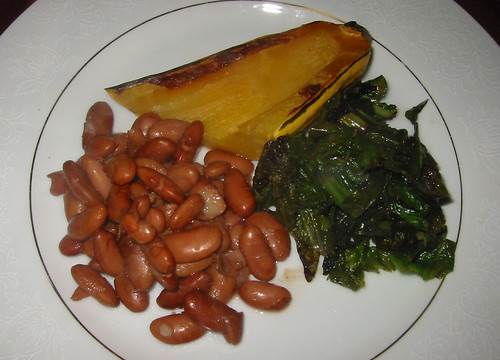
We recently harvested Tiger Eye beans (which we allowed to dry on the vine)...

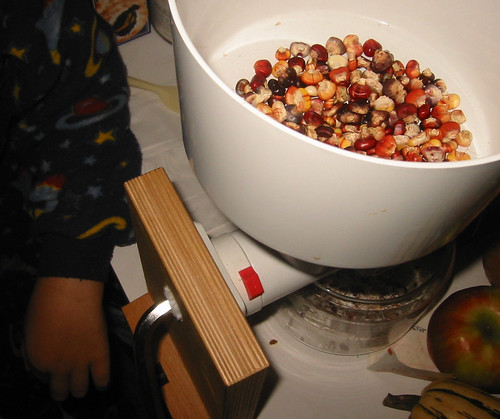
...and Mandan Bride corn:

My 9yo son and I had a blast today removing the kernels from the corncobs...

...and cranking them through our little grain mill to make cornmeal.

We then made traditional southern-style cornbread in a cast iron skillet.

Homegrown delicato squash (so sweet!) and a mix of greens including turnip and mustard rounded out our meal.

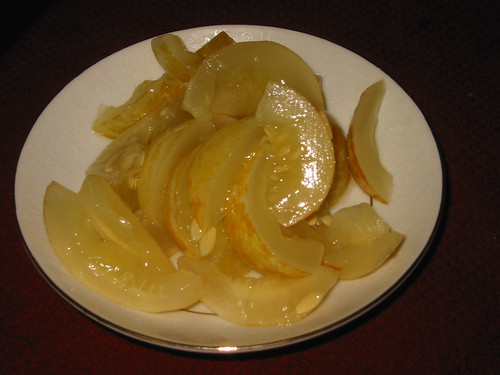
On the side we served pickles canned from our homegrown lemon cucumbers:

The meal ended with cups of steaming tea made from spearmint, lemon verbena, and stevia, all of which we grew ourselves over the summer and dried.
There is something profound about living so simply yet so well. We built our little shelter with our own hands (and a power drill), we ourselves planted the seeds and watered the garden that fed us tonight, and we sang songs with our voices alone. All of this plain homemade evening was glorious. How fortunate we are!
* * *
It is becoming clear what the lessons of the hoe, the apron, and the sukkah are: gratitude for simple things, yes--but also the responsibility to work for tikkun olam (the healing of the world), and, perhaps most importantly, the awareness that we on this planet are all one family.
Sukkot connects us to the world: both the land which feeds us, and the friends who share that nourishment with us in our sukkahs. We sit in our fragile booths, shivering in the chilly evening breeze and hoping it won't rain--yet we rejoice in the abundance of our harvest.
Times may be hard, and they may become harder--but we have enough to celebrate; we have each other.
At the end of our evenings, we carry the china and the candles back into our warm houses and say goodnight to our friends.
But Sukkot is also the moment when we are called to think of--no, to empathize with--those people who have to live all their days exposed to the elements just as we are this week in our festival booths. This year--when so many people have been kicked out of their homes to live in their cars, crash on a friend's couch, or sleep on the streets--this lesson is more important than ever.
Regardless of our religious or cultural practices, Harvest Time is a moment when we must remember how many people--in this country and around the world--do not ever experience abundance. Instead, struggling people are going hungry every night, shivering as the winter approaches, in their own fragile cardboard booths.
Let us reach out our hands.


Sukkot is my favorite holiday. For seven to nine days (depending on one's practice), Jews eat and sometimes sleep in a little open hut we build in our backyards. The roof must be made with natural materials such as leaves and branches, and openings must be left in the ceiling so we can see the stars and the light of the moon.
Religiously, Sukkot is a time of remembering when the Hebrew people wandered in the wilderness without a permanent home after being freed from slavery. The famous Jewish philosopher Maimonides proposed that we build sukkahs every fall so we will always be reminded of times of misfortune (of being homeless) during our times of good fortune.
Sukkot is also a celebration of the "ingathering" (ie, the harvest) after a season of hard work in the fields. A holiday with roots which predate Judaism, Sukkot is a kind of Jewish Thanksgiving when we celebrate the reaping of the fruits of the season and our ability to share it with our friends and families.
Although the spiritual meanings of Sukkot mean a lot to many Jews, others of us who reject the religious mandates still find deep symbolism in its celebration. It is hard to miss that the times of misfortune are exactly the moments when we can most appreciate our riches. We relax around the table in our sukkah with all our loved ones seated around us and celebrate how much we have to sustain us: not only our full pantries but our full hearts.
* * *
No time seems more appropriate to me to enjoy my own contemporary family's labor in the field. Our own personal "field" is a tiny urban backyard garden which only produces enough to supplement our diet. But tonight, we've made dinner exclusively from what we grew ourselves.
We recently harvested Tiger Eye beans (which we allowed to dry on the vine)...
...and Mandan Bride corn:
My 9yo son and I had a blast today removing the kernels from the corncobs...

...and cranking them through our little grain mill to make cornmeal.

We then made traditional southern-style cornbread in a cast iron skillet.

Homegrown delicato squash (so sweet!) and a mix of greens including turnip and mustard rounded out our meal.

On the side we served pickles canned from our homegrown lemon cucumbers:

The meal ended with cups of steaming tea made from spearmint, lemon verbena, and stevia, all of which we grew ourselves over the summer and dried.
There is something profound about living so simply yet so well. We built our little shelter with our own hands (and a power drill), we ourselves planted the seeds and watered the garden that fed us tonight, and we sang songs with our voices alone. All of this plain homemade evening was glorious. How fortunate we are!
* * *
It is becoming clear what the lessons of the hoe, the apron, and the sukkah are: gratitude for simple things, yes--but also the responsibility to work for tikkun olam (the healing of the world), and, perhaps most importantly, the awareness that we on this planet are all one family.
Sukkot connects us to the world: both the land which feeds us, and the friends who share that nourishment with us in our sukkahs. We sit in our fragile booths, shivering in the chilly evening breeze and hoping it won't rain--yet we rejoice in the abundance of our harvest.
Times may be hard, and they may become harder--but we have enough to celebrate; we have each other.
At the end of our evenings, we carry the china and the candles back into our warm houses and say goodnight to our friends.
But Sukkot is also the moment when we are called to think of--no, to empathize with--those people who have to live all their days exposed to the elements just as we are this week in our festival booths. This year--when so many people have been kicked out of their homes to live in their cars, crash on a friend's couch, or sleep on the streets--this lesson is more important than ever.
Regardless of our religious or cultural practices, Harvest Time is a moment when we must remember how many people--in this country and around the world--do not ever experience abundance. Instead, struggling people are going hungry every night, shivering as the winter approaches, in their own fragile cardboard booths.
Let us reach out our hands.


Wednesday, September 30, 2009
is this fast enough?
As I mentioned at Rosh Hashanah, my family has come together to celebrate a Humanist High Holidays this year. For the last few years, we've spent the Days of Awe partly together and partly going separate ways as we traversed our own roads towards non-Zionist Jewish-inspired humanism.
This year we are ready to chart a new course: a holiday season of family connection. Of course, we know that there will always be time when we feel we are in different places on the journey, but it is a blessing to know that we are rowing together.
Many Jews who have left religious Judaism in every other way continue to refrain from work, go to the day-long synagogue services of the High Holidays, and participate in the 25-hour fast of Yom Kippur. Since both of the adults in the household have fasted for years (whether or not we believed, and whether or not we attended synagogue), we wondered how we would handle this question this year--at this time when we are trying so hard to reshape our traditions into something that feels true, feels honest, to us.
Although my family feels incredibly tied to many ritual aspects of Judaism, it is only through the study of traditional interpretation and (often) the reshaping of tradition to be in line with our own lights, that we practice anything. Some rituals remain almost exactly, with only the words changed. Some leave their echos as we transform the practice slightly, or significantly. Other rituals (such as the prohibition against shellfish, and the practice of infant circumcision) we have discarded almost completely.
I wondered, could the fast ever begin to feel authentic, real, and honest to us nonbelievers?
We tried to understand Talmudic understandings, the interpretations of Maimonides, the take of current orthodox leaders, the practice of the Reform movement, and everything else we could find. Two basic (and related) interpretations kept arising:
1. The fast is a way to make up for our sins of the past year. It is a way to take our dirty selves and purify ourselves. Some interpreters suggest that the purification process is about reconciling with God. Some stress the mild punishment of our bodies.
2. The fast, joined with other practices such as not bathing and not having sex and not brushing our teeth, emphasize separation from our corporal bodies. Yom Kippur is a time to separate from our animal selves and connect with our spiritual Godly selves. In some theorists' views, fasting shows that the nutrients we need come not from the dirty earth but from God. Others suggest that the symbolic flirtation with death which fasting represents forces us to focus on what "truly" matters.
I do not feel comfortable with the idea that our highest selves are somehow removed from our most physical, most HUMAN of selves. I turn away from religion because I believe that being human is, in fact, our highest calling.
After some soul searching, some arguing, and some personal pain, we decided that neither of us would fast this year.
But neither David nor I felt comfortable leaving all of the tradition, all of the meaning and lessons, behind.
We chose to eat the food of poverty instead. Every year as we have sat with our annual day of hunger, we've been acutely aware that others are not nourished as they ought to be. And for the vast majority of the world, even those who are not at all hungry do not consume the wide array of luxuries--and resources--that we do.
We packed lentils and barley for lunch. Throughout the morning as we awaited our picnic, we thought about how we would be reminded of the hardships of many people in this world of ours. We would feel gratitude in ways we don't always.
I was amazed at how delicious I found the grains and legumes, and how deeply fulfilled I was by that lunch. That simple meal goes forward with me into the new year.
This year we are ready to chart a new course: a holiday season of family connection. Of course, we know that there will always be time when we feel we are in different places on the journey, but it is a blessing to know that we are rowing together.
Many Jews who have left religious Judaism in every other way continue to refrain from work, go to the day-long synagogue services of the High Holidays, and participate in the 25-hour fast of Yom Kippur. Since both of the adults in the household have fasted for years (whether or not we believed, and whether or not we attended synagogue), we wondered how we would handle this question this year--at this time when we are trying so hard to reshape our traditions into something that feels true, feels honest, to us.
Although my family feels incredibly tied to many ritual aspects of Judaism, it is only through the study of traditional interpretation and (often) the reshaping of tradition to be in line with our own lights, that we practice anything. Some rituals remain almost exactly, with only the words changed. Some leave their echos as we transform the practice slightly, or significantly. Other rituals (such as the prohibition against shellfish, and the practice of infant circumcision) we have discarded almost completely.
I wondered, could the fast ever begin to feel authentic, real, and honest to us nonbelievers?
We tried to understand Talmudic understandings, the interpretations of Maimonides, the take of current orthodox leaders, the practice of the Reform movement, and everything else we could find. Two basic (and related) interpretations kept arising:
1. The fast is a way to make up for our sins of the past year. It is a way to take our dirty selves and purify ourselves. Some interpreters suggest that the purification process is about reconciling with God. Some stress the mild punishment of our bodies.
2. The fast, joined with other practices such as not bathing and not having sex and not brushing our teeth, emphasize separation from our corporal bodies. Yom Kippur is a time to separate from our animal selves and connect with our spiritual Godly selves. In some theorists' views, fasting shows that the nutrients we need come not from the dirty earth but from God. Others suggest that the symbolic flirtation with death which fasting represents forces us to focus on what "truly" matters.
I do not feel comfortable with the idea that our highest selves are somehow removed from our most physical, most HUMAN of selves. I turn away from religion because I believe that being human is, in fact, our highest calling.
After some soul searching, some arguing, and some personal pain, we decided that neither of us would fast this year.
But neither David nor I felt comfortable leaving all of the tradition, all of the meaning and lessons, behind.
We chose to eat the food of poverty instead. Every year as we have sat with our annual day of hunger, we've been acutely aware that others are not nourished as they ought to be. And for the vast majority of the world, even those who are not at all hungry do not consume the wide array of luxuries--and resources--that we do.
We packed lentils and barley for lunch. Throughout the morning as we awaited our picnic, we thought about how we would be reminded of the hardships of many people in this world of ours. We would feel gratitude in ways we don't always.
I was amazed at how delicious I found the grains and legumes, and how deeply fulfilled I was by that lunch. That simple meal goes forward with me into the new year.
Tuesday, September 22, 2009
Humanist Rosh Hashanah
For quite a while, I've struggled to imagine how our family would celebrate the High Holidays this year.

As I have mentioned on this blog before, I have great difficulties believing in God. I am a pure atheist at heart and by my early rearing, but Judaism has been very important to me for a long time. Many years ago I converted after working closely with a Reconstructionist rabbi who held closely to traditional practice but interpreted that faith within a liberal theology. My partner David, who grew up Reform (a tradition which emphasizes more liberal practice but more conventional faith), soon adjusted to both my requests for more orthodox ritual and more "discussion" about what we actually believed--that is, what we really didn't believe.
* * *
Rosh Hashanah, the Jewish New Year, is a holiday when we are asked to consider what we have done right for the world this year, what we have not done right, and how we want to do better in the upcoming year. This is a holiday ripe for a humanist interpretation. Although I became uncomfortable in any synagogue's religious HiHo service, I have always felt great power in the broad call which Rosh Hashanah sounds--for reconciliation with one's loved ones, with the world community at large, and with oneself.
Yom Kippur, though, is one of those holidays that really does not make sense in that kind of metaphorical way--at least for me. The message is that after you get right with the rest of the world during Rosh Hashanah, you get right with God during Yom Kippur. Because Rosh Hashanah and Yom Kippur are in many ways really only one holiday (or at least one season of thought), my discomfort with the second commemoration has made me uncomfortable by default with the whole damn month.
* * *
This year is the first time my whole family has decided that all of us would not attend formal services at our old synagogue--or anywhere else. We decided instead to spend the day in the world: in nature, and with each other in conversation..
We went to a nature preserve on the Delmarva peninsula--a place where the Delaware Bay meets the Atlantic ocean.
We took a picnic of leftovers from our evening feast in our favorite picnic ware.

It was lovely sitting on the sand, having long and quiet conversations--some related to the holiday, and some unrelated.
David and I watched our son slowly make his way into the water. Although we had dressed for a chilly day, the sun made the day quite inviting.


As the day began to come to a close, we celebrated tashlikh, a ritual where one tosses breadcrumbs into moving water, symbolically casting one's sins away. Acknowledging our misdeeds is an important part of the High Holidays, but equally important is getting past those imperfections and creating a clean slate for the creation of our better selves.
For years we have tossed our breadcrumbs into a stream running near our house. This is the first time we've gone to the ocean.

It is somewhat disconcerting to have your sins come back to you, as the waves return the crumbs to their starting place.
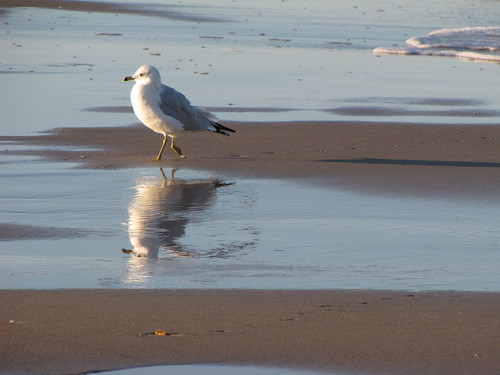
It is even more disconcerting to have the seagulls eat the crumbs. Does them make them ScapeGulls?


As I have mentioned on this blog before, I have great difficulties believing in God. I am a pure atheist at heart and by my early rearing, but Judaism has been very important to me for a long time. Many years ago I converted after working closely with a Reconstructionist rabbi who held closely to traditional practice but interpreted that faith within a liberal theology. My partner David, who grew up Reform (a tradition which emphasizes more liberal practice but more conventional faith), soon adjusted to both my requests for more orthodox ritual and more "discussion" about what we actually believed--that is, what we really didn't believe.
* * *
Rosh Hashanah, the Jewish New Year, is a holiday when we are asked to consider what we have done right for the world this year, what we have not done right, and how we want to do better in the upcoming year. This is a holiday ripe for a humanist interpretation. Although I became uncomfortable in any synagogue's religious HiHo service, I have always felt great power in the broad call which Rosh Hashanah sounds--for reconciliation with one's loved ones, with the world community at large, and with oneself.
Yom Kippur, though, is one of those holidays that really does not make sense in that kind of metaphorical way--at least for me. The message is that after you get right with the rest of the world during Rosh Hashanah, you get right with God during Yom Kippur. Because Rosh Hashanah and Yom Kippur are in many ways really only one holiday (or at least one season of thought), my discomfort with the second commemoration has made me uncomfortable by default with the whole damn month.
* * *
This year is the first time my whole family has decided that all of us would not attend formal services at our old synagogue--or anywhere else. We decided instead to spend the day in the world: in nature, and with each other in conversation..
We went to a nature preserve on the Delmarva peninsula--a place where the Delaware Bay meets the Atlantic ocean.
We took a picnic of leftovers from our evening feast in our favorite picnic ware.

It was lovely sitting on the sand, having long and quiet conversations--some related to the holiday, and some unrelated.
David and I watched our son slowly make his way into the water. Although we had dressed for a chilly day, the sun made the day quite inviting.


As the day began to come to a close, we celebrated tashlikh, a ritual where one tosses breadcrumbs into moving water, symbolically casting one's sins away. Acknowledging our misdeeds is an important part of the High Holidays, but equally important is getting past those imperfections and creating a clean slate for the creation of our better selves.
For years we have tossed our breadcrumbs into a stream running near our house. This is the first time we've gone to the ocean.

It is somewhat disconcerting to have your sins come back to you, as the waves return the crumbs to their starting place.
It is even more disconcerting to have the seagulls eat the crumbs. Does them make them ScapeGulls?

Monday, July 14, 2008
Happy-Happy-Happy, all the time
I have a whole list of happy, uncontroversial posts running around in my head, and a few even on my list of I-Can't-Believe-I-Haven't-Posted-That-Yet items.
Instead, I'm thinking about how much we avoid talking about the negative in this culture, even when we're living in its midst.
* * *
I listened to a few minutes of a fantastic radio discussion yesterday--and I am currently downloading the program to my iPod for some listen-while-knitting "entertainment." On the show, one scholar suggested that atheism was an unacceptable idea because it defined by the negative rather than suggesting what one does believe (as secular humanism does).
I found myself highly troubled by this correction. For those of us who do not believe in God, it IS precisely this "negative" idea that is at the core of any effort to behave honestly.
Don't get me wrong: I'm not at all saying that real believers are dishonest. I am saying that when a person (read "Purloined herself") says she believes in God (or maybe even when she goes through rituals that imply belief?), even though she knows in her heart of hearts that she really doesn't believe--but that so-called belief is socially expected, or socially expedient, or reassuring--she is not living an honest life. It is not helping her become a better person.
It is when we force ourselves to confront the fog and the voids in our lives that there is the most potential to grow.
(Yes, well... I am still waiting for that growth personally--but I, um have faith that it is on its way one of these days.)
The fact that I believe in our duty to other humans and the earth, and in equality of all people, and more-or-less in the inherent goodness of our hearts (despite all the real-life complications in human hearts) makes me a humanist. That is all fine and good--in fact, those beliefs are a big part of who I am. Not surprisingly, I have been able to find other nonbelievers as well as many believers from a great number of religious traditions who all accept similar things and can work together for progressive change--even when we are not coming from the same underpinnings. It is essential that we find each other and work across religion in order to address issues--but that does not mean I have found my own tribe, my own sense of who I am and what I can be openly, when I am in those groups.
No--what really defines my beliefs about religion, about the people in my tribe, is the negative, the absence of God--not the belief in unity with-or-without God.
* * *
This desire not to say anything negative stems, I think, from the Disneyfication of our culture: a complete turning off of the critical mind.
Critical, of course, has two meanings: that you are being negative, and that you are being analytical. At heart, the definitions are linked; the ability to be analytical means you sometimes wind up in negative territory. THINKING can leave you in lots of nots.
* * *
I am part of the facilitation planning committee for a community visioning process. One person suggested that we ask groups to start out with a list of things they were seeking and a list of things they actively wanted to avoid. Very quickly, others jumped in that we did not need to ask for "avoids" and if anyone suggested one, we should help them reframe it as a positive. (Don't want things to harm the environment? Say we want to protect Mother Earth. Don't want jackhammers running at 7AM? Say you want to maintain peaceful mornings.)
All that is true: you can almost always cast the negative in reverse positive terms.
But WHY do we feel called upon to censure the language of avoidance? Why can't we embrace the negative sometimes, even "learn from our mistakes" as they used to say? Everything now has to be sanitized of anything that might suggest failures, complexity, sadness.
We are trading in the authentic for the romantic comedy version of our lives.
* * *
Yes--I wallow way too often in my own private underworld.
Sometime the demons get the better of me. Even when I make sure all the closet doors are firmly closed and the door to the basement is shut and locked, spray lavender on my pillow--the demons still seep out and enter the room.
When I deny they are there, that all is happy-happy, I am literally denying my own life. When we do it as a culture, we are shutting down our brains and losing our true selves to what is real and honest darkness.
Instead, I'm thinking about how much we avoid talking about the negative in this culture, even when we're living in its midst.
* * *
I listened to a few minutes of a fantastic radio discussion yesterday--and I am currently downloading the program to my iPod for some listen-while-knitting "entertainment." On the show, one scholar suggested that atheism was an unacceptable idea because it defined by the negative rather than suggesting what one does believe (as secular humanism does).
I found myself highly troubled by this correction. For those of us who do not believe in God, it IS precisely this "negative" idea that is at the core of any effort to behave honestly.
Don't get me wrong: I'm not at all saying that real believers are dishonest. I am saying that when a person (read "Purloined herself") says she believes in God (or maybe even when she goes through rituals that imply belief?), even though she knows in her heart of hearts that she really doesn't believe--but that so-called belief is socially expected, or socially expedient, or reassuring--she is not living an honest life. It is not helping her become a better person.
It is when we force ourselves to confront the fog and the voids in our lives that there is the most potential to grow.
(Yes, well... I am still waiting for that growth personally--but I, um have faith that it is on its way one of these days.)
The fact that I believe in our duty to other humans and the earth, and in equality of all people, and more-or-less in the inherent goodness of our hearts (despite all the real-life complications in human hearts) makes me a humanist. That is all fine and good--in fact, those beliefs are a big part of who I am. Not surprisingly, I have been able to find other nonbelievers as well as many believers from a great number of religious traditions who all accept similar things and can work together for progressive change--even when we are not coming from the same underpinnings. It is essential that we find each other and work across religion in order to address issues--but that does not mean I have found my own tribe, my own sense of who I am and what I can be openly, when I am in those groups.
No--what really defines my beliefs about religion, about the people in my tribe, is the negative, the absence of God--not the belief in unity with-or-without God.
* * *
This desire not to say anything negative stems, I think, from the Disneyfication of our culture: a complete turning off of the critical mind.
Critical, of course, has two meanings: that you are being negative, and that you are being analytical. At heart, the definitions are linked; the ability to be analytical means you sometimes wind up in negative territory. THINKING can leave you in lots of nots.
* * *
I am part of the facilitation planning committee for a community visioning process. One person suggested that we ask groups to start out with a list of things they were seeking and a list of things they actively wanted to avoid. Very quickly, others jumped in that we did not need to ask for "avoids" and if anyone suggested one, we should help them reframe it as a positive. (Don't want things to harm the environment? Say we want to protect Mother Earth. Don't want jackhammers running at 7AM? Say you want to maintain peaceful mornings.)
All that is true: you can almost always cast the negative in reverse positive terms.
But WHY do we feel called upon to censure the language of avoidance? Why can't we embrace the negative sometimes, even "learn from our mistakes" as they used to say? Everything now has to be sanitized of anything that might suggest failures, complexity, sadness.
We are trading in the authentic for the romantic comedy version of our lives.
* * *
Yes--I wallow way too often in my own private underworld.
Sometime the demons get the better of me. Even when I make sure all the closet doors are firmly closed and the door to the basement is shut and locked, spray lavender on my pillow--the demons still seep out and enter the room.
When I deny they are there, that all is happy-happy, I am literally denying my own life. When we do it as a culture, we are shutting down our brains and losing our true selves to what is real and honest darkness.
Sunday, September 23, 2007
Hanging Out with the Fish
Traditionally, Jews on Yom Kippur read the portion of the Bible about Jonah and the Whale, or rather (a better translation) Jonah and the Really Big Fish.
In this story, God commands Jonah to pass judgment against the people living in the capital of the Assyrian (ie, not Jewish) empire.
Jonah refuses, running off to sea to escape God.
The Bible that I picked up during services tells me that Jonah literally means dove, symbolizing his reluctance to put God's wrathful command to action.
When an enormous storm arises and will not abate, the crew throws Jonah overboard in an effort to appease God and make the winds die down. Once in the waters, a giant fish swallows Jonah whole. He stays in his belly for three days and three nights until Jonah repents to God.
* * *
Perhaps you guessed from my last post how frustrated I feel with Yom Kippur. So I did what Jonah did. I planned my escape.
So I packed my bag with my journal, an iPod with something specific in mind to listen to, a book, and other assorted entertainments.
After I left the synagogue, I walked to a local park to sit on a bench. But what I found there was not peace and quiet but a small peace rally. I held a banner which read "Peace is the way" and showed a dove with outstretched wings. I thought of Jonah, wondering if he could be here, too.
Then I sat on a bench, plugged in my earphone and turned on Julia Sweeney's Letting Go of God
. She is terribly witty and amazingly wise--and, well, not exactly your standard Yom Kippur fare.
I've been an atheist all my life, but the role of organized religion has changed and re-changed over time. Right now I feel like I am hypocritical and lying, even making fun of true believers, if I engage in words and rituals that not only have no literal meaning to me but also challenge my metaphorical notions of how the world works.
Thinking about this rupture, I heard Sweeney say these words:
"If I look over my life, every single step of maturing for me, every single one, has had the exact same common denominator--and that was accepting what was true over what I wished were true."
When she has that long difficult conversation with God sitting on his suitcases, already thrown out of her house, she says:
"It's because I take you so seriously that I can't bring myself to believe in you. I mean, if it is any consolation, it's sort of a sign of respect."
I stayed on the park bench listening to Sweeney and realizing that not only did the lies keep me from being a good person but kept me from growing in other ways. I listened to her, words in my ears and yarn in my fingers to help me learn:

* * *
Eventually I come back in to services. We read Martin Buber: "We can be redeemed only to the extent we see ourselves." It is only by being totally honest with ourselves, only by acknowledging our individual truths, that we can truly move forward. Pretending something because it is comforting or pleasurable--or simply less dangerous--means muffling that small, still voice so intensely that we'll stop being able to hear it.
Perhaps the Very Big Fish will spit me out near Nineveh with increased purpose and renewed faith in faith. For right now, I'll light my candle in its belly and illuminate where I am.
In this story, God commands Jonah to pass judgment against the people living in the capital of the Assyrian (ie, not Jewish) empire.
Jonah refuses, running off to sea to escape God.
The Bible that I picked up during services tells me that Jonah literally means dove, symbolizing his reluctance to put God's wrathful command to action.
When an enormous storm arises and will not abate, the crew throws Jonah overboard in an effort to appease God and make the winds die down. Once in the waters, a giant fish swallows Jonah whole. He stays in his belly for three days and three nights until Jonah repents to God.
* * *
Perhaps you guessed from my last post how frustrated I feel with Yom Kippur. So I did what Jonah did. I planned my escape.
So I packed my bag with my journal, an iPod with something specific in mind to listen to, a book, and other assorted entertainments.
After I left the synagogue, I walked to a local park to sit on a bench. But what I found there was not peace and quiet but a small peace rally. I held a banner which read "Peace is the way" and showed a dove with outstretched wings. I thought of Jonah, wondering if he could be here, too.
Then I sat on a bench, plugged in my earphone and turned on Julia Sweeney's Letting Go of God
I've been an atheist all my life, but the role of organized religion has changed and re-changed over time. Right now I feel like I am hypocritical and lying, even making fun of true believers, if I engage in words and rituals that not only have no literal meaning to me but also challenge my metaphorical notions of how the world works.
Thinking about this rupture, I heard Sweeney say these words:
"If I look over my life, every single step of maturing for me, every single one, has had the exact same common denominator--and that was accepting what was true over what I wished were true."
When she has that long difficult conversation with God sitting on his suitcases, already thrown out of her house, she says:
"It's because I take you so seriously that I can't bring myself to believe in you. I mean, if it is any consolation, it's sort of a sign of respect."
I stayed on the park bench listening to Sweeney and realizing that not only did the lies keep me from being a good person but kept me from growing in other ways. I listened to her, words in my ears and yarn in my fingers to help me learn:
* * *
Eventually I come back in to services. We read Martin Buber: "We can be redeemed only to the extent we see ourselves." It is only by being totally honest with ourselves, only by acknowledging our individual truths, that we can truly move forward. Pretending something because it is comforting or pleasurable--or simply less dangerous--means muffling that small, still voice so intensely that we'll stop being able to hear it.
Perhaps the Very Big Fish will spit me out near Nineveh with increased purpose and renewed faith in faith. For right now, I'll light my candle in its belly and illuminate where I am.
Subscribe to:
Posts (Atom)