For our New Year's Resolution this year, my family has decided to spend the year considering how to move towards "The Hanukkah Standard"--an idea I talked about recently in a post over at the Green Phone Booth. Hanukkah is a time when Jews commemorate the "miracle of the oil" when one day's worth of sacred olive oil in the eternal lamp stayed lit for eight days as the early Jews rededicated their temple after its desecration.
We have come to a time where we again must use much less than we assume we need. The idea of the Hanukkah Standard, a plan created by Arthur Waskow and the folks at Green Menorah Covenant, is to make what normally lasts for one day carry us through eight--that is, only use 1/8th of the energy resources used by the average American.
Although the three of us here at Chez Raven have attempted for several years to green our lives and reduce our impact on our planet and community, this year I am committed to stepping up our efforts. Guided by the Riot 4 Austerity, over the course of the year we'll look at the changes we need to make in order to reach our ultimate target.
The goal for the year is not to reach the Hanukkah Standard immediately but to begin the journey and learn how to get there. We know that some changes will be much easier than others.
Join me this year as my family imagines a new future, struggles against the forces of darkness, celebrates our successes, and displays our lights in this window for all to see.
Showing posts with label Judaism. Show all posts
Showing posts with label Judaism. Show all posts
Thursday, January 07, 2010
Thursday, December 17, 2009
Making the Oil Last

image source: Jewish Review
Chanukah/Hanukkah is a beautiful holiday celebrating the universal hope for the return of the light as we approach the winter solstice.
It is also a time when Jews celebrate both the victory of the weak against the mighty, as well as the "miracle of the oil" when one day's worth of sacred olive oil in the eternal lamp stayed lit for eight days as the early Jews rededicated their temple after its desecration. This event was perhaps the world's first oil shock, and resource conservation is obviously the moral of the story. (Well, perhaps everyone doesn't read it that way.)
We are facing questions of oil again now. Again we ask ourselves: "How long will it last?" Peak Oil activists deal with this issue. And climate activists ask us to try to use less oil in order to save the planet. We have to recognize that this time, we should not expect a sequel to the Hanukkah miracle.
Thinking about the holiday from these perspectives can shake our ideas about long-celebrated traditions. Jews all over the world celebrate by eating foods cooked in oil, especially latkes (potato pancakes) and sufganiyot (jelly doughnuts). As Culiblog says, "Now I don’t know why it took me so long to question the logic of this, but why do we celebrate this miracle of oil conservation by massively increasing oil consumption? Shouldn’t we be eating the opposite of oily foods? Shouldn’t Chanukkah be an oil fast, a holiday of raw and steamed vegetables and bike riding?"
my post is continued here

Monday, October 05, 2009
Living in Booths
A repost of an entry I wrote for that marvelous blog Green Phone Booth:

Sukkot is my favorite holiday. For seven to nine days (depending on one's practice), Jews eat and sometimes sleep in a little open hut we build in our backyards. The roof must be made with natural materials such as leaves and branches, and openings must be left in the ceiling so we can see the stars and the light of the moon.
Religiously, Sukkot is a time of remembering when the Hebrew people wandered in the wilderness without a permanent home after being freed from slavery. The famous Jewish philosopher Maimonides proposed that we build sukkahs every fall so we will always be reminded of times of misfortune (of being homeless) during our times of good fortune.
Sukkot is also a celebration of the "ingathering" (ie, the harvest) after a season of hard work in the fields. A holiday with roots which predate Judaism, Sukkot is a kind of Jewish Thanksgiving when we celebrate the reaping of the fruits of the season and our ability to share it with our friends and families.
Although the spiritual meanings of Sukkot mean a lot to many Jews, others of us who reject the religious mandates still find deep symbolism in its celebration. It is hard to miss that the times of misfortune are exactly the moments when we can most appreciate our riches. We relax around the table in our sukkah with all our loved ones seated around us and celebrate how much we have to sustain us: not only our full pantries but our full hearts.
* * *
No time seems more appropriate to me to enjoy my own contemporary family's labor in the field. Our own personal "field" is a tiny urban backyard garden which only produces enough to supplement our diet. But tonight, we've made dinner exclusively from what we grew ourselves.
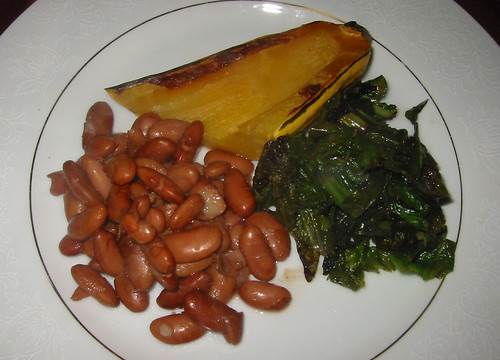
We recently harvested Tiger Eye beans (which we allowed to dry on the vine)...

...and Mandan Bride corn:

My 9yo son and I had a blast today removing the kernels from the corncobs...

...and cranking them through our little grain mill to make cornmeal.
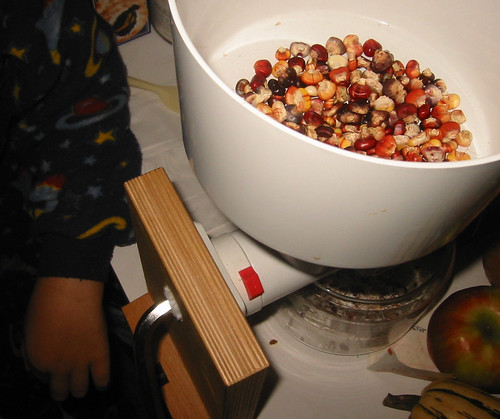
We then made traditional southern-style cornbread in a cast iron skillet.

Homegrown delicato squash (so sweet!) and a mix of greens including turnip and mustard rounded out our meal.
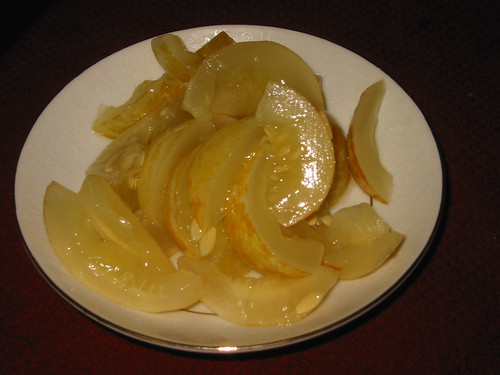
On the side we served pickles canned from our homegrown lemon cucumbers:
The meal ended with cups of steaming tea made from spearmint, lemon verbena, and stevia, all of which we grew ourselves over the summer and dried.
There is something profound about living so simply yet so well. We built our little shelter with our own hands (and a power drill), we ourselves planted the seeds and watered the garden that fed us tonight, and we sang songs with our voices alone. All of this plain homemade evening was glorious. How fortunate we are!
* * *
It is becoming clear what the lessons of the hoe, the apron, and the sukkah are: gratitude for simple things, yes--but also the responsibility to work for tikkun olam (the healing of the world), and, perhaps most importantly, the awareness that we on this planet are all one family.
Sukkot connects us to the world: both the land which feeds us, and the friends who share that nourishment with us in our sukkahs. We sit in our fragile booths, shivering in the chilly evening breeze and hoping it won't rain--yet we rejoice in the abundance of our harvest.
Times may be hard, and they may become harder--but we have enough to celebrate; we have each other.
At the end of our evenings, we carry the china and the candles back into our warm houses and say goodnight to our friends.
But Sukkot is also the moment when we are called to think of--no, to empathize with--those people who have to live all their days exposed to the elements just as we are this week in our festival booths. This year--when so many people have been kicked out of their homes to live in their cars, crash on a friend's couch, or sleep on the streets--this lesson is more important than ever.
Regardless of our religious or cultural practices, Harvest Time is a moment when we must remember how many people--in this country and around the world--do not ever experience abundance. Instead, struggling people are going hungry every night, shivering as the winter approaches, in their own fragile cardboard booths.
Let us reach out our hands.


Sukkot is my favorite holiday. For seven to nine days (depending on one's practice), Jews eat and sometimes sleep in a little open hut we build in our backyards. The roof must be made with natural materials such as leaves and branches, and openings must be left in the ceiling so we can see the stars and the light of the moon.
Religiously, Sukkot is a time of remembering when the Hebrew people wandered in the wilderness without a permanent home after being freed from slavery. The famous Jewish philosopher Maimonides proposed that we build sukkahs every fall so we will always be reminded of times of misfortune (of being homeless) during our times of good fortune.
Sukkot is also a celebration of the "ingathering" (ie, the harvest) after a season of hard work in the fields. A holiday with roots which predate Judaism, Sukkot is a kind of Jewish Thanksgiving when we celebrate the reaping of the fruits of the season and our ability to share it with our friends and families.
Although the spiritual meanings of Sukkot mean a lot to many Jews, others of us who reject the religious mandates still find deep symbolism in its celebration. It is hard to miss that the times of misfortune are exactly the moments when we can most appreciate our riches. We relax around the table in our sukkah with all our loved ones seated around us and celebrate how much we have to sustain us: not only our full pantries but our full hearts.
* * *
No time seems more appropriate to me to enjoy my own contemporary family's labor in the field. Our own personal "field" is a tiny urban backyard garden which only produces enough to supplement our diet. But tonight, we've made dinner exclusively from what we grew ourselves.
We recently harvested Tiger Eye beans (which we allowed to dry on the vine)...

...and Mandan Bride corn:

My 9yo son and I had a blast today removing the kernels from the corncobs...
...and cranking them through our little grain mill to make cornmeal.
We then made traditional southern-style cornbread in a cast iron skillet.
Homegrown delicato squash (so sweet!) and a mix of greens including turnip and mustard rounded out our meal.
On the side we served pickles canned from our homegrown lemon cucumbers:
The meal ended with cups of steaming tea made from spearmint, lemon verbena, and stevia, all of which we grew ourselves over the summer and dried.
There is something profound about living so simply yet so well. We built our little shelter with our own hands (and a power drill), we ourselves planted the seeds and watered the garden that fed us tonight, and we sang songs with our voices alone. All of this plain homemade evening was glorious. How fortunate we are!
* * *
It is becoming clear what the lessons of the hoe, the apron, and the sukkah are: gratitude for simple things, yes--but also the responsibility to work for tikkun olam (the healing of the world), and, perhaps most importantly, the awareness that we on this planet are all one family.
Sukkot connects us to the world: both the land which feeds us, and the friends who share that nourishment with us in our sukkahs. We sit in our fragile booths, shivering in the chilly evening breeze and hoping it won't rain--yet we rejoice in the abundance of our harvest.
Times may be hard, and they may become harder--but we have enough to celebrate; we have each other.
At the end of our evenings, we carry the china and the candles back into our warm houses and say goodnight to our friends.
But Sukkot is also the moment when we are called to think of--no, to empathize with--those people who have to live all their days exposed to the elements just as we are this week in our festival booths. This year--when so many people have been kicked out of their homes to live in their cars, crash on a friend's couch, or sleep on the streets--this lesson is more important than ever.
Regardless of our religious or cultural practices, Harvest Time is a moment when we must remember how many people--in this country and around the world--do not ever experience abundance. Instead, struggling people are going hungry every night, shivering as the winter approaches, in their own fragile cardboard booths.
Let us reach out our hands.
Wednesday, September 30, 2009
is this fast enough?
As I mentioned at Rosh Hashanah, my family has come together to celebrate a Humanist High Holidays this year. For the last few years, we've spent the Days of Awe partly together and partly going separate ways as we traversed our own roads towards non-Zionist Jewish-inspired humanism.
This year we are ready to chart a new course: a holiday season of family connection. Of course, we know that there will always be time when we feel we are in different places on the journey, but it is a blessing to know that we are rowing together.
Many Jews who have left religious Judaism in every other way continue to refrain from work, go to the day-long synagogue services of the High Holidays, and participate in the 25-hour fast of Yom Kippur. Since both of the adults in the household have fasted for years (whether or not we believed, and whether or not we attended synagogue), we wondered how we would handle this question this year--at this time when we are trying so hard to reshape our traditions into something that feels true, feels honest, to us.
Although my family feels incredibly tied to many ritual aspects of Judaism, it is only through the study of traditional interpretation and (often) the reshaping of tradition to be in line with our own lights, that we practice anything. Some rituals remain almost exactly, with only the words changed. Some leave their echos as we transform the practice slightly, or significantly. Other rituals (such as the prohibition against shellfish, and the practice of infant circumcision) we have discarded almost completely.
I wondered, could the fast ever begin to feel authentic, real, and honest to us nonbelievers?
We tried to understand Talmudic understandings, the interpretations of Maimonides, the take of current orthodox leaders, the practice of the Reform movement, and everything else we could find. Two basic (and related) interpretations kept arising:
1. The fast is a way to make up for our sins of the past year. It is a way to take our dirty selves and purify ourselves. Some interpreters suggest that the purification process is about reconciling with God. Some stress the mild punishment of our bodies.
2. The fast, joined with other practices such as not bathing and not having sex and not brushing our teeth, emphasize separation from our corporal bodies. Yom Kippur is a time to separate from our animal selves and connect with our spiritual Godly selves. In some theorists' views, fasting shows that the nutrients we need come not from the dirty earth but from God. Others suggest that the symbolic flirtation with death which fasting represents forces us to focus on what "truly" matters.
I do not feel comfortable with the idea that our highest selves are somehow removed from our most physical, most HUMAN of selves. I turn away from religion because I believe that being human is, in fact, our highest calling.
After some soul searching, some arguing, and some personal pain, we decided that neither of us would fast this year.
But neither David nor I felt comfortable leaving all of the tradition, all of the meaning and lessons, behind.
We chose to eat the food of poverty instead. Every year as we have sat with our annual day of hunger, we've been acutely aware that others are not nourished as they ought to be. And for the vast majority of the world, even those who are not at all hungry do not consume the wide array of luxuries--and resources--that we do.
We packed lentils and barley for lunch. Throughout the morning as we awaited our picnic, we thought about how we would be reminded of the hardships of many people in this world of ours. We would feel gratitude in ways we don't always.
I was amazed at how delicious I found the grains and legumes, and how deeply fulfilled I was by that lunch. That simple meal goes forward with me into the new year.
This year we are ready to chart a new course: a holiday season of family connection. Of course, we know that there will always be time when we feel we are in different places on the journey, but it is a blessing to know that we are rowing together.
Many Jews who have left religious Judaism in every other way continue to refrain from work, go to the day-long synagogue services of the High Holidays, and participate in the 25-hour fast of Yom Kippur. Since both of the adults in the household have fasted for years (whether or not we believed, and whether or not we attended synagogue), we wondered how we would handle this question this year--at this time when we are trying so hard to reshape our traditions into something that feels true, feels honest, to us.
Although my family feels incredibly tied to many ritual aspects of Judaism, it is only through the study of traditional interpretation and (often) the reshaping of tradition to be in line with our own lights, that we practice anything. Some rituals remain almost exactly, with only the words changed. Some leave their echos as we transform the practice slightly, or significantly. Other rituals (such as the prohibition against shellfish, and the practice of infant circumcision) we have discarded almost completely.
I wondered, could the fast ever begin to feel authentic, real, and honest to us nonbelievers?
We tried to understand Talmudic understandings, the interpretations of Maimonides, the take of current orthodox leaders, the practice of the Reform movement, and everything else we could find. Two basic (and related) interpretations kept arising:
1. The fast is a way to make up for our sins of the past year. It is a way to take our dirty selves and purify ourselves. Some interpreters suggest that the purification process is about reconciling with God. Some stress the mild punishment of our bodies.
2. The fast, joined with other practices such as not bathing and not having sex and not brushing our teeth, emphasize separation from our corporal bodies. Yom Kippur is a time to separate from our animal selves and connect with our spiritual Godly selves. In some theorists' views, fasting shows that the nutrients we need come not from the dirty earth but from God. Others suggest that the symbolic flirtation with death which fasting represents forces us to focus on what "truly" matters.
I do not feel comfortable with the idea that our highest selves are somehow removed from our most physical, most HUMAN of selves. I turn away from religion because I believe that being human is, in fact, our highest calling.
After some soul searching, some arguing, and some personal pain, we decided that neither of us would fast this year.
But neither David nor I felt comfortable leaving all of the tradition, all of the meaning and lessons, behind.
We chose to eat the food of poverty instead. Every year as we have sat with our annual day of hunger, we've been acutely aware that others are not nourished as they ought to be. And for the vast majority of the world, even those who are not at all hungry do not consume the wide array of luxuries--and resources--that we do.
We packed lentils and barley for lunch. Throughout the morning as we awaited our picnic, we thought about how we would be reminded of the hardships of many people in this world of ours. We would feel gratitude in ways we don't always.
I was amazed at how delicious I found the grains and legumes, and how deeply fulfilled I was by that lunch. That simple meal goes forward with me into the new year.
Tuesday, September 22, 2009
Humanist Rosh Hashanah
For quite a while, I've struggled to imagine how our family would celebrate the High Holidays this year.

As I have mentioned on this blog before, I have great difficulties believing in God. I am a pure atheist at heart and by my early rearing, but Judaism has been very important to me for a long time. Many years ago I converted after working closely with a Reconstructionist rabbi who held closely to traditional practice but interpreted that faith within a liberal theology. My partner David, who grew up Reform (a tradition which emphasizes more liberal practice but more conventional faith), soon adjusted to both my requests for more orthodox ritual and more "discussion" about what we actually believed--that is, what we really didn't believe.
* * *
Rosh Hashanah, the Jewish New Year, is a holiday when we are asked to consider what we have done right for the world this year, what we have not done right, and how we want to do better in the upcoming year. This is a holiday ripe for a humanist interpretation. Although I became uncomfortable in any synagogue's religious HiHo service, I have always felt great power in the broad call which Rosh Hashanah sounds--for reconciliation with one's loved ones, with the world community at large, and with oneself.
Yom Kippur, though, is one of those holidays that really does not make sense in that kind of metaphorical way--at least for me. The message is that after you get right with the rest of the world during Rosh Hashanah, you get right with God during Yom Kippur. Because Rosh Hashanah and Yom Kippur are in many ways really only one holiday (or at least one season of thought), my discomfort with the second commemoration has made me uncomfortable by default with the whole damn month.
* * *
This year is the first time my whole family has decided that all of us would not attend formal services at our old synagogue--or anywhere else. We decided instead to spend the day in the world: in nature, and with each other in conversation..
We went to a nature preserve on the Delmarva peninsula--a place where the Delaware Bay meets the Atlantic ocean.
We took a picnic of leftovers from our evening feast in our favorite picnic ware.

It was lovely sitting on the sand, having long and quiet conversations--some related to the holiday, and some unrelated.
David and I watched our son slowly make his way into the water. Although we had dressed for a chilly day, the sun made the day quite inviting.


As the day began to come to a close, we celebrated tashlikh, a ritual where one tosses breadcrumbs into moving water, symbolically casting one's sins away. Acknowledging our misdeeds is an important part of the High Holidays, but equally important is getting past those imperfections and creating a clean slate for the creation of our better selves.
For years we have tossed our breadcrumbs into a stream running near our house. This is the first time we've gone to the ocean.

It is somewhat disconcerting to have your sins come back to you, as the waves return the crumbs to their starting place.
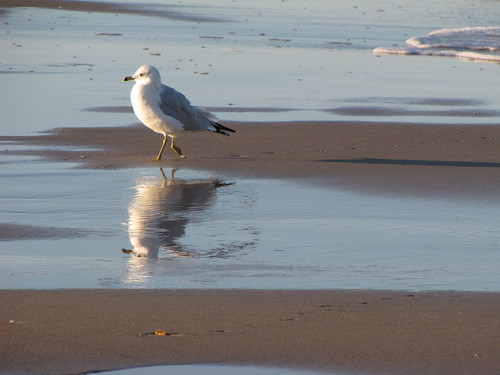
It is even more disconcerting to have the seagulls eat the crumbs. Does them make them ScapeGulls?

As I have mentioned on this blog before, I have great difficulties believing in God. I am a pure atheist at heart and by my early rearing, but Judaism has been very important to me for a long time. Many years ago I converted after working closely with a Reconstructionist rabbi who held closely to traditional practice but interpreted that faith within a liberal theology. My partner David, who grew up Reform (a tradition which emphasizes more liberal practice but more conventional faith), soon adjusted to both my requests for more orthodox ritual and more "discussion" about what we actually believed--that is, what we really didn't believe.
* * *
Rosh Hashanah, the Jewish New Year, is a holiday when we are asked to consider what we have done right for the world this year, what we have not done right, and how we want to do better in the upcoming year. This is a holiday ripe for a humanist interpretation. Although I became uncomfortable in any synagogue's religious HiHo service, I have always felt great power in the broad call which Rosh Hashanah sounds--for reconciliation with one's loved ones, with the world community at large, and with oneself.
Yom Kippur, though, is one of those holidays that really does not make sense in that kind of metaphorical way--at least for me. The message is that after you get right with the rest of the world during Rosh Hashanah, you get right with God during Yom Kippur. Because Rosh Hashanah and Yom Kippur are in many ways really only one holiday (or at least one season of thought), my discomfort with the second commemoration has made me uncomfortable by default with the whole damn month.
* * *
This year is the first time my whole family has decided that all of us would not attend formal services at our old synagogue--or anywhere else. We decided instead to spend the day in the world: in nature, and with each other in conversation..
We went to a nature preserve on the Delmarva peninsula--a place where the Delaware Bay meets the Atlantic ocean.
We took a picnic of leftovers from our evening feast in our favorite picnic ware.
It was lovely sitting on the sand, having long and quiet conversations--some related to the holiday, and some unrelated.
David and I watched our son slowly make his way into the water. Although we had dressed for a chilly day, the sun made the day quite inviting.
As the day began to come to a close, we celebrated tashlikh, a ritual where one tosses breadcrumbs into moving water, symbolically casting one's sins away. Acknowledging our misdeeds is an important part of the High Holidays, but equally important is getting past those imperfections and creating a clean slate for the creation of our better selves.
For years we have tossed our breadcrumbs into a stream running near our house. This is the first time we've gone to the ocean.
It is somewhat disconcerting to have your sins come back to you, as the waves return the crumbs to their starting place.
It is even more disconcerting to have the seagulls eat the crumbs. Does them make them ScapeGulls?
Wednesday, October 22, 2008
Living in Booths
Laura Ingallstein from Little House in the Shtetl joins me this week in the Green Phone Booth to cook a meal made entirely from stuff my family grew in our backyard. We also talk about the meanings and practice of the Jewish holiday of Sukkot.
This mission requires me to transform my green superhero cape into an apron. It also requires the Green Phone Booth to become a sukkah. Luckily, this is not a difficult prestidigitation since the Jewish holiday of Sukkot is also called the Festival of Booths.
Ma Ingallstein Preparing the Evening Meal in the Family's Green Booth
(Who would have thought that Jews have been pioneers for millenia?)
CONTINUED HERE...
This mission requires me to transform my green superhero cape into an apron. It also requires the Green Phone Booth to become a sukkah. Luckily, this is not a difficult prestidigitation since the Jewish holiday of Sukkot is also called the Festival of Booths.
Ma Ingallstein Preparing the Evening Meal in the Family's Green Booth
(Who would have thought that Jews have been pioneers for millenia?)
CONTINUED HERE...
Monday, May 19, 2008
Leaving the Narrow Place for the Open Fields

During Passover, Jews are asked to acknowledge the history of slavery. Not only should we "acknowledge" it: we should act as if we were personally enslaved and personally freed.
Many Jews ask what things in our selves and in our surroundings keep us enslaved now. Then we think about ways we might loosen those bonds and step away from our own Mitzrayim, our own narrow place--no matter how safe and cozy it might seem at any given moment. When we are able finally to make that first step, we will begin to see how constrained we have been. Only at that point is an end to freedom--and a start to independence--possible.
I spent a bit of my Passover thinking about how to become ready to make a change, how to be ready to abandon the things that hold us back even if they seem to put us in such a secure place right now.
Many parts of my own personal narrow place are internal personality traits--parts of my self that hold me (and those around me) back from where we could go. One is my sometimes-extreme shyness. Another is my fear of anger, whether it is in myself or in others (anger towards me or towards others). Yet another is my reluctance to do or say anything that could make me stand out too much. And a biggie: I think about big issues until they are fully dissected, get depressed (too often in a too serious way), and do nothing about whatever the issues are.
But here we are, my family, ready to make some big steps out of our narrow place.
* * *
One way out of our Mitzrayim seems to be increasing food security both for us and for our community.
For a long time, my family has sought to eat a diet (and live a life more generally) less dependent on corporate consumerism and more reliant on the local economy of small business and small farmers. We attempt to purchase mostly foods without labels. (Ah--wouldn't the nutrition police fall over dead? No label to read?! Surely that is not healthy....)
This year we've expanded our garden to grow more of our diet in the back yard--our very tiny "postage stamp of native soil"
 which will really just be a symbolic way to help us understand more about how food is produced. Some of the old pros who do this (on a much larger scale in an only slightly smaller yard) call it the "path to freedom." They've launched the 100 Foot Diet challenge to help us connect with other people doing the same thing. I've mentioned their challenge before.
We've also made a serious commitment to prepare now so we will be able to keep up our non-corporate eating during the winter and early spring. And for this, the brilliant Sharon issued her own challenge:

Sharon asks us to create "food independence" (and to a degree, independence from a fossil-fuel-led society more generally) by regularly trying to, as Sharon lays out:
1. Plant something.
...The idea that you should plant all week and all year is a good reminder to those of us who sometimes don’t get our fall gardens or our succession plantings done regularly. Remember, that beet you harvested left a space - maybe for the next one to get bigger, but maybe for a bit of arugula or a fall crop of peas, or a cover crop to enrich the soil. Independence is the bounty of a single seed that creates an abundance of zucchini, and enough seeds to plant your own garden and your neighbor’s.
2. Harvest something.
From the very first nettles and dandelions to the last leeks and parsnips I drag out of the frozen ground, harvest something from the garden or the wild every day you can. I can’t think of a better way to be aware of the bounty around you to realize that there’s something -- even if it is dandelions for tea or wild garlic for a salad -- to be had every single day. Independence is really appreciating and using the bounty that we have.
3. Preserve something.
Sometimes this will be a big project, but it doesn’t have to be. It doesn’t take long to slice a couple of tomatoes and set them on a screen in the sun, or to hang up a bunch of sage for winter. And it adds up fast. The time you spend now is time you don’t have to spend hauling to the store and cooking later. Independence is eating our own, and cutting the ties we have to agribusiness.
4. Prep something.
Hit a yard sale and pick up an extra blanket. Purchase some extra legumes and oatmeal. Sort out and inventory your pantry. Make a list of tools you need. Find a way to give what you don’t need to someone who does. Fix your bike. Fill that old soda bottle with water with a couple of drops of bleach in it. Plan for next year’s edible landscaping. Make back-road directions to your place and send it to family in case they ever need to come to you - or make ‘em for yourself for where you might have to go.... Independence is being ready for whatever comes.
5. Cook something. Try a new recipe, or an old one with a new ingredient. Sometimes it is hard to know what to do with all that stuff you are growing or making. So experiment now. Can you make a whole meal in your solar oven? How are stir-fried pea shoots? Stuffed squash blossoms? Wild morels in pasta? Independence is being able to eat and enjoy what is given to us.
6. Manage your reserves. Check those apples and take out the ones starting to go bad and make sauce with it. Label those cans. Clean out the freezer. Ration the pickles, so you’ll have enough to last to next season. Use up those lentils before you take the next ones out of the bag. Find some use for that can of whatever it is that’s been in the pantry forever. Sort out what you can donate, and give it to the food pantry. Make sure the squash are holding out. Independence means not wasting the bounty we have.
7. Work on local food systems. This could be as simple as buying something you don’t grow or make from a local grower, or finding a new local source. It could be as complex as starting a coop or a farmer’s market, creating a CSA or a bulk store. You might give seeds or plants or divisions to a neighbor, or solicit donations for your food pantry. Maybe you’ll start a guerilla garden or help a homeschool coop incubate some chicks. Maybe you’ll invite people over to your garden, or your neighbors in for a homegrown meal, or sing the praises of your local CSA. Maybe you can get your town to plant fruit or nut producing street trees or get a manual water pump or a garden put in at your local school. Whatever it is, our Independence days come when our neighbors and the people we love are food secure too.
Participants had lots of creative ideas for tweaking the rules--moving things out of one listing into their own categories in order to emphasize them more--or adding things entirely new. Some of my favorite additions:
8. Store something (edible) you'll need in the future so you won't have to go to the market as often.
9. Reduce waste, Compost.
10. Clean something, Mend something, Make do.
11. Learn a new skill, or practice one you are learning.
Coming soon: how we're taking our first steps along this new road.
Sunday, September 23, 2007
Hanging Out with the Fish
Traditionally, Jews on Yom Kippur read the portion of the Bible about Jonah and the Whale, or rather (a better translation) Jonah and the Really Big Fish.
In this story, God commands Jonah to pass judgment against the people living in the capital of the Assyrian (ie, not Jewish) empire.
Jonah refuses, running off to sea to escape God.
The Bible that I picked up during services tells me that Jonah literally means dove, symbolizing his reluctance to put God's wrathful command to action.
When an enormous storm arises and will not abate, the crew throws Jonah overboard in an effort to appease God and make the winds die down. Once in the waters, a giant fish swallows Jonah whole. He stays in his belly for three days and three nights until Jonah repents to God.
* * *
Perhaps you guessed from my last post how frustrated I feel with Yom Kippur. So I did what Jonah did. I planned my escape.
So I packed my bag with my journal, an iPod with something specific in mind to listen to, a book, and other assorted entertainments.
After I left the synagogue, I walked to a local park to sit on a bench. But what I found there was not peace and quiet but a small peace rally. I held a banner which read "Peace is the way" and showed a dove with outstretched wings. I thought of Jonah, wondering if he could be here, too.
Then I sat on a bench, plugged in my earphone and turned on Julia Sweeney's Letting Go of God . She is terribly witty and amazingly wise--and, well, not exactly your standard Yom Kippur fare.
I've been an atheist all my life, but the role of organized religion has changed and re-changed over time. Right now I feel like I am hypocritical and lying, even making fun of true believers, if I engage in words and rituals that not only have no literal meaning to me but also challenge my metaphorical notions of how the world works.
Thinking about this rupture, I heard Sweeney say these words:
"If I look over my life, every single step of maturing for me, every single one, has had the exact same common denominator--and that was accepting what was true over what I wished were true."
When she has that long difficult conversation with God sitting on his suitcases, already thrown out of her house, she says:
"It's because I take you so seriously that I can't bring myself to believe in you. I mean, if it is any consolation, it's sort of a sign of respect."
I stayed on the park bench listening to Sweeney and realizing that not only did the lies keep me from being a good person but kept me from growing in other ways. I listened to her, words in my ears and yarn in my fingers to help me learn:

* * *
Eventually I come back in to services. We read Martin Buber: "We can be redeemed only to the extent we see ourselves." It is only by being totally honest with ourselves, only by acknowledging our individual truths, that we can truly move forward. Pretending something because it is comforting or pleasurable--or simply less dangerous--means muffling that small, still voice so intensely that we'll stop being able to hear it.
Perhaps the Very Big Fish will spit me out near Nineveh with increased purpose and renewed faith in faith. For right now, I'll light my candle in its belly and illuminate where I am.
In this story, God commands Jonah to pass judgment against the people living in the capital of the Assyrian (ie, not Jewish) empire.
Jonah refuses, running off to sea to escape God.
The Bible that I picked up during services tells me that Jonah literally means dove, symbolizing his reluctance to put God's wrathful command to action.
When an enormous storm arises and will not abate, the crew throws Jonah overboard in an effort to appease God and make the winds die down. Once in the waters, a giant fish swallows Jonah whole. He stays in his belly for three days and three nights until Jonah repents to God.
* * *
Perhaps you guessed from my last post how frustrated I feel with Yom Kippur. So I did what Jonah did. I planned my escape.
So I packed my bag with my journal, an iPod with something specific in mind to listen to, a book, and other assorted entertainments.
After I left the synagogue, I walked to a local park to sit on a bench. But what I found there was not peace and quiet but a small peace rally. I held a banner which read "Peace is the way" and showed a dove with outstretched wings. I thought of Jonah, wondering if he could be here, too.
Then I sat on a bench, plugged in my earphone and turned on Julia Sweeney's Letting Go of God
. She is terribly witty and amazingly wise--and, well, not exactly your standard Yom Kippur fare.I've been an atheist all my life, but the role of organized religion has changed and re-changed over time. Right now I feel like I am hypocritical and lying, even making fun of true believers, if I engage in words and rituals that not only have no literal meaning to me but also challenge my metaphorical notions of how the world works.
Thinking about this rupture, I heard Sweeney say these words:
"If I look over my life, every single step of maturing for me, every single one, has had the exact same common denominator--and that was accepting what was true over what I wished were true."
When she has that long difficult conversation with God sitting on his suitcases, already thrown out of her house, she says:
"It's because I take you so seriously that I can't bring myself to believe in you. I mean, if it is any consolation, it's sort of a sign of respect."
I stayed on the park bench listening to Sweeney and realizing that not only did the lies keep me from being a good person but kept me from growing in other ways. I listened to her, words in my ears and yarn in my fingers to help me learn:

* * *
Eventually I come back in to services. We read Martin Buber: "We can be redeemed only to the extent we see ourselves." It is only by being totally honest with ourselves, only by acknowledging our individual truths, that we can truly move forward. Pretending something because it is comforting or pleasurable--or simply less dangerous--means muffling that small, still voice so intensely that we'll stop being able to hear it.
Perhaps the Very Big Fish will spit me out near Nineveh with increased purpose and renewed faith in faith. For right now, I'll light my candle in its belly and illuminate where I am.
Friday, September 21, 2007
Yom Kippur
This afternoon starting at 4:30, we begin a feast at a friend's house. We're bringing wine and homemade challah:

Why so early? Once the sun begins to go down, there is no eating--and no drinking water, no sex, no leather, and for many people no showering and no brushing teeth--until sundown has finished the next day. This twenty-five hour fast is accompanied by intense prayer while standing next to every Jew who can cram in next to you in the synagogue.
There is no knitting during services. Services last from 9:15am until nearly 8pm or later. That is an awfully long time to go without yarn in my hands. And will someone please tell me how I'm supposed to pay attention with neither stitches in front of me nor food in my belly?
Last year, CygKnit pointed out that 12 of the 39 forbidden acts chronicled in the Talmud are related to fiber.
I think the rabbis must have been talking directly to us....
"Have a happy Yom Kippur" is really not an appropriate greeting. It is relatively traditional to wish people an easy fast--but that does not seem entirely appropriate to me, either, given that this fast seems intended to be difficult. So I wish you a meaningful Holy Day full of reflection about both your own life and the life of your community.

Why so early? Once the sun begins to go down, there is no eating--and no drinking water, no sex, no leather, and for many people no showering and no brushing teeth--until sundown has finished the next day. This twenty-five hour fast is accompanied by intense prayer while standing next to every Jew who can cram in next to you in the synagogue.
There is no knitting during services. Services last from 9:15am until nearly 8pm or later. That is an awfully long time to go without yarn in my hands. And will someone please tell me how I'm supposed to pay attention with neither stitches in front of me nor food in my belly?
Last year, CygKnit pointed out that 12 of the 39 forbidden acts chronicled in the Talmud are related to fiber.
I think the rabbis must have been talking directly to us....
"Have a happy Yom Kippur" is really not an appropriate greeting. It is relatively traditional to wish people an easy fast--but that does not seem entirely appropriate to me, either, given that this fast seems intended to be difficult. So I wish you a meaningful Holy Day full of reflection about both your own life and the life of your community.
Tuesday, September 18, 2007
Approaching Reflection Collectively
I've been thinking a lot about how various cultures encourage and discourage both individual and collective reflection.
Within my own tradition of Judaism, the High Holy Days of Rosh Hashanah and Yom Kippur are a time set our for individuals to pore over the state of their souls--and to do it in the presence of many other individuals doing the same things. Some of the prayers we say aloud in unison ask us to take responsibility collectively for, and to unburden ourselves collectively from, "sins" or misdeeds we may have committed during the year. But the meditations of our individual hearts remain profoundly private.
Certainly the High Holy Days recognize the importance of the heart's direct prayer. The Torah portions (sections of the Jewish Bible) that we read on Rosh Hashanah focus explicitly on individual prayer or discussion--and even unabashedly direct bargaining--with God. The story of Hannah (the Biblical character who shares my name) is the tale of a woman who pleads for what she needs, using not the formal words of communal ritual practice but a song of her own, only partially articulated in any way those around her could understand. The story of Sarah likewise shows us the centrality of direct prayer rather than communal supplication--although perhaps in her case we learn a very different lesson as we watch her prayer that Hagar and her son be banished from the household of Abraham, a banishment the world is still dealing with.
As an atheist, prayer doesn't make much sense to me as anything but a way to talk to oneself. For those who hesitate to spend their lives in heavy reflection, prayer can be exactly the permission to spend a little while meditating about one's self. I am, as I'm sure you can tell, an avid navel-gazer already--and therefore find such constructed periods of prayer somewhat frustrating and contrived.
But I also find the space between private individual reflection and collective reflection to be cavernous.
There are ways that other cultures try to bridge this divide. The Clearness Committee, a concept drawn from Quaker thought, is designed to combine the meditations of an individual with the intellectual reflection of the community. Although the subject is the individual, those invited by the participant to join his or her clearness committee all think together to assist the individual in his or her process of reflection.
Traditionally, the focus person prepares a written statement outlining the issues he or she is facing. Like most bloggers, many participants find writing about their issues to be intensely fruitful to further thinking. The statement is circulated to those the focus person has asked to be on the committee.
When the group gathers, the focus person introduces the discussion. As one practitioner explains, "the committee members may speak--but everything they say is governed by one rule, a simple rule and yet one that most people find difficult and demanding: members are forbidden to speak to the focus person in any way except to ask honest, open questions. This means absolutely no advice and no amateur psychoanalysis. It means no 'Why don’t you...?' It means no 'That happened to me one time, and here’s what I did...' It means no 'There’s a book/therapist/exercise/diet that would help you a lot.' Nothing is allowed except real questions, honest and open questions, questions that will help the focus person remove the blocks to his or her inner truth without becoming burdened by the personal agendas of committee members. I may think I know the answer to your problem, and on rare occasions I may be right. But my answer is absolutely no value to you. The only answer that counts is one that arises from your own inner truth."
As the focus person answers the questions (as feels appropriate), deeper questions can arise. Through this dialectic, through its gentleness and silences as well as its depth, those on the clearness committee surround the focus person with space to allow a reflection far deeper than one mind working along might be able to approach. The Clearness process is not about determining the best way to fix a problem. It is about the community helping the individual's still, small voice to come forward. At the same time, as the above practitioner says, it is "a way to renew community in our individualist times, a way to free people from their isolation without threatening their integrity, a way to counteract the excesses of technique in caring, a way to create space for the spirit to move among us with healing and with power."
A blogger I admire very much wrote a post a couple of years ago which gives a very concise example of how a clearness committee can work. She then challenges us to think of who serves on our own clearness committees, who sits in the group that asks questions that cut to the core but always with love. "Find a unique way to thank them for serving," she writes,"--and start using them."
You, dear Reader, sit on my Clearness Committee. Thank you for the work you have already done, and the work that is to come. I am so honored by the comments yesterday's post received. So many of my favorite bloggers, folks whose blogs I've read and who've read this blog since I first started, seem to have stuck around for all those months when I was barely reading blogs and barely writing. How wonderful to see that you're still there for me.
Within my own tradition of Judaism, the High Holy Days of Rosh Hashanah and Yom Kippur are a time set our for individuals to pore over the state of their souls--and to do it in the presence of many other individuals doing the same things. Some of the prayers we say aloud in unison ask us to take responsibility collectively for, and to unburden ourselves collectively from, "sins" or misdeeds we may have committed during the year. But the meditations of our individual hearts remain profoundly private.
Certainly the High Holy Days recognize the importance of the heart's direct prayer. The Torah portions (sections of the Jewish Bible) that we read on Rosh Hashanah focus explicitly on individual prayer or discussion--and even unabashedly direct bargaining--with God. The story of Hannah (the Biblical character who shares my name) is the tale of a woman who pleads for what she needs, using not the formal words of communal ritual practice but a song of her own, only partially articulated in any way those around her could understand. The story of Sarah likewise shows us the centrality of direct prayer rather than communal supplication--although perhaps in her case we learn a very different lesson as we watch her prayer that Hagar and her son be banished from the household of Abraham, a banishment the world is still dealing with.
As an atheist, prayer doesn't make much sense to me as anything but a way to talk to oneself. For those who hesitate to spend their lives in heavy reflection, prayer can be exactly the permission to spend a little while meditating about one's self. I am, as I'm sure you can tell, an avid navel-gazer already--and therefore find such constructed periods of prayer somewhat frustrating and contrived.
But I also find the space between private individual reflection and collective reflection to be cavernous.
There are ways that other cultures try to bridge this divide. The Clearness Committee, a concept drawn from Quaker thought, is designed to combine the meditations of an individual with the intellectual reflection of the community. Although the subject is the individual, those invited by the participant to join his or her clearness committee all think together to assist the individual in his or her process of reflection.
Traditionally, the focus person prepares a written statement outlining the issues he or she is facing. Like most bloggers, many participants find writing about their issues to be intensely fruitful to further thinking. The statement is circulated to those the focus person has asked to be on the committee.
When the group gathers, the focus person introduces the discussion. As one practitioner explains, "the committee members may speak--but everything they say is governed by one rule, a simple rule and yet one that most people find difficult and demanding: members are forbidden to speak to the focus person in any way except to ask honest, open questions. This means absolutely no advice and no amateur psychoanalysis. It means no 'Why don’t you...?' It means no 'That happened to me one time, and here’s what I did...' It means no 'There’s a book/therapist/exercise/diet that would help you a lot.' Nothing is allowed except real questions, honest and open questions, questions that will help the focus person remove the blocks to his or her inner truth without becoming burdened by the personal agendas of committee members. I may think I know the answer to your problem, and on rare occasions I may be right. But my answer is absolutely no value to you. The only answer that counts is one that arises from your own inner truth."
As the focus person answers the questions (as feels appropriate), deeper questions can arise. Through this dialectic, through its gentleness and silences as well as its depth, those on the clearness committee surround the focus person with space to allow a reflection far deeper than one mind working along might be able to approach. The Clearness process is not about determining the best way to fix a problem. It is about the community helping the individual's still, small voice to come forward. At the same time, as the above practitioner says, it is "a way to renew community in our individualist times, a way to free people from their isolation without threatening their integrity, a way to counteract the excesses of technique in caring, a way to create space for the spirit to move among us with healing and with power."
A blogger I admire very much wrote a post a couple of years ago which gives a very concise example of how a clearness committee can work. She then challenges us to think of who serves on our own clearness committees, who sits in the group that asks questions that cut to the core but always with love. "Find a unique way to thank them for serving," she writes,"--and start using them."
You, dear Reader, sit on my Clearness Committee. Thank you for the work you have already done, and the work that is to come. I am so honored by the comments yesterday's post received. So many of my favorite bloggers, folks whose blogs I've read and who've read this blog since I first started, seem to have stuck around for all those months when I was barely reading blogs and barely writing. How wonderful to see that you're still there for me.
Saturday, April 07, 2007
Tapuz--The Orange
Matzoh, the cracker-like substance that replaces leavened bread, is a famous food eaten during the 8-day celebration of Passover. During that time, observant Jews do not eat wheat, spelt, barley, rye, or oats. Many of us do not eat corn, rice, or legumes like peanuts or soy or other beans or peas, either. Even things like sunflower seeds and sesame seeds are often avoided. Given that additives of various sorts made from corn and soy are in almost every processed food on the shelf, this proscription can be fairly challenging unless you buy specifically kosher-for-Passover brands--or eat a whole foods diet.
There are other foods associated with Passover. A traditional seder plate holds bitter herbs (usually horseradish), charoset (a paste of sweet fruit and nuts), a roasted egg, a shankbone (or roasted beet for vegetarians), etc. In a traditional haggadah, we point to the foods and say things like, "Why do we eat matzah tonight?" or "Why is there charoset on the seder plate?"--then have a discussion of many different understandings, many different possibilities and ideas. The horseradish reminds us of the bitterness of slavery. The charoset is a way of expressing the sweetness of liberation.
Our seder plate, and the plates of many other progressive Jews, also holds an orange.
Why is there an orange on the seder plate?

The explanation we've read for a dozen years is that after hearing about women becoming rabbis, a man roared, "A woman has no more place leading prayer than an orange has a place on the Seder plate!" So we place an orange on the Seder plate, for it belongs there as a symbol that women belong wherever Jews carry on a sacred life.
Recently I discovered that this story is not the full story.
An early feminist haggadah placed a crust of bread on the seder plate as a sign of solidarity with Jewish lesbians, showing that traditional Judaism offers as little acceptance of lesbians as it does of bread during Passover. One rabbi, Susannah Heschel, believed that this symbol suggested that gays and lesbians were truly out of place in Judaism and violated the meaning of the religion. She wanted to use a different symbol, one that showed that the inclusion of gays and lesbians made Judaism all the more fruitful. The need to spit out a few seeds just reminds us that we need to constantly remove traces of prejudice from ourselves.
There are other foods associated with Passover. A traditional seder plate holds bitter herbs (usually horseradish), charoset (a paste of sweet fruit and nuts), a roasted egg, a shankbone (or roasted beet for vegetarians), etc. In a traditional haggadah, we point to the foods and say things like, "Why do we eat matzah tonight?" or "Why is there charoset on the seder plate?"--then have a discussion of many different understandings, many different possibilities and ideas. The horseradish reminds us of the bitterness of slavery. The charoset is a way of expressing the sweetness of liberation.
Our seder plate, and the plates of many other progressive Jews, also holds an orange.
Why is there an orange on the seder plate?

The explanation we've read for a dozen years is that after hearing about women becoming rabbis, a man roared, "A woman has no more place leading prayer than an orange has a place on the Seder plate!" So we place an orange on the Seder plate, for it belongs there as a symbol that women belong wherever Jews carry on a sacred life.
Recently I discovered that this story is not the full story.
An early feminist haggadah placed a crust of bread on the seder plate as a sign of solidarity with Jewish lesbians, showing that traditional Judaism offers as little acceptance of lesbians as it does of bread during Passover. One rabbi, Susannah Heschel, believed that this symbol suggested that gays and lesbians were truly out of place in Judaism and violated the meaning of the religion. She wanted to use a different symbol, one that showed that the inclusion of gays and lesbians made Judaism all the more fruitful. The need to spit out a few seeds just reminds us that we need to constantly remove traces of prejudice from ourselves.
Round you are and bright as a newly risen moon.
You are sweet and acid, dessert and medicine.
You carry within your curves the future
of your kind, those pale seeds winking
from the sections, each an embryo tree.
Come into your own and shine,
where the only roundness was the almost
hidden plate bearing up the ritual items.
Be subject as well as object. Sing
in your orangeness of female strength.
Clash if you need to. Roll if you must.
Center the plate about your glow.
We are, we will be, we become: rabbis,
yes, cantors, shapers, prophets, creating
a new Judaism that is yours and ours.
-- Marge Piercy
Friday, April 06, 2007
Freedom
Passover has an inherently political edge. Here is a time to talk about slavery and about liberation. It is a time to think about the changes we must make, to consider the revolts and rebellions that may be necessary to create a world rooted in justice. It is a time to devote ourselves to tikkun olam, the repair of our damaged world.
* * *
On Monday morning, we woke up in Florida at David's parents house and planned our day. After breakfast, we slipped on our bathing suits and headed for the beach. When we first arrived, the clouds were out and there was a strong enough breeze to keep many of the tourists inside. We collected shells, dipped our toes in the water, and enjoyed the peacefulness.
Soon the sun was out and the crowds descended. David and I spread a towel out and sat down for a while. Son waded in for a little wave jumping. I almost cried while watching our 7yo's absolutely uninhibited JOY. How long will he have this unselfconscious ability to live fully? He is about to turn eight--and many of his friends have already lost it. We've chosen to shelter our child from the contemptuous boredom seen in much of today's pop culture. We try not to control or close down his expressions of emotion, be they this kind of happiness or anger or sadness. We make an effort to restrict how much he is quizzed and drilled or forced to compete at this young age, and perhaps this has given our son some extra room to be a child. We've worked hard so he will not feel that he cannot measure up to someone else's expectations--a feeling I think many successful people in our generation struggle against. Whatever allows it, the greatest joy in my life is seeing my child being so open and exuberant and free.
* * *
We returned to D's parent's house where a cleaning service was using strongly-scented products to clean the bathrooms and floors. I'm a bit oversensitive to smells and quickly escaped to the porch with my knitting along with Son, D's brother, and his partner. David went to make copies of our haggadah (explained below) and to pick up some last minute things to prepare for dinner.
I went in to go to the bathroom at some point--and although I felt fine before, found myself vomiting intensely and then lying on the bathroom floor. I thought I must have food poisoning from the place at the beach where we had eaten lunch. Finally I dragged myself into the room where we sleep, turned on the fan, and sort of passed out on the floor. I tried to figure out how to call someone to tell someone, but everybody was some distance away and I couldn't really get sound out.
David walked in about 90 minutes later. He realized that rather than having food poisoning, I might be sick from the chemicals (probably bleach which often makes me ill). After getting me out to their front yard and giving me a glass of water, it was less than ten minutes before I felt like a human being again. I drank an enormous amount of water and a few crackers, sat outside for a while, and was back to myself--albeit a slightly shaky version of myself.
* * *
Soon, additional family members arrived and we walked back in to a house that had been airing out for a while. I had a dull headache but was doing fine. We all sat down around the table. Before the meal on Passover, Jews traditionally spend time celebrating the story of the Exodus from Egypt. David and I put together a haggadah (sort of a prayerbook) about fifteen years ago--full of not only traditional texts but also modern ideas that we wrote or found. Each year we read texts from the Bible and the Torah, but we also read feminist texts and other leftist political/ activists texts that have acquired a deep patina of meaning for us.
Unfortunately, one of the guests was troubled by a few of our additions. I certainly would not inflict this haggadah on an Orthodox family--or a Republican for that matter. But I thought this gentleman had used our haggadah before at D's parents' seders and that he would be comfortable with it. Unfortunately, he was not. He expressed his frustration--almost anger--and I felt terrible both that we were forcing something on him that was not appropriate for his needs AND because his unhappiness took away from my deep enjoyment of this annual repetition of texts about justice and freedom that David and I wrote and assembled when we were a new couple.
* * *
Following a discussion about idol-worship from the traditional haggadah, we read this, the offending paragraph:
* * *
After we completed the first part of the haggadah, we began the feast. The meal was full of wonderful foods and full of memories: David's grandmother's pot roast, tzimmes (sweet potatoes, carrots, and prunes), mandelbrot (Jewish biscotti kosher for Passover). THIS felt like what Passover was all about. Isn't it amazing how food can link us to the past, to the future, to the justice of sustaining the world? As Marge Piercy says in her new Pesach for the Rest of Us: Making the Passover Seder Your Own , "Food sometimes feels like emotion made edible."
* * *
Traditional haggadah text:
* * *
Tomorrow: our seder plate
* * *
On Monday morning, we woke up in Florida at David's parents house and planned our day. After breakfast, we slipped on our bathing suits and headed for the beach. When we first arrived, the clouds were out and there was a strong enough breeze to keep many of the tourists inside. We collected shells, dipped our toes in the water, and enjoyed the peacefulness.
Soon the sun was out and the crowds descended. David and I spread a towel out and sat down for a while. Son waded in for a little wave jumping. I almost cried while watching our 7yo's absolutely uninhibited JOY. How long will he have this unselfconscious ability to live fully? He is about to turn eight--and many of his friends have already lost it. We've chosen to shelter our child from the contemptuous boredom seen in much of today's pop culture. We try not to control or close down his expressions of emotion, be they this kind of happiness or anger or sadness. We make an effort to restrict how much he is quizzed and drilled or forced to compete at this young age, and perhaps this has given our son some extra room to be a child. We've worked hard so he will not feel that he cannot measure up to someone else's expectations--a feeling I think many successful people in our generation struggle against. Whatever allows it, the greatest joy in my life is seeing my child being so open and exuberant and free.
* * *
We returned to D's parent's house where a cleaning service was using strongly-scented products to clean the bathrooms and floors. I'm a bit oversensitive to smells and quickly escaped to the porch with my knitting along with Son, D's brother, and his partner. David went to make copies of our haggadah (explained below) and to pick up some last minute things to prepare for dinner.
I went in to go to the bathroom at some point--and although I felt fine before, found myself vomiting intensely and then lying on the bathroom floor. I thought I must have food poisoning from the place at the beach where we had eaten lunch. Finally I dragged myself into the room where we sleep, turned on the fan, and sort of passed out on the floor. I tried to figure out how to call someone to tell someone, but everybody was some distance away and I couldn't really get sound out.
David walked in about 90 minutes later. He realized that rather than having food poisoning, I might be sick from the chemicals (probably bleach which often makes me ill). After getting me out to their front yard and giving me a glass of water, it was less than ten minutes before I felt like a human being again. I drank an enormous amount of water and a few crackers, sat outside for a while, and was back to myself--albeit a slightly shaky version of myself.
* * *
Soon, additional family members arrived and we walked back in to a house that had been airing out for a while. I had a dull headache but was doing fine. We all sat down around the table. Before the meal on Passover, Jews traditionally spend time celebrating the story of the Exodus from Egypt. David and I put together a haggadah (sort of a prayerbook) about fifteen years ago--full of not only traditional texts but also modern ideas that we wrote or found. Each year we read texts from the Bible and the Torah, but we also read feminist texts and other leftist political/ activists texts that have acquired a deep patina of meaning for us.
Unfortunately, one of the guests was troubled by a few of our additions. I certainly would not inflict this haggadah on an Orthodox family--or a Republican for that matter. But I thought this gentleman had used our haggadah before at D's parents' seders and that he would be comfortable with it. Unfortunately, he was not. He expressed his frustration--almost anger--and I felt terrible both that we were forcing something on him that was not appropriate for his needs AND because his unhappiness took away from my deep enjoyment of this annual repetition of texts about justice and freedom that David and I wrote and assembled when we were a new couple.
* * *
Following a discussion about idol-worship from the traditional haggadah, we read this, the offending paragraph:
The anger and fear awakened by feminist attempts to alter the way in which we speak about God bespeaks a profound attachment to an image of God as male. When a metaphor such as "He" is assumed and defended, it has ceased to be an image and becomes an idol. The metaphor in no longer simply a way of pointing to God but is identified with God "himself." The claim that only male language may be used for God leads to the worship of maleness. While Jews are used to thinking of idols as pillars and stones, verbal idols can be every bit as powerful as sculpted ones--indeed, more powerful for being less visible.
* * *
After we completed the first part of the haggadah, we began the feast. The meal was full of wonderful foods and full of memories: David's grandmother's pot roast, tzimmes (sweet potatoes, carrots, and prunes), mandelbrot (Jewish biscotti kosher for Passover). THIS felt like what Passover was all about. Isn't it amazing how food can link us to the past, to the future, to the justice of sustaining the world? As Marge Piercy says in her new Pesach for the Rest of Us: Making the Passover Seder Your Own
, "Food sometimes feels like emotion made edible."* * *
Traditional haggadah text:
A Jewish legend teaches that when the armies of Egypt were dying in the sea, the Heavenly Hosts broke out in jubilation. And God asked, "The works of my hands are drowning, and you sing praises?" And the heavens were silent.
* * *
Tomorrow: our seder plate
Friday, February 09, 2007
Shabbat Shalom
This has been kind of a hard week. Because I often worry that I complain too often about the difficult health situations of my father, the petty arguments with my spouse, the (mostly just implied?) struggles I sometimes have with parenting, and the (maybe just implied?) bouts with depression I have too often, I just did not want to sit down to a blog post and open a vein. Hence the last post.
Well, things change and I find myself on the night of Shabbat, violating every Jewish proscription and turning on the computer to write a post.
On Friday nights, my family sits down to a nice Sabbath dinner, candles, a bottle of wine, and an evening of ritual and reflection. We light candles and say a blessing over the light. We drink red wine (sometimes too heavily) while we ruminate on the magical combination of what human hands can add to the simple fruits of the vine. We eat challah and contemplate what Son and I together have made from the raw materials of flour, yeast and water earlier in the day. What an act of transformation! What promises of human potential! I love the fact that the Friday night home service is all about appreciation of not only what we are given but what we do with those gifts.
Our family has added the tradition of picking angels. After rabbis introduced David and me (separately) to this New-Agey thing of these little commercial cards with assorted traits and cute pictures on them, we bought our own set and have, over the last fifteen years, taken more and changing meanings from this practice (and I do not do New-Agey things in general). The set of cards say things like "Communication," "Strength," "Grace" and "Understanding." After we each draw one each week, we talk about what that characteristic means to us. Sometimes we talk about how that particular angel must have been with us this past week. Sometimes we talk about how we need that angel to look after us in the coming week. While none of the three of us have any belief that we are talking about anything real, it gives us a way to talk about what it going on in our lives in a way we often avoid or feel shy about.
(Now that I am flipping through them, I am marveling that in fifteen years, neither David nor I have drawn "Brotherhood" despite the fact that both of us have younger brothers who played a big part in our initial bond. Story to follow sometime soon.)
In my pissy mood this evening, I stole the match out of David's hand after he lit one of the candles. Traditionally, women have lit two candles, or occasionally enough candles to represent all members of their family, as Shabbat started. Our personal family tradition is to alternate on a wing-it sort of schedule--recognizing that the peace of lighting the candles sometimes is a peace that the other needs even if it is not his or her turn. Tonight, we both needed it and each lit one candle.
We drew angel cards. I rolled my eyes internally as I played this stupid game--although I was unclear whether the stupid game was the angel cards or the whole Shabbat thing.
At the same time, I begged the powers that be not to give me some irritating didactic angel like Patience, or Obedience. I thought, "Yeah, I know--I deserve an angel rebuke. At least give me Love or something that will remind me why I should be be patient."
I drew my card.
"Play."
!!
The angels are with me.
David drew Light.
Son drew Creativity.
THIS is the Shabbat we need.
So I am off to play, to create the personal world of light, Or so advises one of my favorite teachers, Rabbi Michael Strassfeld:
Enjoy! Shabbat is a time for simplicity, but not asceticism.... The physical world is not denied; rather, it is to be savored. We are to enjoy good food and wine. The tradition encourages couples to have sex on Friday night. Yet Shabbat discourages the acquiring of material things. We turn inward on Shabbat. Accordingly, some people don’t answer the phone or read their mail or e-mail, just so the world intrudes less on their lives. If we try, we can cultivate the neshamah yeteirah, that extra measure of soulfulness, which is at the heart of the Shabbat experience.
Funny.... It is this soulfulness that is part of the spiritual world and part of the material that draws me to knitting, too....
And with this thought, I am off to PLAY for the rest of Shabbat.
That is, when I am not doing my onerous biblical duties as a member of a couple....
Well, things change and I find myself on the night of Shabbat, violating every Jewish proscription and turning on the computer to write a post.
On Friday nights, my family sits down to a nice Sabbath dinner, candles, a bottle of wine, and an evening of ritual and reflection. We light candles and say a blessing over the light. We drink red wine (sometimes too heavily) while we ruminate on the magical combination of what human hands can add to the simple fruits of the vine. We eat challah and contemplate what Son and I together have made from the raw materials of flour, yeast and water earlier in the day. What an act of transformation! What promises of human potential! I love the fact that the Friday night home service is all about appreciation of not only what we are given but what we do with those gifts.
Our family has added the tradition of picking angels. After rabbis introduced David and me (separately) to this New-Agey thing of these little commercial cards with assorted traits and cute pictures on them, we bought our own set and have, over the last fifteen years, taken more and changing meanings from this practice (and I do not do New-Agey things in general). The set of cards say things like "Communication," "Strength," "Grace" and "Understanding." After we each draw one each week, we talk about what that characteristic means to us. Sometimes we talk about how that particular angel must have been with us this past week. Sometimes we talk about how we need that angel to look after us in the coming week. While none of the three of us have any belief that we are talking about anything real, it gives us a way to talk about what it going on in our lives in a way we often avoid or feel shy about.
(Now that I am flipping through them, I am marveling that in fifteen years, neither David nor I have drawn "Brotherhood" despite the fact that both of us have younger brothers who played a big part in our initial bond. Story to follow sometime soon.)
In my pissy mood this evening, I stole the match out of David's hand after he lit one of the candles. Traditionally, women have lit two candles, or occasionally enough candles to represent all members of their family, as Shabbat started. Our personal family tradition is to alternate on a wing-it sort of schedule--recognizing that the peace of lighting the candles sometimes is a peace that the other needs even if it is not his or her turn. Tonight, we both needed it and each lit one candle.
We drew angel cards. I rolled my eyes internally as I played this stupid game--although I was unclear whether the stupid game was the angel cards or the whole Shabbat thing.
At the same time, I begged the powers that be not to give me some irritating didactic angel like Patience, or Obedience. I thought, "Yeah, I know--I deserve an angel rebuke. At least give me Love or something that will remind me why I should be be patient."
I drew my card.
"Play."
!!
The angels are with me.
David drew Light.
Son drew Creativity.
THIS is the Shabbat we need.
So I am off to play, to create the personal world of light, Or so advises one of my favorite teachers, Rabbi Michael Strassfeld:
Enjoy! Shabbat is a time for simplicity, but not asceticism.... The physical world is not denied; rather, it is to be savored. We are to enjoy good food and wine. The tradition encourages couples to have sex on Friday night. Yet Shabbat discourages the acquiring of material things. We turn inward on Shabbat. Accordingly, some people don’t answer the phone or read their mail or e-mail, just so the world intrudes less on their lives. If we try, we can cultivate the neshamah yeteirah, that extra measure of soulfulness, which is at the heart of the Shabbat experience.
Funny.... It is this soulfulness that is part of the spiritual world and part of the material that draws me to knitting, too....
And with this thought, I am off to PLAY for the rest of Shabbat.
That is, when I am not doing my onerous biblical duties as a member of a couple....
Subscribe to:
Posts (Atom)
LinkWithin
