Wednesday, July 16, 2008

AC-CENT-TCHU-ATE

You've got to accentuate the positive
Eliminate the negative
Latch on to the affirmative
Don't mess with Mister In-Between

* * *

Sometimes a book comes along at just the right moment.

For me, today's book is Food Not Lawns: How to Turn Your Yard into a Garden And Your Neighborhood into a Community.

I spent yesterday complaining about happy-happy talk--but now I finally get what my partner David was trying to explain to me after he read my post.

He kept saying that stating things in the positive made it possible to move toward what you want to build. And I kept saying that the difference between saying you don't want to hurt something versus you do want to help it doesn't make any difference in how one decides to act.

So he goes to work and Son and I sit on the couch to read next to each other.

I pick up Heather Flores's book and just roll my eyes one (last) time as I start this quote: "Much of the work [done by activists] was about stopping something--logging, mining, violence, et cetera--and not much seemed to focus on starting real alternatives."

Yes, yes, whatever--I think. "But we must respond to the crises of logging, mining, violence, et cetera. That is what often produces true change!" I want to whine at the author.

But then, I got it, understood what she was saying. I sat up. My eye-rolling suddenly stopped and I heard Melinda telling me to stop complaining and start finding solutions.

Yes--that is it! One must define the problem, often in the negative, and then try to move forward with it. Not abandon it and not ignore it--but solve it. Sometimes the solution to changing the world is working hard to stop something. That is a positive step all by itself.

If one gets too stalled, either in the negatives or the positives, one cannot make a difference. You can cry all day, you can whistle Dixie--or you can actually work (even if it is just on ideas). As Flores says in her book, "Dreams of industrial collapse became prayers for communities feeding and healing themselves."

* * *

So I'm all for accentuating the positives of the future--but in crafting that future, we absolutely can't "eliminate the negative" as Disney would have it in the song.

We cannot abandon our efforts for positive change. But building that better future happens not through dreams or hope alone. It happens because of analysis of the past and present, analysis of plans. It happens because of hard work in the dirt, because sweat and mosquitoes don't stop you. (Hrumph. They stopped me today.) Dreams only become reality when we get past the simplicity of both the positives AND the negatives and on with the real building of what we want and need, as individuals and as a community.

So just call me Mister In-Between.

Monday, July 14, 2008

Happy-Happy-Happy, all the time

I have a whole list of happy, uncontroversial posts running around in my head, and a few even on my list of I-Can't-Believe-I-Haven't-Posted-That-Yet items.

Instead, I'm thinking about how much we avoid talking about the negative in this culture, even when we're living in its midst.

* * *

I listened to a few minutes of a fantastic radio discussion yesterday--and I am currently downloading the program to my iPod for some listen-while-knitting "entertainment." On the show, one scholar suggested that atheism was an unacceptable idea because it defined by the negative rather than suggesting what one does believe (as secular humanism does).

I found myself highly troubled by this correction. For those of us who do not believe in God, it IS precisely this "negative" idea that is at the core of any effort to behave honestly.

Don't get me wrong: I'm not at all saying that real believers are dishonest. I am saying that when a person (read "Purloined herself") says she believes in God (or maybe even when she goes through rituals that imply belief?), even though she knows in her heart of hearts that she really doesn't believe--but that so-called belief is socially expected, or socially expedient, or reassuring--she is not living an honest life. It is not helping her become a better person.

It is when we force ourselves to confront the fog and the voids in our lives that there is the most potential to grow.

(Yes, well... I am still waiting for that growth personally--but I, um have faith that it is on its way one of these days.)

The fact that I believe in our duty to other humans and the earth, and in equality of all people, and more-or-less in the inherent goodness of our hearts (despite all the real-life complications in human hearts) makes me a humanist. That is all fine and good--in fact, those beliefs are a big part of who I am. Not surprisingly, I have been able to find other nonbelievers as well as many believers from a great number of religious traditions who all accept similar things and can work together for progressive change--even when we are not coming from the same underpinnings. It is essential that we find each other and work across religion in order to address issues--but that does not mean I have found my own tribe, my own sense of who I am and what I can be openly, when I am in those groups.

No--what really defines my beliefs about religion, about the people in my tribe, is the negative, the absence of God--not the belief in unity with-or-without God.

* * *

This desire not to say anything negative stems, I think, from the Disneyfication of our culture: a complete turning off of the critical mind.

Critical, of course, has two meanings: that you are being negative, and that you are being analytical. At heart, the definitions are linked; the ability to be analytical means you sometimes wind up in negative territory. THINKING can leave you in lots of nots.

* * *

I am part of the facilitation planning committee for a community visioning process. One person suggested that we ask groups to start out with a list of things they were seeking and a list of things they actively wanted to avoid. Very quickly, others jumped in that we did not need to ask for "avoids" and if anyone suggested one, we should help them reframe it as a positive. (Don't want things to harm the environment? Say we want to protect Mother Earth. Don't want jackhammers running at 7AM? Say you want to maintain peaceful mornings.)

All that is true: you can almost always cast the negative in reverse positive terms.

But WHY do we feel called upon to censure the language of avoidance? Why can't we embrace the negative sometimes, even "learn from our mistakes" as they used to say? Everything now has to be sanitized of anything that might suggest failures, complexity, sadness.

We are trading in the authentic for the romantic comedy version of our lives.

* * *

Yes--I wallow way too often in my own private underworld.

Sometime the demons get the better of me. Even when I make sure all the closet doors are firmly closed and the door to the basement is shut and locked, spray lavender on my pillow--the demons still seep out and enter the room.

When I deny they are there, that all is happy-happy, I am literally denying my own life. When we do it as a culture, we are shutting down our brains and losing our true selves to what is real and honest darkness.

Sunday, July 13, 2008

A Very Special One Local Summer #6


We set our table with some fridge-weary kale leaves that we let dry:


For dinner we had grilled portobello mushrooms from Pennsylvania, roasted asparagus spears from New Jersey, baby potatoes from Maryland, lamb shanks from Maryland grilled over fresh rosemary from our neighbor's yard, and slices of gorgeous Chioggia beets pulled from our own garden. Yummy. (Who knew you could get local asparagus, one of my partner's favorite vegetables, in July?!)


To top the meal off, we had a non-local treat: a sour cream chocolate chip pound cake especially requested by the birthday boy.


Happy 40th Birthday, David!

* * *

We began the next day with pancakes made from the remnants of various flours we had been grinding during the month. There was a bit of oat, quinoa, amaranth, winter wheat, and millet. On top of the pancakes we served some homemade cow's milk cheese (like chevre but we made it with cow's milk) and homemade blueberry jam (details coming soon). What a local way to start the weekend!

Friday, July 11, 2008

Obama-vore!

Check out Alice Waters discussing the presidential candidates in the video over at at Grist!

(Due to technical difficulties, I have removed the actual video--but please click through.)

Tuesday, July 08, 2008

Monday, July 07, 2008

Pewter and Bronze

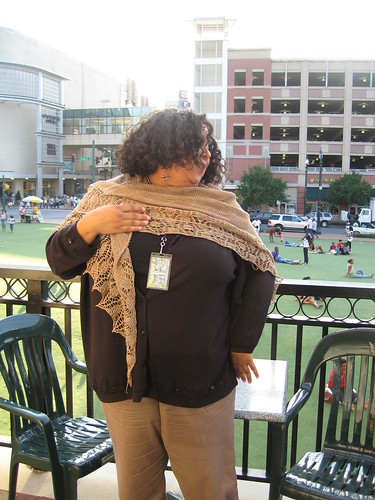
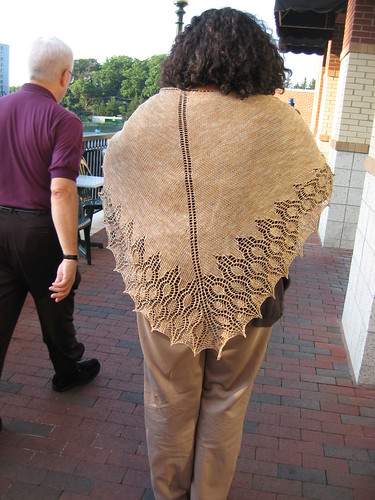
I showed you a corner of the Seraphim shawl as it was blocking, where you could see the radiant yarn (Blue Heron mercerized cotton) and the beautiful beads. I promised some modeling shots...

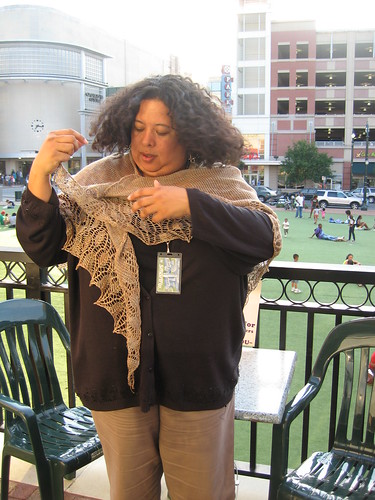
...so may I present my lovely friend Carol showing off the shawl to its best advantage:


In this last photo, she is posing with Amy's daughter. Thanks, Amy, for lending me your camera!

Sunday, July 06, 2008

One Local Summer #5

My current vegan challenge is only about CAFO animal products, so while we're home, we still eat meat, milk, and eggs--all from "our" farm.

For this week's one local summer meal, we combined leftovers:

A beautiful salad of arugula, salad turnips, and radishes, all from our CSA, topped with fresh peas from the farmer's market...


...and fried rice with leftover with farm steak and South Carolina rice (both above-linked in their original dishes) combined with farm eggs, CSA radish greens, farmers market green onions, and our own garden's swiss chard. A real kitchen-sink meal that left us fully satisfied in almost every way.

Saturday, July 05, 2008

Industrial Vegan...

...or CAFO terroir?

At the Smithsonian Folklife festival, I am struggling with my month-long pledge to myself not to eat CAFO animal products.

I thought about bringing my own food but decided it would be interesting to get something from one of the festival vendors. Surprisingly, there is nothing vegan here that I can find other than Lime Fizz and watermelon. (Note to self: Follow Chile's advice and check first next time. Duh.)

Am I really thinking of getting a ConAgra-owned Tofu Pup from a side stand on the Mall instead of this, which of course is not exactly terroir but is about cultural traditions and it is from an independent restaurant:

Nakey Tshoem
Chicken (shredded), fiddleheads, cheese, chiles, onion, garlic, ginger, and special seasonings served with Bhutanese rice

Ema Datsi
National dish of chiles with cheese, served with Bhutanese rice


Bhutanese cuisine, influenced by those of Tibet and India, links the country's eastern Himalayan environment and traditions, including food production and consumption. Chicken Nakey Tshoem includes nakey, which is a type of fern, and tshoem, which translates literally as "curry," but in Bhutan the name refers not to spiciness but to a hearty stew served with rice. Ema Datsi is the national dish of Bhutan and is the undisputed favorite of the Bhutanese. Its main ingredients are chiles; a fat-free, fresh cheese; and onions. As a side dish, it accompanies almost every traditional meal.


This pledge of mine is not easy.

Friday, July 04, 2008

Happy Independence Day!

Now I am off for a swim!

Photograph by Singlefinlove

Thursday, July 03, 2008

Confined Feeding

Chile can make us do things we've been putting aside for too long.


Her Quit Now challenge asks participants to think about their everyday choices and what they will mean in a peak oil world.

Last month I officially signed up for the challenge of not using the clothes dryer. With one small exception, my family made it through the month with, um, flying colors (or at least waving-in-the-breeze dingy-whites).

I also managed to make the switch from shampoo in bottles to shampoo bars, and from disposable kitchen sponges to hand-knit washrags.

* * *

This month I pledged not to buy bread but to make it myself all the time, using grain we grind ourselves. I love making bread but often don't get it done for any time other than Shabbat.

(Well, we already blew it once. Last night we bought pita to go with our its-too-hot-to-cook hummus and tabbouleh picnic....)

* * *

I made another pledge, one that I've been struggling with intellectually for some time and only sometimes trying to live up to:

I will not eat CAFO (confined or concentrated animal feeding operations) or factory farmed animal products this month.

In the next few weeks, I'll write more about why I chose this action and what my issues with this decision are. But for now, a little history:

I was a most-of-the-time vegetarian for many years.

"Most of the time," you ask? I've always eaten whatever my mother and grandmother put in front of me. And I've always eaten foods culturally important to the people and cultures we visited on trips. (That meant eel in Quebec, pork barbeque in South Carolina, tako poke in Hawaii.)

While I was pregnant, I craved meat and eventually decided to honor that craving and eat all the liver I wanted. For years after my son's birth, I continued to be vegetarian except on the first day of my menstrual period when I ate beef.

We kept a vegetarian house, partly to make it easy for our kitchen to remain kosher. I ate meat out at restaurants during my monthly exceptions.

Then Peter Singer and Erik Marcus entered my life. When I read about how dairy cows and laying poultry worked into the industrial agricultural system, I began to feel that eating no meat but continuing to support the system nonetheless by purchasing milk and eggs was something I could not do. We began to buy soy milk and artificial egg powder, as well as TVP and more tofu and tempeh than we had been eating before in our dairy-and-egg days.

Then, Son had significant reactions to the soy he was eating. We cut out the soy for a brief experiment--and his weight and height both soared instantly. He had been a tiny child--and now I believe it is because his body could not absorb nutrients well because of his food sensitivities. (He is now very average size-wise and doesn't have significant food issues of any type.) I'm not saying that children cannot be fed well on a heavy soy diet--just that this particular child could not due to the reactions of his gut.

After a lot of soul searching, long conversations into the night, and reading in the philosophy section, David and I decided to buy both meat, eggs, and dairy from a nearby farm. I have been extremely pleased with this decision.

I swapped utterly, from keeping to a vegetarian diet at home but eating meat out, to keeping an omnivore's kitchen but eating vegetarian out. Or at least that was my plan. David kept to his word far more than I did.

We never said we'd be vegans when we were out--but a lot of my hair-pulling was from the fact that I truly believe a factory farm is a factory farm. Whether the animal is killed for meat or just de-beaked and de-tailed and crowded beyond belief in a dark warehouse full of its own shit really does not make much difference to me.

Ordering the cheese omelette instead of the burger really doesn't make me feel better about my ability to be a moral person.

The funny thing is that my belief that a factory farm is a factory farm pushes me away from not only animal products produced industrially but PLANT products produced industrially--and that means almost all soybeans and other meat analogs. I'll write more about this in coming posts, but for now...

...I am going to keep my meat eating and my dairy and egg consumption to our own kitchen, where, yes, we will cook animal foods, all from animals living on a farm we have visited, raised by a farmer we know.

* * *

I've already blown it. July 1st at knitting group, I decided to order eggplant fries. I did not ask if they were vegan. Even though I realized they might have some kind of egg dip, I decided they probably did not given that they do not have a thick-batter coating.

What a wimp I am. I'm going to have to learn how to ask again.

Then when I was chatting about it later, I realized they were sprinkled with parmesan cheese. What an auspicious start.

Wednesday, July 02, 2008

Lego my Edgar

Given the combination of my Poe fixation and yesterday's Lego post, I just couldn't let these pass:


Tuesday, July 01, 2008

Plastic Dreams

The heat-plus-humidity stranglehold that gripped my home for the entire weekend has finally let go.

I am left, surprisingly, sad.

* * *

While I cooked breakfast (I fried up pancake batter leftover from the weekend with the first few local peaches), Son found an unopened Lego set in our Random Closet.

Both my parents and David's parents saved our childhoods in attics and basements, so many of Son's too-numerous playthings come from the early 1970s.

The '70s now seem like such an innocent decade. Did people see that at all back then?

Son's Legos, almost all leftover from David's childhood, are stored in a big box. It is an astonishingly large collection of plain blocks in a great variety of sizes.

Almost all of the blocks are red, white, or blue. Clearly, David came of Lego age in 1976.

* * *

1976. I remember drilling my much-younger brother, newly two years old, on how to talk as we watched Walter Cronkite on the television. He learned to whip out, "Bicentennial Minute!" at any opportune moment, saying it at lightening speed in his high lispy tones.

My brother celebrated his very adult birthday this past weekend. I still think of him as nine years old, my son's current age.

Poor brother. He had to deal with having three parents giving him instructions about how to live.

He still does.

* * *

The Lego set Son found in the closet this morning was double-bagged in plastic Publix grocery bags. I have absolutely no memory of this toy, but I would guess it is from Grandma and Grandpa (my in-laws) since Publix is the main grocery chain where they live most of the year.

The set comes with directions. The pieces are not necessarily easy to recognize as Legos. They all share the ability to link to those classic cubes--but now they are just parts of a particular whole, parts that come with instructions that tell you how to put them together, how to play with them.

Following the directions, we make a hard-plastic hot air balloon to take a few little Lego people on an Orient Expedition.

* * *

I lament the passing of the world that now seems to have allowed creativity. When we were children, we were given a chance to make whatever images came into our head. Those red-white-and-blue Legos turned into covered wagons, rockets, Big Foot's footprint, the Mouseketeers, castles, mountains, a hospital... whatever was relevant to our own personal and changing interests.

* * *

As I take a load of dirty laundry down to the washing machine in the basement, I glance at the prepackaged box of magic tricks.

When I was seven, I started to understand that nothing happened without human intervention. But in that age, it seemed that that intervention could not be mine.

Before receiving the magic set, all I heard when my uncles pulled eggs out of cloth bags was, "Magicians never tell!"

Someone else controlled things, someone pulled the strings.

God was a job open to anyone with the right directions.

I had such a sense of power in my hands that Christmas when I opened the magic box. That holiday when I turned seven years old, before the birth of my brother, my parents were telling me they trusted me enough for ME to be the ones pulling those strings.

What could I make happen in this world that had appeared so mysterious before I had the manual?

* * *

I look at my childhood ranch-style doll house, now set up on a little table in the basement. The dollhouse used to have working electricity. Tiny 1970s-style fixtures lit up its back corners. Son points out that there is no way to get from one floor to the next, except by magic.

My grandmother, long dead, knit complicated lace blankets for the beds and crocheted simple rugs for the floors. I, at age seven, cross-stitched a miniature daisy and put it in a tiny frame.

What was handmade looks timeless, still works, even though the peeling doll-house family now lives off the grid.

* * *

I pick up the pattern for the sweater I am knitting on this cool afternoon. It is the first time in days we haven't had all the fans in the house going at full blast. The quiet is wonderful, opening. The pattern sits on the coffee table where I put it, instead of flying under the sofa when the turning column of air lifts it. I look at it closely and imagine following the directions precisely.

K1, yo, k1, ssk, k3, k2tog, k1, yo, k1.

Symmetry, knit from right to left--not like my words.

* * *

Here I am, facing a new day, wanting for all the world for everything to be packaged up and self explanatory.

And yet, I know.

Now is the time to repair our lives and remake the world as we see fit, at this moment, in these difficult times. I know that what is of value is what happens when we pack away the carefully-constructed plastic designed to fit together in one way, pull the plug and try to make do with what we can create ourselves, and let the rules and instructions fly to the wind as we make our own maps.

Sunday, June 29, 2008

It All Comes Due

The farmer's market was ablaze with every beautiful summer fruit and vegetable you can imagine. Even a couple of nectarines and some non-hothouse tomatoes made their appearance. Blackberries (destined to be tonight's dessert), blueberries, and the last of the strawberries all called to me and filled our little cloth bags and plastic quart-sized containers. Homemade violet jelly and some delectably mild goat cheese also came home with us.

Our CSA share was also brimming with goodies. From kale to chard, from a few more blueberries to radishes and salad turnips, we'll be eating well all week.

Even our garden is going gang-busters, after a brief lull between the rapini-and-radish feasts and this new abundance. While our corn and potatoes are still a long way from being ready, we harvested our first zucchini, a handful of green beans and purple beans, and tons of mint and basil this week. The peppers and tomatoes have their first fruits ripening on the vine.

For this week's One Local Summer meal, we grilled--almost embarrassingly for the first time this season.

While drinking a dry cherry martini...


...we snacked on a few barely-steamed sugar snap peas.


After farm-fresh steaks, corn, and foil packets of potatoes and onions all grilled...


...we feasted on this all-local celebration of a meal:


What fun my whole family is having looking at everybody else's meals! We've gotten a lot of inspiration for our upcoming meals, too. Thanks, everybody!

Wednesday, June 25, 2008

Doing Magic

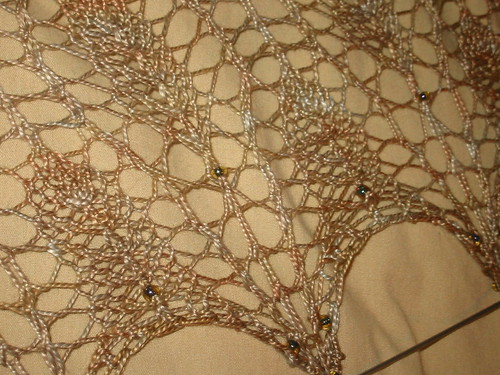
It has been a while since I pinned out a knitted project on our bed. I'd almost forgotten about that old blocking magic, when you take that nasty thing that cat drug in, wet it, and stretch the living daylights out of it . . . until:


This is Miriam Felton's Seraphim Shawl--my second one--with a few holes taken away and a few beads added. More pictures coming soon!

Tuesday, June 24, 2008

Heading to the Bar

I've been trying over the last little while to stop using some of the corporate products I have come to rely upon. Sometimes I am trying to avoid the big companies. Other times I am trying to opt for healthier alternatives for my body. And often, I am trying to learn to cut down on the waste stream I produce (including all the things I throw in the recycling bucket).

One of the things that used to fill up our recycling container was all those plastic shampoo containers. In my effort to break the shampoo-bottle addiction, I tried out a number of alternatives, starting with a couple of choices easily available in many mainstream stores.


1. Burt's Bees used to be a tiny company in Maine. Then it was a small company in North Carolina. Well, now it is part of Clorox. Nevertheless, I still love some of their products so I first tried their Rosemary Mint Shampoo Bar.
After using it for a couple of days, I almost gave up on the idea of using a shampoo bar at all. My hair felt sticky and I looked like there were sticks coming straight out of my head. My comb got covered in white waxy mess.

I had heard that the transition from commercial liquid shampoos to bars might take a little while--so after things had gotten better with other products, I went back to this bar. It was still awful.

What a shame. It is certainly pleasant smelling.


2. I thought my very fine and relatively dry long hair might have hated the Rosemary Mint because it was drying, so I tried their baby shampoo. The scent is subtle and extremely appealing--just a bit of apricot for a smooth scent with a fresh kick.
My hair responded much better to this bar, although it left a sticky residue that even a vinegar rinse did not remove. Although the residue was dulling, it did give my bone-straight hair a bit more body...

David's experience with the bar has been much better. His short curly hair looks great these days--and he is on his second baby shampoo bar now.

I was a little disconcerted to discover that the Skin Deep Cosmetic Safety Database did not give it a great score, mostly because of the product's use of tocopheryl acetate, panthenol, and unidentified fragrance. There are certainly more dangerous chemicals in a lot of American cosmetics--but given that I think of Burt's Bees as a "natural" company, and that this particular product is designed for babies, I was quite surprised.

3. After hearing more and more about the potential dangers of various products commonly used in the beauty industry, I decided to start reading my labels more carefully. While picking up a prescription in a mainstream pharmacy, I ran across Skin Free Extra Moisturizing Soap, which advertises that it makes a great shampoo. Its Skin Deep rating is much better: a perfect zero.

I love this bar. It is clear and scent-free, lathers beautifully, and feels great in the hand with its ever-s0-slight bevel shape. But if I use it for several shampoos in a row, my hair takes on the quality of hay. Not particularly pleasing. So I alternate using this bar with other options.

4. My absolute favorite shampoo bar so far: J. R. Liggett!

This bar, a much squarer bar than the others, lasts a long time, doesn't leave much residue in my hair, is almost scentless, and makes my scalp feel more honestly clean than any of the other bars have. This one is a keeper.

5. I have another favorite: baking soda and vinegar. I put a tablespoon or two of baking soda into a bottle, fill it with a cup or two of water from the shower, and shake until it is clear. I pour it over my hair and rub it in. There is really no real lather and it takes a while to get used to this feeling--but my hair feels deep-down clean after a BS wash.

For conditioner, pour a tablespoon or two of apple cider vinegar into cool water and rinse your hair with it. Then rinse again with clear water. The first time I tried it, I was utterly amazed at the softness that resulted. Whether you use baking soda, a shampoo bar, or even traditional shampoo, this is a great find!

6. The other thing I do? I now wash my hair every other day, or every third day. Although it took a little while for my hair to adjust, it is pretty happy with this routine now. I never would have believed that I could make this transition!

* * *

What have you found that works for you?

Sunday, June 22, 2008

One Local Shabbat

On Friday we all had busy days and found ourselves close to dinnertime with very little planned. Friday evenings are usually a special dinner for us as we welcome Shabbat. Although we threw this dinner together, we especially enjoyed it as we ate in our garden and toasted to the mosquitoes, finally hitting their stride in the DC area.

We served farm-fresh hotdogs with spicy sauerkraut from the same farm, bread from a local bakery, and a big arugula salad courtesy of our CSA. For dessert (which we gobbled down before we thought about the camera), we enjoyed strawberry ice cream--made by the farmers from dairy and strawberries from the farm and maple syrup from one of the farmer's neighbors.


For breakfast the next morning we made French Toast using bakery challah, farm eggs and milk, home-rolled oats, and nonlocal almonds--and topped the bread with farmers market strawberries and local maple syrup. Delish!


For lunch, we heated up leftovers in the solar oven. On Thursday evening, we had cooked cornbread with yogurt from the farm and cornmeal we ground ourselves, and we served it next to South Carolina cowpeas and Carolina Gold rice. Saturday's lunch was a repeat, this time minus the greens we enjoyed that evening.

Although I grew up in the Carolinas with a historian father who studied slave culture on Carolina rice plantations, I'd never had "Carolina Gold" rice. (For many many years, the state standard has been long-grain white rice.) Much to my surprise, Carolina Gold (the variety that made South Carolina into a major grower of rice at the beginning of this country) is short-grained and almost sticky. Fascinating. And tasty!

I cooked the cowpeas with some local onion from the farmers market. The cooking broth was one made from assorted vegetable peelings (onion skins, asparagus bottoms, green bean ends, very holy rapini leaves, etc.) and a few leftover chicken bones. To make the beans taste authentic, remember to cook them with a little black pepper.

Thursday, June 19, 2008

Changing Directions

A morning of weeding in the garden, clipping clean whites to the clothesline to dry, and grinding corn for tonight's homemade cornbread made me feel alive, productive, sure of myself.

But the beautiful morning sun is now all clouds. The laundry hanging on the line no longer looks like some great artist's portrayal of Tuscany or Provence. I've pulled on a long-sleeve shirt to cope with the chill in the air.

This afternoon I find myself feeling lost, feeling that I am in some world other than the one I was planning on.

I have been reading a novel that has affected me profoundly. It is an interesting book, well-enough written, but certainly not high literature. Nonetheless, it has somehow wrung so much out of me that I find myself in tears, afraid.

Finally I put the book down, with only about 100 pages until the end.

I don't know whether I should read on, hoping for some sense of resolution that will allow me to get past the place I am now, or return the book to the library and go read some cozy mystery.

It is time for a pot of tea.

Wednesday, June 18, 2008

Washing Dishes

aAlthough we have used cloth napkins and kitchen towels instead of disposable paper products for years, we've had an enormously difficult time getting past our addiction to disposable scrubby-sponges for washing dishes.

We now have some answers:


The blue thing is the plastic netting our seed potatoes came in this spring. We've been using it now for a couple of months and it is in great shape. While it is ultimately disposable, it was saved from the trashcan where it could have gone immediately after planting the potatoes. It provides absolutely superior scraping of cast iron pans, etc. and has lasted extremely well. Because it is so easy to wash out well, we don't worry about the germs that can grow so easily in disposable sponges. We have another one waiting in the wings when this one finally wears out.

The two green squares are a knitted cotton washcloth that David made and a woven potholder square that Son made. Both are absolutely fantastic--with a lot more traction and absorbing ability than the cloths we had been trying to use before.

Addiction number one broken!

Tuesday, June 17, 2008

When I a Fat and Bean-Fed Horse Beguile

During the spring, my 9yo son participated in a fabulous local production of A Midsummer Night's Dream. Despite his initial protestations, he loved being a lover. He played Lysander to his best friend's Hermia.


Shakespeare plays around with size quite a bit in this play. During an argument, Hermia betrays her shame about her short stature. Other characters pick up on her discomfort and tease her. At one point Lysander calls her a dwarf, an acorn, and a bead for being so tiny.

In most productions, directors can be counted upon to cast shorter actresses as Hermia and taller ones as Helena, the other (mortal) female love interest. In this production--full of homeschooled children--the director (a homeschooled highschooler) cast as Hermia a young woman who is about six inches taller than my son. She played the part brilliantly--and when Lysander labeled her a dwarf, the audience burst out laughing, realizing that she was only hurt by the comment because of her own feelings of inadequacy.

* * *

In this same production, Oberon (King of the fairy world) was played by an intense and small boy who acted the overbearingly royal qualities brilliantly. Titania, his love and the queen of the fairies, towered over him by nearly a foot. And when she fell in love with Bottom (after his transformation into a donkey), she found a love several inches shorter than Oberon.

Compared to the two of them, Titania looked not like a delicate fairy but like an Amazon. The idea that the character is weak and basically loses in the play always irks me. So I was thrilled with the transformation.

* * *

Now I am considering casting on that beautiful knitted cotton sweater Titania, named for the Queen of the Fairies.

Here's the pic from the knitting designer's website:


The above model is not a little wispy thing of no substance--but she is a combination of slender and curvy that shows off this sweater wonderfully.

You could say I am curvy. In all the right places.

And, well, in most of the wrong places, too. You could never say I am slender.

Am I going to look like an Amazon Fairy in this thing or am I going to look more like Bottom the Weaver in his Ass costume?

"wide enough to wrap a fairy in"

Monday, June 16, 2008

Mosaic Meme

Inspired by 2 Sistah's Knit Together:


How many of my answers can you figure out from the photos?

Questions:
  1. What is your first name?
  2. What is your favorite food?
  3. What high school did you go to?
  4. What is your favorite color?
  5. Who is your celebrity crush?
  6. Favorite drink?
  7. Dream vacation?
  8. Favorite dessert?
  9. What do you want to be when you grow up?
  10. What do you love most in life?
  11. One word to describe you.
  12. Your Flickr name.

The instructions to create the mosaic are:

  • Type your answers to each of the questions below into Flickr Search
  • Using only the first page, pick an image
  • Copy and paste each of the URLs into the mosaic maker

Sunday, June 15, 2008

Purslane Paneer

Inspired by the last week's local Matar Paneer over at One Size Fits All, I decided to copy her and make a vegetarian Indian dish for One Local Summer.

Making paneer is quite easy--easier even (and faster) than making goat cheese. I brought a gallon of whole milk to a hard boil. As the boiling milk began to rise, I took the pot off the burner and added about a quarter cup of lemon juice, whisking it in for a couple of minutes. I then let the tiny curds sit in the whey for about ten minutes, then drained the mixture through a cheesecloth. (I'm enjoying a cultural cheese game that can make your head spin by saving the whey to make mysost.) After it had drained for about fifteen minutes, I shaped it into a round (still in cheesecloth), put it on a tray, and weighted it down with a big pot filled with water for about a half an hour.


While the cheese was draining, I went out to the garden to help David do some weeding in the Three Sisters plot.

I brought in a handful of radish tops and a large bowl full of purslane--that plant that is ridiculously easy to grow (since it doesn't even need to be planted) but hard to get rid of. Yes, it is a weed--but a very tasty one full of great nutrition. Why not replace the spinach in saag paneer with this garden-fresh produce?

I sauteed a farmers market onion (on its very last legs) in some farm butter until it was soft. I added various Indian spices (cumin, coriander, ginger, red pepper, etc.), then stirred in the radish greens and the purslane. After a few minutes, I added the cubed paneer, then added some cream and some yogurt, both from the above-linked farm.

We served the meal over some non-local jasmine rice. How delicious!


* * *

I enjoyed the meal so much that we made Indian food for the next meal, too--with a lot more nonlocal ingredients--and equally iconoclastic and non-authentic, I fear.

While sipping a rhubarb martini...


...I put together a dish made with home-canned tomatoes, store-canned chickpeas, some leftover green beans brought home from a restaurant one evening, and some leftover radish tops. Assorted seasonings and some yogurt and cream rounded out the dish. Since we were out of rice, we served it over millet (one of my favorite grains).


For dessert, I chopped up some non-local almonds in the old family wooden bowl and mezzaluna given to us recently by David's parents. The grooves worn into the wooden by his ancestors made the tool fit just perfectly into my hand.


Inspired by the gorgeous pictures and great ideas over at Tea & Cookies, we sprinkled some of the leftover paneer with local honey and the almonds. Although folks who love sweets might not be completely satisfied with this dessert, I thought it was an absolutely perfect ending.

Saturday, June 14, 2008

Register Your Discontent, because...

the real Inconvenient Truth is the Constitution, or so say these funny and brilliant folks:

Friday, June 13, 2008

The Life of the Individual

Partially inspired by Green Bean Dreams' Bookworm Challenge, I've had a great time reading books about families who made the move from one way of life--one that only taxed their brains--to a more sustainable one that put their beliefs into practice.

There are a lot of open paths. Path to Freedom, the granddaddy of homesteading blogs, shows how to do it in an urban setting. Crunchy and Melinda do it in Seattle. Colin and his family are at it in a high-rise in Manhattan. Madeline shows us how when you live in the boonies outside a big city. Sharon and Greenpa teach us what to do in the country. You can do it in the suburbs. You can even do it in the desert. And there are so many more ways!

But for those who want to curl up with a good book rather than a laptop, I have a few to recommend:

Logan Ward's See You in a Hundred Years: Four Seasons in Forgotten America was a surprisingly wonderful read. I had not heard of the book before I randomly stumbled across it, and it is published by a relatively little-known press. Logan and his wife and young child move from New York City to a farm in a rural area of Virgina. They decide to spend one year living with only the tools available to a person one hundred years ago. While they are a very modern family with very modern issues sometimes, they go through daily life growing their own food, putting it up for the winter, learning to travel by horse and bicycle, living without electricity, mass-market toothpaste, and running water. What they make themselves comes to the fore--including the community they find themselves creating in their rural town. One of the most interesting sections of the book is how they deal with the tragedy of 9/11, which occurs during their 1900 year. Highly recommended as thoughtful but light reading. Perfect for an afternoon in the shade.

A less appealing but equally interesting book is A Reasonable Life: Toward a Simpler, Secure, More Humane Existence by Ferenc Mate. The author, in a very edgy funny-if-you-are-not-too-sensitive attack on modernity and all of us who make any compromises with it, engages some fascinating issues but offers answers that sound awfully off-putting. For example, I am probably as anti-television as he is (sorry, Carrie!), but being bombarded with writing like "Open an upstairs window...and throw the heinous sonovabitch as far as your arms let you!" makes me want to rebel and go buy one. Mate has a lot of interesting insights--and if you handle this style better than I do, let me know what you think. I know I am not really being fair to him, given that I've heard others say that this book has transformed their lives.

I was similarly unimpressed with Extreme Simplicity: Homesteading in the City. Although the authors' tone is respectful throughout, they wind up sounding a bit self-important and preachy. I don't exactly blame them: their task writing this book is a really difficult one. When authors set out to show you how to do better, it is often difficult to take. On the other hand, when authors detail their own path--especially if it is a pretty bumpy path--toward trying to make a more authentic life, it can be utterly charming. This book, much to my disappointment, comes across as an example of the first kind of book. But it is filled with a lot of very interesting ideas to transform your life without moving to a farm or something. The choices open to them in southern California are radically different from what I have in the DC area, but many ideas are applicable nonetheless. Glad I read it, but don't plan your vacation reading around this one.

We also reread parts--the "spring planting" chapters--of Barbara Kingsolver's fabulous Animal, Vegetable, Miracle: A Year of Food Life last month, too--always a joy and an inspiration. Kingsolver is an elegant writer with a wickedly funny edge sometimes, and even when she is talking about how amazing her life is, she sounds real and down-to-earth. Her partner writes short political essays scattered throughout, and her daughter writes up recipes and reminiscences. This book is absolutely a must-read, and a must-read-again.

Another lovely book I briefly revisited this season is Plenty: One Man, One Woman, and a Raucous Year of Eating Locally. The authors (from British Columbia) are much stricter in their eat-local rules than Kingsolver is. Where she uses eating local as an entree (sorry) into the connection between culture and agriculture, they explore more precisely what the consequences as well as the joys of a local economy are. Well written and very funny.

Up soon on my nightstand: Michael Pollan's pre-Omnivore book, Second Nature: A Gardener's Education. Has anyone read it? Any reviews? Or does anyone have any other book recommendations for me?

LinkWithin

Related Posts with Thumbnails