Showing posts with label EatLocal. Show all posts

Wednesday, January 20, 2010

School Gardens and the Seeds of Change


Poster uploaded by Joan Thewlis


Have you seen the critique of school gardens published recently in The Atlantic?

Imagine that as a young and desperately poor Mexican man, you had made the dangerous and illegal journey to California to work in the fields with other migrants. There, you performed stoop labor, picking lettuce and bell peppers and table grapes; what made such an existence bearable was the dream of a better life. You met a woman and had a child with her, and because that child was born in the U.S., he was made a citizen of this great country. He will lead a life entirely different from yours; he will be educated. Now that child is about to begin middle school in the American city whose name is synonymous with higher learning, as it is the home of one of the greatest universities in the world: Berkeley. On the first day of sixth grade, the boy walks though the imposing double doors of his new school, stows his backpack, and then heads out to the field, where he stoops under a hot sun and begins to pick lettuce.

The author continues that schools should never be "a venue in which to advance a social agenda." They should not try to teach self-sufficiency in the growing and eating of healthy food. She suggests, although rates of diabetes and heart disease are astoundingly high among inner-city communities and others living in poverty, the "suicidal dietary choices of so many poor people are the result of a problem, not the problem itself." Instead of teaching students about gardening and cooking, "the solution lies in an education that will propel students into a higher economic class, where they will live better and therefore eat better." Therefore, the only question educators should consider is "What are you doing to prepare these kids for college?"

At a certain level, I agree with the author: poverty is the problem at the root of so many of our society's ills. And I also agree that the answer to addressing poverty goes way beyond school gardens.

But honestly, addressing poverty also goes way beyond trying to send all students to college.

Students raised in a family and community with less than they need often struggle in academic settings. Yes--college is absolutely a way out of poverty for exceptionally bright students who can fight against the odds. But poverty also prevents many just reasonably bright students from succeeding in academia, no matter how much their teachers drill them in test-taking skills or even teach them great literature. This is terribly wrong--but it is true none the less. Those of us who grew up middle class with educated parents often have an easy time in the classroom, even if we're NOT reasonably bright.   And honestly, not all students (and this has nothing to do with whether they are poor or rich) should be told that college is their only option for creating a productive life.

While school gardens might not solve the problems of poverty, I do believe that they begin to address far more than just the eating habits of students.

Berkeley's Edible Schoolyard is located at a school with a high number of brand new immigrants who speak little or no English yet. While learning English can happen in a classroom with a textbook, language also gets learned in real life when students of many cultures come together in a more relaxed place to grow, cook, and eat food together. They share their native plants, the recipes of their cultures, and their traditions of hospitality. This makes for a place where people can both appreciate each others' differences and see each others' similarities.

For those students who do struggle in the classrooms, the garden offers a place where learning happens in a different fashion--just as the art classroom and the music rooms can. Should these subjects be offered completely INSTEAD of teaching a skill that (as the author states) clearly "improves a child’s chances of doing well on the state tests that will determine his or her future"? No--but leaving these other subjects completely behind--and suggesting they are not at all valuable as real education--denigrates those who now create their lives in fields like these. And of course denigrating the growing of food means that that farmers will never be paid enough or respected enough. It is a vicious circle.

As our world moves rapidly into a time when we have to confront both climate change and severe resource depletion, it seems likely that farmers will be in great demand and treated with much more respect than they have been recently. All students--those who have grown up in families of farmers and those who have grown up thinking food comes from Wal-Mart, those who are living in poverty and those who are living in McMansions--need to know about how sustainable agriculture works.

Barbara Kingsolver approached these issues long before the author of the Atlantic article wrote her inflammatory attention-seeking piece:

The baby boom psyche embraces a powerful presumption that education is a key to moving away from manual labor, and dirt--two undeniable ingredients in farming.  It's good enough for us that somebody, somewhere, knows food production well enough to serve the rest of us with all we need to eat, each day of our lives.

It is our disconnect from growing food and our disrespect for the manual labor that sustains us that leads Americans to, as Kingsolver says, "consider the food industry to be a thing rather than a person. We obligingly give 85 cents of our every food dollar to that thing, too--the processors, marketers, and transporters." The corporatization of our food supply and the high degree of food processing have made farmers almost invisible. If we were more educated about the process of what farmers do to grow our food, perhaps we would "want to compensate or think about these hardworking people."

* * *

So my family plants a few seeds in our tiny garden--partly to produce a few treats here and there and partly to remind ourselves of the skills and labor of those who grow more. We have a CSA share and we meet the amazing growers who work there. We shop at the farmer's market in order to remind ourselves that the food we grow has been nurtured by human hands.

My homeschooled son jokes that this is our own school garden, our own edible schoolyard.

Tuesday, January 05, 2010

Proselytizing

For many years, David and I have talked about the politics of food with his parents. Before this year, those conversations have gone nowhere. Usually, they just humor us as we buy whole wheat bread and organic milk when we visit them. They nod mindlessly as we drone on about sustainable local, seasonal, or organic “real” food. Those kids! Once the discussion erupted into the closest thing to an argument I have had with them in all the time I have loved their son.

Both of David's parents grew up in post-WWII New York City immigrant communities. Although food was an incredibly important part of Jewish culture and even Jewish religion, the people in their community had relatively little direct connection with the actual growing of the food they ate. Both my MIL and FIL were instilled with beliefs in Americanization, in progress, and in a post-rural economy. They are loyal and trusting people who believe deeply in justice—but I think they have trouble believing that anything that looks to the future could possibly be wrong, that anything that is a convenience or a small luxury could possibly be bad for them or the world.

I first met Jay when he was in the ICU after a heart attack. (Interestingly, the day I was supposed to meet David’s parents was two months earlier--the day I was admitted for my brain surgery.) He is a diabetic who has lost much of his sight and had other complications from the disease as well. Sue--the recipient of some of my finest knitting (like this silk lace shawl, and this beaded one, and this lightly multicolored one) because of her petite size--carefully watches her weight and her family member’s weights. Recently, she has some recurring heart issues--and had a somewhat high blood sugar reading at her last appointment as well. Eating a healthy diet is something extremely important to her—although she approaches healthy eating with a shopping cart full of iceberg lettuce, margarine, low-fat American cheese, artificial sweeteners, and diet sodas. Her sweet tooth doesn’t always make it easy to avoid the highly processed goodies she can find in the local grocery stores here in south Florida (like chocolate babka and rugelach, or that fat-free/sugar-free chocolate that tastes like Styrofoam to me).

When the movie Food, Inc. came out this year, we wondered if this might be the perfect way to bring up these issues again. But after much thought and discussion, we decided not to mention it this year. Yes, we’d buy our own milk and the like, but this time we wouldn’t say a word about their choices. They've suffered through that discussion quite enough. At some point, we recognized that our connection with them had to lead us to at least try to respect their food decisions.

But then Sue surprised us by describing a show she had watched on Ellen Degeneris. What she could remember is that it was a young man with a new baby who talked about how industry is doing bad things to food and that we need to use our dollars to support what we believed in. She was excited to pass this information on to us. After searching on Ellen's site, I think the interview she saw might have been with Jonathan Safran Foer, author of Eating Animals. You can watch the clip over at Ellen's site.

I was thrilled--and immediately started thinking that perhaps this was the right time to do a little proselytizing after all!

We started telling them about Michael Pollen's The Omnivore's Dilemma, his next book In Defense of Food, and Barbara Kingsolver's Animal, Vegetable, Miracle. As we were talking, Jay picked up the phone and dialed the number of the service that provides audio books for the blind to him at his request.  He ordered all three. If after listening to these he is still itching for more, I think I'll recommend Fast Food Nation to him.  It was the book that really pushed us into this issue when it first came out.

Jay commented to Sue that it would be hard for them to listen to the books together because of the way the technology works. So we also bought paper copies of In Defense of Food and Animal, Vegetable, Miracle for Sue to read in print. When she finishes those two, if she wants more I might give her the new young reader's adaptation of The Omnivore's Dilemma which my son has enjoyed.  I’ve also heard about the guidebook that accompanies the Food Inc. (Anyone know if any good?  I think I'll have to go check it out.)

After seeing their interest, we started to reconsider showing Food Inc.  It is currently available for instant watch on Netflix, so we pulled it up on their large-screen computer and gathered our chairs around.

After watching the film, we sat at the kitchen table and talked a bit. Sue was very moved by the film and interested in making changes, but she was at a loss as to how to go about it. “Are there still any farms around here?” she asked—a good question since gated retirement communities (including their own) are replacing farms everywhere you look.

Immediately I popped on Local Harvest and found the address of the farmer’s market nearby, a farm stand, and even a CSA. I don’t think they are quite ready for a CSA since they are not yet serious fresh vegetable eaters and Jay is pretty picky about what vegetables he’ll even taste. (Serving broccoli and asparagus to him will illicit cries of “Are you trying to poison me?!”) Nevertheless, I do think finding places where they could make their own choices might work.

The south Florida growing season is during the winter, so the markets are open and full of abundance right now:

fl tomatoes

fl grower

fl grower 2

As a DC gal, I'm blown away by their "homegrown" labels on things like mangos, avocados, and bananas!

fl pickles

For New York transplants, these pickles are a welcome sight.

* * *

David knows it won’t be easy for his parents to break habits they have had for decades. And we’ll be miles away from them as they navigate this new terrain, unable to offer regular shopping support. We tried to think of a few first steps to help them out.

1. Buy organic milk when you go to the grocery store.

2. Commit to going to the farmer’s market or a farmstand at least every two weeks. Plan to spend at least $20 of your food budget on foods you can buy from a local grower.

Do y’all have any other suggestions for those just getting started on this path?

Sunday, December 20, 2009

Eating in the Snow: Dark Days Update

Here at Chez Raven, located inside the beltway of Washington DC, we were blessed with almost twenty inches of snow this weekend!

My family spent much of the weekend sitting on the couch watching the snow, enjoying fires in the fireplace, listening to books on tape, knitting, and drinking warm beverages.

*  *  *

We started the morning with migas (made with local eggs, cheese, onions, and salsa as well as home-grown parsley picked just before the snow--but non-local beans) and mimosas (made fresh with non-local clementines and champagne):

migas and mimosas

mimosas during snow

* * *

I spent most of the day knitting holiday presents in the warmth of our house while David and our son shoveled the driveway, made snow forts, and went sledding.

*  *  *

Our brisket dinner cooked all day in the crockpot. I added to the pot a few onions, some turnips, mushrooms, carrots, shredded cabbage, and dehydrated greens. Before serving, I shredded the meat and added it back to the liquid. We served the stew next to mashed potatoes.  Everything was local except the tomato paste I added to the sauce.  We enjoyed some local red wine along with our meal.

local dinner--during snow

* * *

Dessert during the snow was homemade eggnog with local milk, egg yolks from local organically raised free-range chickens (important if you're consuming raw eggs), and maple syrup from the farmer's market. The adults spiked with non-local bourbon.

egg nog

* * *

This time, we decided not to have our meals at the bistro table on our deck.  The lump on the left lower than the table is my chair!

bistro table in snow

Sunday, November 29, 2009

Local Thanksgiving: Dark Days Challenge

We had a wonderfully quiet, almost 100% local Thanksgiving this year--following on the heels of a combination of travel to various conferences by both the adults in the family, work crises that took a lot of time and emotion, and lots of random busyness and its attending crankiness. It was lovely to take a day off just to cook, play games, and eat.

We have a tradition of splitting our Thanksgiving feast into two meals. This plan works well for both cooks and eaters.

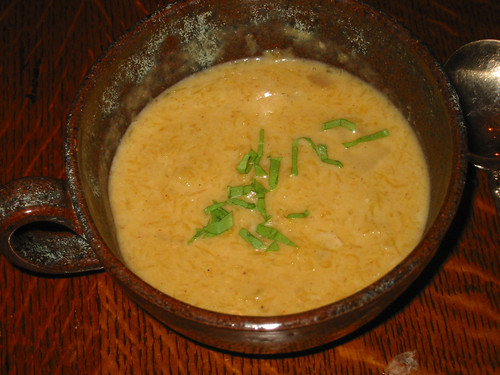
For lunch, we made a thick apple-butternut squash soup enriched with local onion, cream, and hot pepper as well as some non-local spices such as ginger and cumin.

soup

David fried up some fritters made with wild rice and frozen corn. The rice, while not local, is sold by the sustainable White Earth Land Recovery Project, an American Indian organization dedicated "to preserving and restoring traditional practices of sound land stewardship, language fluency, community development, and strengthening our spiritual and cultural heritage."

native fritters 2

It seemed especially fitting to recognize the importance on native harvests--like wild rice but also corn and winter squash--as well as American Indian cooking traditions. The recipe for the fritters can be found in the beautiful new book, Foods of the Americas: Native Recipes and Traditions.

* * *

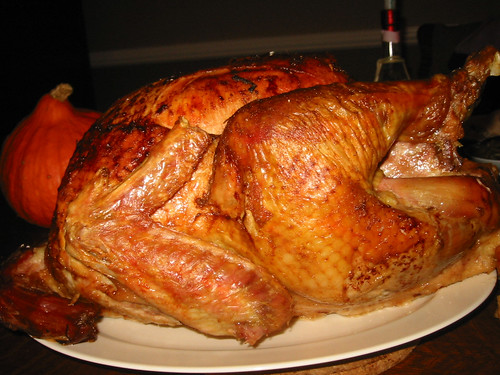
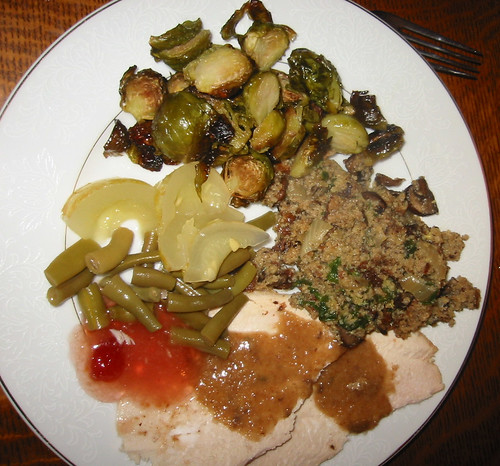
At suppertime, we had our main meal of local turkey, pickled lemon cukes, pickled garlicky green beans...

turkey with pickles in bowls

...roasted Brussels sprouts, mashed potatoes-and-turnips, and cherry jam (instead of cranberries--which we could not find locally).  The dressing was made from cornbread (the gorgeous Indian corn we grew in our backyard!), assorted winter greens from our backyard garden, CSA carrots, sage and rosemary from our herb plot, local eggs, lots of local mushrooms--plus local oysters!  We ran into them at the very last moment--and it was absolutely kismet.  Oyster stuffing may become a tradition in our family.

thanksgiving table

The meal was served with a local white wine. When David first handed it to me, I misread the variety and honestly thought it said it was Vinegar. Luckily, it was a delicious, perfect-with-turkey Viognier.

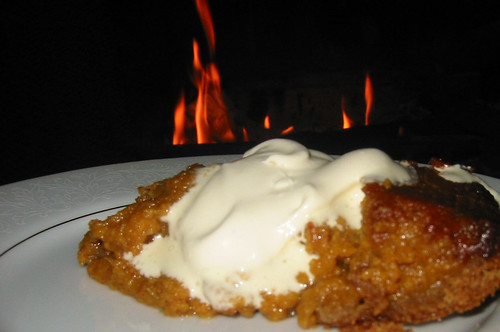
To end the feast, David made a not-pumpkin pie using the recipe on the back of canned pumpkin. He made a few exceptions: first, he used pureed butternut squash and carnival squash which he baked himself. Second, he replaced the canned evaporated milk with a mix of milk and cream from our Amish dairy supplier.

pie

The pie was fabulous--a little yellower than pumpkin pie but sweet, light, and delicate. We served it warm with whipped cream.

We enjoyed the rest of the evening in front of a fire in the fireplace, sipping our wine and reconnecting.

Sunday, November 22, 2009

Eating Local during the Dark Days of Winter


This year's celebration of the eating local during the Dark Days begins this week. While finding local produce seems easy during the abundant harvests of late summer and early fall, the pickings start getting slim once the temperatures drop and the amount of light lessons. The annual challenge put forth by the (not so) Urban Hennery helps motivate eaters to keep up the work and realize that what sometimes seems hidden is in fact its own kind of abundance.

Eighteen months ago, we started a tradition of Eco-Shabbat, or Sabbath for the Earth--a continuation of Earth Hour. We were originally inspired by Melinda at One Green Generation to have an evening off the grid. We've enjoyed the candlelight dinners every fall, winter, and spring--but during the summer, we usually loose our way when the sun provides the light to allow us to continue full speed ahead. Darkness doesn't point toward a slowing down until it is almost time for bed.

But now that the "Dark Days" are back, we've started again. Our No Impact Project helped us adopt the practice again more regularly this season. The official project guide gives a variety of helpful suggestions for ways to mark one day a week as an eco-sabbath.

For our recent Eco-Shabbat, we pulled the only successful spaghetti squash out of our garden and baked it up.  We served it with a sauce made of red peppers (from our amazing CSA), which we dehydrated last summer.  Dried peppers simmered in water--just as simple and plain as that, and yet it was astoundingly delicious.

For a side, we cooked up some mixed greens with an onion and some garlic from our CSA and from the farmer's market in town.

We also served a home-canned jar of "Not-So-Sweet Bread and Butter Pickles." The recipe can be found in the excellent canning guide The Joy of Pickling: 250 Flavor-Packed Flavor-Packed Recipes for Vegetables and More from Garden or Market.

For our dessert beverage, the adults at the table sipped our sickeningly sweet but oddly charming homemade Rhubarb Liqueur.  This little taste of preserved summer was a lovely ending to the evening.

dark days 1

Tuesday, October 20, 2009

Local Harvest: Foraging for Acorns

Inspired by Euell Gibbons Stalking The Wild Asparagus, we recently harvested acorns to make delicious acorn pancakes.

acorn pile

See the full post here.

acorn pancakes

Friday, January 02, 2009

Eating Local on the Road


I've not been posting much recently about our efforts to eat locally, but that does not mean we haven't been doing it! At home, much of our diet is sourced locally--so much that we sometimes take it for granted. Quite often, we realize half way through a meal that all ingredients other than salt and pepper are local.

On the road, however, it is a little more difficult. Our two week vacation to visit our families has had a few local moments--including one of my favorite annual traditions: roasted oysters, gathered and prepared in coastal South Carolina where my parents are from. Delicious!

Saturday, November 29, 2008

Local Thanksgiving


Although on Thursday we attended a friend's Thanksgiving, on Friday we cooked our own meal--all local and some of it from our own backyard garden.

* * *

For several years, we've split our celebratory meal into two. This allows us to have a full menu, not starve in the early part of the day, and not get too extraordinarily stuffed at the end.

For lunch, we served a salad of our backyard-grown arugula, local feta seasoned with Herbes de Provence (found at the farmers market), and a homemade maple-mustard vinaigrette.


We completed our midday section with a thick and spicy pumpkin soup. After roasting the tan pumpkin for about 45 minutes, I scooped out the flesh and added it to some sauteed onions and apples that I had going in the soup pot. Then I threw in some some vegetable-peeling stock, a bit of cream, pureed hot peppers, and a pinch of non-local curry powder. A warming preparation for an afternoon of cooking.


* * *

Dinner was more elaborate.

We acquired the local turkey from our Amish dairy supplier and served it with all our favorite sides.


Using corn we grew and ground ourselves, I made a skillet of all-corn cornbread, then crumbled it up and added mushrooms, onions, and some of our own backyard mustard greens. Throw in a couple of eggs, a bit of turkey broth seasoned with sage and rosemary, and then bake in a casserole for about half and hour. Surprisingly delicious. I felt quite proud eating what we had nurtured from seed.

Our main vegetable was roasted Brussels sprouts--an all-time favorite around here. There is very little that is easier to make. Cut the orbs in half length-wise, toss them on a baking sheet with oil, salt, and pepper, then roast until brown and slightly crispy. I throw them in with whatever else I am cooking, so the temperature varies--but ideally, try something around 400 degrees.

Because we could not find local cranberries, we substituted a thrown-together relish: cherry preserves I canned over the summer with some farmers-market horseradish. It was the same combination of sweet and tart--but it reminded me more of Passover than it did of Thanksgiving...

We also served two of our pickles, both canned with produce we grew ourselves. The green beans were spicy and garlicy, while the lemon cukes were sweet and mild. Great combo.


We drank a bottle of white made by our county's own vineyard. A bit sweet, which went well with the turkey.

* * *

To end our local feast, we made a sweet potato pie with a whole-wheat crust, served it with maple whipped cream, and ate it in front of a lovely fire.


We all were satiated and slept very, very well.

Sunday, November 23, 2008

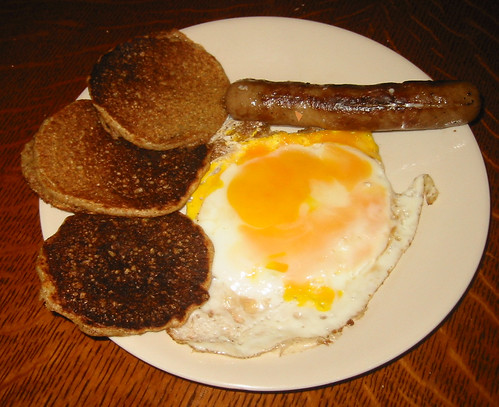
Our family has decided to kick off the Dark Days Challenge by making a local breakfast of pancakes, eggs, and sausage.


The eggs and sausage came from our Amish dairy source. Delicious, easy, and filling.

The pancakes were more complicated. Although the wheat was not grown locally, we bought it in bulk and ground it ourselves with a little human-powered grinder. (You can see which human we're talking about in that link.)


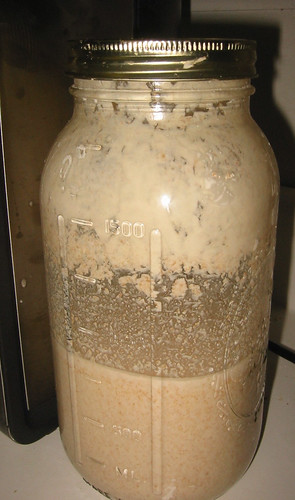
We then made a sourdough starter with that flour. The jar of starter lives on the counter of our very cold kitchen. We feed it regularly and when the half-gallon jar gets too full...


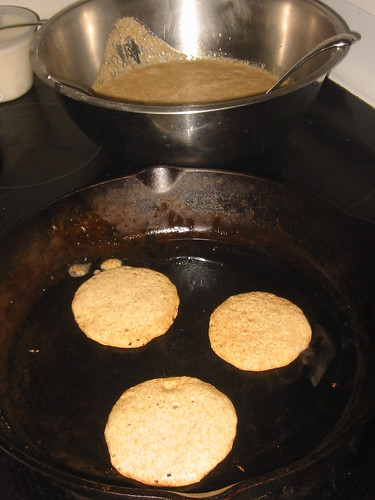
...we pull out a two cups of the starter, add sugar to taste (a tablespoon or two is our usual, depending on the cook) as well as three or four tablespoons of melted butter or oil. Throw in a pinch of salt. If the mixture seems too loose for pancakes, add enough flour to thicken it up a bit. If you like, stir in an egg, or some grated apple, or blueberries, or whatever. Then add a teaspoon of baking soda to the batter. You can dilute it in a tiny amount of water first or you can just pour it in. Stir it and let the batter foam for a moment as you heat up a skillet.

Remember those volcanoes we made in elementary school with baking soda and vinegar? These pancakes work on the same principle. The sourdough starter mixed with soda causes the release of gas which allows the pancakes to rise without baking powder.

The flavor is a bit different from "sweet" pancakes, but we think they are absolutely delicious with farmer's market maple syrup!

Sunday, July 27, 2008

Homegrown Mess

Our dinner came completely from our own garden.

To emphasize the DIY nature of the meal, we cooked it in our solar oven--making this almost a zero-carbon meal (except, of course, that fact that all the food was previously living and made of carbon).

We dug our very first little tiny pearls of new potatoes, then added our first-of-the-season tomato, a zucchini and a yellow squash, a few green beans, a chioggia beet, some yellow-stemmed chard, and a little basil.

It isn't the prettiest dish we've ever made, but I have never been prouder:

Sunday, July 20, 2008

Local Summer Eating

This week we made a delicious Cream of Purslane soup--made with the most abundant backyard weed vegetable in our garden. After steaming the greens, we pureed them with local cream (but you could use yogurt instead if you had some in the fridge), stock made from the week's vegetable peelings, and a little bit of salt and pepper, and garnished with backyard basil. We only discovered how much we love purslane a few years ago--and it serves a starring role in many a summer dish.


We continued the meal with zucchini (from our garden) cooked down in pureed tomatoes that we canned ourselves a few weeks ago. South Carolina rice, the grain that often anchors our homegrown vegetable dishes, served as the base.


For dessert we had a handful of blackberries. David and Son had gone for a bike ride to the adjoining neighborhood/town of Silver Spring right before dinner--and they passed the lovely little backyard farm of an older neighbor who sells fruits and veggies from his yard. The berries were tart and plump--my very favorite fruit and a marker of the height of summer.

Sunday, July 06, 2008

One Local Summer #5

My current vegan challenge is only about CAFO animal products, so while we're home, we still eat meat, milk, and eggs--all from "our" farm.

For this week's one local summer meal, we combined leftovers:

A beautiful salad of arugula, salad turnips, and radishes, all from our CSA, topped with fresh peas from the farmer's market...


...and fried rice with leftover with farm steak and South Carolina rice (both above-linked in their original dishes) combined with farm eggs, CSA radish greens, farmers market green onions, and our own garden's swiss chard. A real kitchen-sink meal that left us fully satisfied in almost every way.

Sunday, June 29, 2008

It All Comes Due

The farmer's market was ablaze with every beautiful summer fruit and vegetable you can imagine. Even a couple of nectarines and some non-hothouse tomatoes made their appearance. Blackberries (destined to be tonight's dessert), blueberries, and the last of the strawberries all called to me and filled our little cloth bags and plastic quart-sized containers. Homemade violet jelly and some delectably mild goat cheese also came home with us.

Our CSA share was also brimming with goodies. From kale to chard, from a few more blueberries to radishes and salad turnips, we'll be eating well all week.

Even our garden is going gang-busters, after a brief lull between the rapini-and-radish feasts and this new abundance. While our corn and potatoes are still a long way from being ready, we harvested our first zucchini, a handful of green beans and purple beans, and tons of mint and basil this week. The peppers and tomatoes have their first fruits ripening on the vine.

For this week's One Local Summer meal, we grilled--almost embarrassingly for the first time this season.

While drinking a dry cherry martini...


...we snacked on a few barely-steamed sugar snap peas.


After farm-fresh steaks, corn, and foil packets of potatoes and onions all grilled...


...we feasted on this all-local celebration of a meal:


What fun my whole family is having looking at everybody else's meals! We've gotten a lot of inspiration for our upcoming meals, too. Thanks, everybody!

LinkWithin

Related Posts with Thumbnails