Friday, March 26, 2010

Moving to the Foreground

Last weekend, the weather was glorious in the DC area. Several days of sun and warmth rewarded us for surviving the snowiest winter our region had ever seen.

Of course, the gorgeous days called us to the garden. This year we've decided to expand our gardening space to the front yard. The backyard garden, which has produced much for us, has gotten shadier and shadier as the years go by.

We decided to construct raised beds the easy way.

making raised beds

After laying out a design, we went to the lumber store and purchased 2 boards 8 feet long and 2 boards 10 feet long. We asked the store to cut 3 1/2 foot lengths off each board.

Because we have absolutely no skills, we decided to buy decking L's. I don't know what these are actually called, but they make it possible to create perfect right angles by sliding boards into slots. It made laying out the beds quite easy. (You can see the metal L's at the base of each corner.) We then screwed the tops of the boards together.

our garden

After an afternoon of work, we had all four beds laid out. There is a large space in the middle so we can have picnics, play in the grass, and enjoy the sun. We might put a table in the center. If we feel a need for more gardening space at some point in the future, we might construct a 4x4 diamond or something in the center.

We then lined the beds with cardboard we'd been collecting all winter. Many of the large pieces came from the cool refrigerator we recently purchased.

raised beds with cardboard

David always appreciates photos that show him to such advantage:

raised beds from behind

Our son, old enough now to be a big help in construction projects like this, was wiped out after an afternoon of work. He was very pleased to find new beds exactly where he wanted them:

new bed for napping

After his nap, our son soaked the cardboard down--using the leak in our hose as the main source of water distribution.

hoping to grow real boxes

After filling the beds with cardboard and watering it in so well, we're really hoping to raise some full-sized boxes by the end of the season... (Do you know Edward Lear's nonsense botany? I think he could draw the box plants better than I ever could.)

victory garden beds

Tomorrow, we're having 3 cubic yards of topsoil delivered. David plans to go with a friend to collect composted horse manure from a local stable to amend the dirt. And then soon, we will start planting spring seeds and then summer transplants. Here we are at the beginning of our own front-yard victory garden!

Thursday, March 25, 2010

Statistics

According to a new Harris Interactive poll, conservatives have some pretty strong feelings about Obama.

67% of Republicans think the President is a socialist, and 57% believe he is a Muslim.  51% believe he wants to turn over the sovereignty of the United States to a one world government.

Perhaps the most astonishing statistic is that 24% of Republicans believe that Obama "may be the Anti-Christ."  (Only 6% of self-identified Democrats believe he may be the Anti-Christ.  WHAT?!)

Be sure to check out some of the other lovely little tidbits at the poll site.

Wednesday, March 24, 2010

Nothing

I just finished Raj Patel's The Value of Nothing: How to Reshape Market Society and Redefine Democracy. What a great read!  I'll say straight up that while I am an academic historian, I know precious little about economics.  Luckily, Patel assumes his readers know, well, nothing--and yet he treat us as intelligent and thoughtful people at the same time.

He also has a sense of humor.  I loved the lightbulb jokes that showed his point.  I loved his pithy snippets of wisdom that pepper the book and had me reading lines outloud to my partner.  Best of all, he has FABULOUS footnotes--ones that simply support his textual comments but also literate inciteful ones that add depth to the comments he makes in the body. (Footnoting TS Eliot in an economic analysis? You get points from me.)

Before I read the book, I had heard that it was commie pinko drivel.  Well, with all honesty, that just does not condemn a book for me.  In fact, as a driveling commie pinko myself, that always makes me hope to find a soulmate.

But of course Raj Patel, while remaining a soulmate in many ways, is certainly not spouting radical leftist stuff.  He's talking in a more intellectual way (and perhaps a more thoughtful way) about more or less what Michael Moore was talking about in Capitalism: A Love Story: how unfettered capitalism can absolutely destroy true democracy.

I especially love chapter six. Here Patel talks about everything from the demise of the commons and the rise of accusations of witchcraft--to the creation of colonialism and the idea of the "savage"--to territorial use rights of fisheries. At other places in the book he talks about the politics of breastfeeding (a subject near and dear to my heart which also exemplifies many of his points). The whole book is a feast of ideas, combined with a critical thesis. Go, now, to your local independent bookstore or to your library and get thee a'readin'!

Tuesday, March 16, 2010

Cooling Things Down

or, Purchasing an Extremely Energy Efficient Refrigerator
...and reducing our electric bill by almost 40% overnight.


Since my partner David and I moved into our house a dozen years ago, we've been thinking about the day when we would have to replace the 1970 refrigerator. As the years passed, the old white Kenmore continued to work perfectly--but it was incredibly inefficient, using about 1800 kilowatts per year.

Because the refrigerator was relatively small and surrounded by cabinets, our choices were quite limited. Unless we wanted to redo that entire half of our tiny kitchen, we would need to stick with a super-small model. When we first started looking at our options...continued here

Thursday, March 04, 2010

The Unplugged Schoolhouse

During the month of March, my homeschooled son and I have decided that our "one small change" will be to pull the plug on all electrical use during at least one school day per week.

For a while, my family has celebrated--albeit inconsistently--a weekly powerdown evening where (after the meal is prepared) we spend the rest of the evening together without using electricity. We light the table with beeswax candles, spend time together reading aloud and playing recorder trios and just talking, and go up to bed on the early side. I hope we will get back in the habit this month.

For our unplugged schoolhouse, however, the challenge will be a bit different. My son and I plan to turn off any lights as well as the laptop by 8:3O or 9 am, depending on when we wake up. Everything will stay off until 3:30 or 4. Although these are traditional school times for many children, most of that time is not actually "school" for us. Instead, it is time for music practice, free reading, yoga or running around outside, and other pursuits such as knitting or drawing or folding paper airplanes. (My son would add that his chore of taking out the compost also falls during this time.)

We're honestly fairly removed from a lot of plugged-in entertainment compared to many families, I guess.  We don't own a TV or some game system or anything like that. But significant amounts of our days disappear to the hungry soul of this laptop. We've fallen into the habit of using it as a teacher sometimes--especially enjoying things like Thinkwell and the free Hippocampus. My son loves to watch old Pink Panther cartoons and Buster Keaton movies--as well as Myth Busters--on Netflix instant-watch.  Not that these things are bad; they certainly aren't occasionally.  But too much always seems to leave us further removed from any real-life connection than I think either of us wants.

A powered-down homeschool day also forces us to get out the solar oven and cook in the sun at least one lunch a week.  On days that are very cloudy, we'll have cold sandwiches.

By not starting the day until 8:30, I can make a pot of tea for myself and encase it in my homemade recycled-sweater tea cozy to keep it warm for a while.  Cheating?  Maybe.  But a hot beverage seems to be the only way I can stand freezing our buns off this season.

We're allowing ourselves the liberty of deciding which day to celebrate the unplugged schoolhouse.  Mondays are our free day.  When we are home, it will be ideal.  But we do sometimes go on adventures in downtown DC on Mondays and would therefore be mooching off a museum's electrical supply.  On Tuesdays, my son has a piano lesson at home.  The room with our piano is one of the darker rooms in our house--and our deal is that if it is a cloudy day, it will be perfectly acceptable for my son and his piano teacher to turn on the light in that room during the lesson.  This Tuesday was our first day and although it was cloudy, neither bothered to turn on the lights when they walked in the room.  (The teacher has no idea about this game, by the way.)

Just like last month's small change of not eating out, this day of powerdown is not something I imagine keeping rigidly for the rest of our lives.  Instead, I hope that this month will get us in the habit of relying on ourselves rather than our devices--and making us more conscious of the role of electricity in our lives all the time.

Anyone want to join us?

Wednesday, March 03, 2010

One Small Change: Eating In Recap

Last month, my "one small change" was to eat dinner every night at home. The month was quite a success--more than I could have predicted.

There were a few rough spots, but not many. On one afternoon, I was craving take-out pizza as we came home from a day at the Smithsonian museums, but by dinnertime we were ready to spend the effort for a home-cooked meal. On the night where I could just not stand the idea of cooking at all, my partner David took over the complete preparations.

One evening, our 10yo son served us a lovely candlelight dinner. He played both chief cook and waiter. He was even the evening entertainment, serenading us with his violin. (He did not play the role of chief bottle-washer, unfortunately.)

We went to a party at friends' house one evening where we had vegan take-out from a locally-owned Middle Eastern restaurant in town. It was yummy and we did not feel like we were cheating at all. There is something about time with friends that changes all the rules.

On the last night of the month, I stayed home recovering from a stomach bug while my fiddling son and his Papa went to a local Scottish pub for a children's Irish music session. (As odd as it sounds, I suspect Irish and Scottish pubs in this country probably do a lot of crossing over....) Like eating at our friends' house, this meal seemed right, even though it technically broke the rules.

So what is it that made these seem like times to bend our self-imposed regulations? I think it is because both times we were after something special--not just the default position. A special event, a time of togetherness, a celebration--these are things I do not want to miss as time goes forward. Even a special meal--be it a cuisine I've never tasted, or a meal at a new downtown restaurant in our little inner suburb, or a feast at an organic or local restaurant--could certainly count. We have no intention of continuing this "one small change" in its extremity--but it has set us up to be more deliberate about our choices.

Of course, when I began to eat again after my stomach bug, it was March--and we immediately went out to my favorite Pho soup restaurant. (David chose a vegan dish, mostly to avoid what is probably CAFO meat. Sometimes, especially in the face of Pho, he is simply a better person than I am.)

I knew I had soul-mates on this eating-in journey, but I had no idea how many I would find. As I mentioned before, my initial inspiration came from The Conscious Shopper--but during the course of February, I also discovered Cathy Erway's blog and also her brand-new book The Art of Eating In: How I Learned to Stop Spending and Love the Stove. To celebrate the release of the book, Huffington post sponsored The Week of Eating In--which drew an enormous number of other folks to the same challenge I was setting for myself. And what I thought might be a challenge that could isolate us introduced us to a whole new online community!

Tomorrow: One Small Change for March.

Monday, February 22, 2010

Cherries in Winter

When magazine writer Suzan Colon lost her job as the economic crisis came to a head, she found something even more wonderful to replace it: a beautiful life, and a brilliant and thoughtful idea for a book:Cherries in Winter: My Family's Recipe for Hope in Hard Times.

The book--a quick read with print large enough even for those of us who just might be starting to need bifocals--revolves around how Colon's family history sustains her and inspires her through times of trouble.  While they cook classic family recipes, Colon's mother tells her stories about her family's past.  And then Suzan finds the writings and recipes of her "Nana" Matilda, who created a life during the Great Depression and WWII years with strength and verve.  The lesson that Suzan Colon uncovers from her family allows her to recognize her own ability to weather the storms occuring in her own life.

Cherries in Winter is a lovely and relaxing book--but it isn't the perfect read in all circumstances.  Clearly, it is not a political or analytical discussion of the economic crisis.  Neither will it make much sense to anyone who has struggled with any real poverty or hunger.  She and her family have plenty to live a comfortable life--just not the upscale life they had led before (of $200 haircuts and fancy meals).  A husband with a job and a substantial savings account protect them. 

But nevertheless, the shock and the changes for Colon's family have been very real.  As the author says, "I used to tell my parents they'd never have to worry about their old age, that I would take care of them.  Can I say that now?"

Of course, many people have weathered  much worse during this crisis--and many had faced more difficult situations even before the recession started.  If you are expecting a guide through any substantial struggle, this is not the book for you.  Instead, it will probably appeal to those of us who have been required to cut back on our luxuries but are still doing OK--and those of us who have chosen a simpler life during this time (or before the economic crisis began).

There are several recipes in addition to the gentle storytelling.  None really inspired me to cook them, but they did make me think of the foods that had been passed down to me in the history of my own family.

The title of the book, Cherries in Winter, is the author's articulation, handed down from the matriarchs of her family, of the idea that very occasional and very special treats can help us maintain a sense of balance: the importance of "spending extra, just once in a while, where there is no extra to be spent.  Because."  Why?  "It's a deep breath reminding us not to become miserly in spirit.  We may be broke but we're not poor."

What is your extravagance, your "cherries in winter"?

In the end, Colon recognizes her bounty: "It wasn't at all bad--sometimes what looked at first like more rotten luck turned out to be fate's little crooked smile."

I highly recommend this light but thoughtful book as the thing to pick up as you relax with a cup of tea in front of the fire--or as you sit in your garden on a warm summer day (a day I am dreaming about through this cold and snowy winter).

Tuesday, February 09, 2010

One Small Change: Staying Home

Last month, my "one small change" was to take reusable containers with us when we were out of the house.  We were very good about making sure we had not only our stainless steel water bottles or coffee cups as well as cloth bags with us--perhaps because these have been habits for years.  But this month we were much more consistent about bringing utensils, cloth napkins, and even tiffins or lunchbots with us when we went to restaurants, so we could pack away our leftovers.

This month, inspired by the Conscious Shopper, our goal is to avoid going out to restaurants at all.  For a long time we've been committed to spending the majority of our restaurant dollars at locally-owned places--but for this month, every dinner will be cooked and served at home.

This one small change will dramatically reduce our wastes, potentially reduce our waists as well, definitely lead to healthier meals, lead to a healthier pocketbook, save a bit of gasoline, and give us some extra family time to boot.

I'm a bit late getting this post up--but that simply means I've already had a week on this challenge.  Although I did have one evening where I was craving pizza and a movie, we survived on leftovers and a movie instead.  One of the keys to success seems to be to have the makings for both easy throw-together meals and meals that satisfy the foodie in me.

Although many people swear by having a fixed menu plan, I really like having a list of meals for the week, then stocking the fridge and pantry with those ingredients so we can have the flexibility to choose each afternoon or evening what we would like to prepare.

Things have been really easy for the last few days--since we've been snowed in!

We've set ourselves this challenge just for the short month of February.  We have no intention to keep ourselves completely out of restaurants after the month is over--but I want us to learn from this one small change to keep eating out special--to always be conscious of the choice rather than have it as a default when we're tired.

Monday, February 08, 2010

Snow!

Here in the Mid-Atlantic, we've been buried with more snow than I have ever seen:

Snow!
Our house

Snow!
Our street

Snow!
Out the front door

Snow!
Out the back door

Snow!
A path!

Snow!
But where do we put it?

Snow!


*  *  *

The forecast calls for a new storm to begin tomorrow afternoon--and bring us 5-10 inches more snow...

5pm UPDATE:  The National Weather Service is now saying 10 to 20 inches of additional snow.  Yikes.

Sunday, January 31, 2010

Beating Hearts: The Humanist Symposium


As you might guess from the title of this blog, I am a bit obsessed with Edgar Allan Poe.

Imagine my surprise when I began to read through the submissions for this week's edition of the Humanist Symposium and came across Michael Campbell's clever post, "Edgar Allan Poe Should've Read Carl Sagan." Quoting from Poe's "Sonnet: To Science" (Why preyest thou thus upon the poet's heart?), Campbell points out that it is pure nonsense to imply that science and its emphasis on reality steals all beauty from life. Instead of imagining that science kills poetry, we should open our eyes to see the majesty of the cosmos. At the same time, Campbell acknowledges that poetry has a special beauty of its own, one that depends on its subjectivity to reveal "the complex nature of what it means to be human." (Those of you who want to redeem your faith in Poe might want to check out this essay which addresses the question of Poe's potential humanism/atheism.)

Steven Handel suggests that it is precisely this "poet's heart," beating solidly in each human, that gives our lives meaning. As he writes, "In some sense I find that creativity in humans is just as important as our need for air. What we express through art can give us our first sense of worth and purpose." After a thoughtful discussion of the ways creativity can enhance our lives, he offers many ways to be express one's inner life even for those of us who don't think of ourselves as artists.

In a fascinating essay over at Daylight Atheism, Adam Lee anazlyzes how creativity can be stifled by fundamentalism. He reviews a book about Christian pop culture and learns about the Christian version of Woodstock, called Cornerstone. One of the long-time participants at the music festival eventually abandoned his religious faith--as has a prominent Christian comedian. Lee argues that since "evangelicalism is a creed built on certainty and on having all the answers," it is incompatible with true and honest expression. In order for the poet's heart to beat, it "requires self-doubt, introspection, and self-questioning."

Recently Greta Christina headed out to the Edwardian Ball, where a weekend-long celebration of poet/author/artist Edward Gorey is a place where "Goth, steampunk, ballroom, and historical recreation society scenes collide in a magnificent explosion" complete with "live music, ballroom dancing, costumes, art, exhibitions, absinthe cocktails, trapeze performances, weird taxidermy displays, and more." (Now this is an event I am sure Edgar Allan Poe would not want to miss.) What Greta realizes is that, as she says, "the Edwardian Ball is a near-perfect example of what I think of as the atheist meaning of life." Go read her wonderfully-written and inspiring post.

* * *

Of course, having a heart isn't just about personal expression and creative exploration. It is also about kindness and caring about all of humanity. There is a long history of people arguing that people who do not believe in God cannot be good people. As Ophelia Benson points out that old line of attack is still alive and well. She quotes an inflammatory article in the National Catholic Register which asks, "Why is other human life worth anything if there is no God?" Most humanists would argue that valuing human lives happens simply because we feel empathy and connection with all humanity. When you click through to Butterflies and Wheels, make sure you don't miss that great conversation going on in the comments.

Sometimes the critiques of non-believers feel mean-spirited. But at other times, we can tell our best interests are fully in the hearts of those who confront us.  Hemant Mehta (The Friendly [and Handsome] Atheist) shares with us a beautiful and hilarious letter to a young atheist from his Christian grandmother.

* * *

Edgar Allan Poe wrote (in the sonnet mentioned above) that science is all about "dull realities." While he was wrong that science is dull and cannot show us beauty, he was correct that what is at the heart of science is reality--that is, what can be measured, what can be studied, what can be observed. Several of this week's posts concern this issue.

Secular Guy points out that it is totally unnatural to believe in the supernatural. As he says, "Isn't accepting the universe on its own terms more realistic than trying to change it by fruitlessly praying for miracles?" As the Secular Guy's wife argues, embracing the natural can set us free.

One way we can be set free is to recognize that our social conventions and beliefs hold us back from acknowledging scientific research. Andrew Bernardin chronicles how students in his class are asked to take sides on a heated issue (same-sex parenting) and use information from a textbook to support their positions. Invariably, many of the students attempt to use their own experiences and beliefs instead to back up their ideas. Bernardin finds himself saying again and again, "While that sounds true, is there any research that supports it?"  And now, new research has come out!

Russell Blackford presents a thought-provoking review of Robert Wright's The Evolution of God. Although Blackford makes it clear that the subject is fascinating and that the writing is compelling, he is disturbed by Wright's repeated hints that "the narrative of religion's cultural evolution may be evidence for something divine behind it all." At times, that "divinity" seems to refer to Natural Selection. At other times, it is "just something [still] unknown to us, something of great significance that stands in relation to us, who are ignorant of it." But Wright is being intellectually dishonest--or perhaps disingenuous: ignorance and imagination does not a God make.

David Michael tackles the same kind of question by asking what will happen to religion in the future. "Religion probably originates either from a desire to grasp the ungraspable and control the uncontrollable," he writes, "or to gain political power, or some combination of both." He predicts a future world of more interaction and more debate--and therefore less rigid orthodoxy. The consequence will be less powerful religion. As David Michael says, "In a post-religious world the appealing myths of religion will seem only that: appealing, and nothing more."

* * *

Finally, you can't miss the generous heart of Chanson. She writes a post about attending a fundamentalist Mormon service and getting to know a group of people with beliefs and practices very different from her own. When meeting a "sister-wife" (in a sea of folks dressed as pioneers) in a polygamist family, Chanson stammers a bit and "explained to her that I was visiting the AUB church because I wanted to learn more about my Mormon heritage." Chanson continued that her great-great-great-great aunt was one of the wives of Joseph Smith, founder of Mormonism. Looking back, says Chanson, "I figure I was either motivated by a pathological desire to fit in under any circumstances or I’m secretly proud of my strange Mormon-history claim-to-fame and figured that if anyone would be impressed by it, it would be the polygamists."

* * *

If you still have it in you to read a bit more Poe, make sure you check out my favorite piece of his, The Tell-Tale Heart.

* * *

The next Humanist Symposium will be hosted on Feb 21, 2010. You can find more information at Daylight Atheism or over at the carnival homepage. And if you are interested in hosting an upcoming Symposium, email ebonmusings at gmail dot com.
Friday, January 29, 2010

In the Pot


One of the presents I received for the holidays was a beautiful 4.5 quart enameled cast iron Le Creuset French Oven (usually called a Dutch Oven in this part of the world).

As a big fan of both non-enameled cast iron skillets and slow cookers, I had a feeling that this would be a pot I would love.  And I certainly do: the "French Oven" holds heat tremendously well, it is naturally nonstick (more or less), and it looks absolutely beautiful sitting on the stove or on the table.

Some people love all the bright colors that Le Creuset comes in--but as a confirmed plain-jane, I'm ecstatic about onyx (pure black) and dune (off-white).

* * *

In these cold days and in our cold house, stews and braises feel just perfect. I scoured the library for cookbooks and found several--and know I can adjust slow cooker recipes as well. I'm looking forward to more experiments with this pot.

I also found an interesting cookbook called Glorious One-Pot Meals which uses a technique very different from slow braising. Instead, you layer raw ingredients into the pot, cover, and cook in a very hot oven for forty-five minutes or so.

The technique, which author Elizabeth Yarnell calls the infusion method, is incredibly convenient. All the cook needs to do is chop the ingredients, layer them in the pot, insert the pot in the oven, and head to the couch with a glass of wine and some good company to await the glorious smells which will soon emerge from the kitchen.

The recipes in Yarnell's book are all fairly vegetable-heavy.  As a confirmed veggie fanatic who loves to cook but hates to clean up, I thought I might have found a perfect match with this book.

After cooking a few dishes, though, I am only partly convinced.

While the meals are easy to put together, easy to clean up, and in general quite healthy, they sometimes are a bit pedestrian in their flavors. Although Yarnell takes inspiration from a variety of ethnic cuisines, the recipes are all substantially Americanized--or perhaps "Mid-Westernized" would be more accurate.  Fine--I can spice things up to my own tastes. And pedestrian is just fine for most of our weeknight meals, anyway.

The larger problem for me is that the individual ingredients don't always need the same amount of cooking time, even though by definition that is what they get in this cooking method. Last night's meal (Argentinian Beef) featured both mildly crunchy rice and somewhat limp broccoli.  Perhaps the special South Carolina-grown rice I used had too much bite for this cooking method?  I plan to do a bit more experimenting to see what will work.

One of the things I do like about the cookbook is that while it offers plenty of recipes, it also emphasizes the wide range of possibilities this method makes available to a cook adventurous enough to try out his or her own combinations.  The author actively encourages the reader to imagine new possibilities.  What if I were to skip the rice and add a few root veggies instead?  What if I were to replace the broccoli with mustard greens?  In fact, for tonight's meal, we'll be replacing chicken with some tempeh we've had in our freezer for much too long.

On a cold day, a hot stew coming out of the dutch oven can be just the thing to make us warm.  But having stew after stew, night after night, can get old.  Yarnells's Glorious One-Pot Meals are recipes that are not simply more stews. Although the ingredients are all cooked together, they in general remain quite distinct.  This makes for a nice variation from usual Dutch Oven recipes.

Another thing I really like about the cookbook is that the recipes are written for just two people.  For our family of three, I usually double the recipes (which the author encourages) and pack leftovers for lunch the next day.  But cooking a single recipe--and augmenting with salad or soup or dessert if we need to--might make a lot of sense for us sometimes.

So, in summary: although I do have some reservations about this cookbook, it seems like it will add ease and variety to our basic no-time-to-think weeknight meals.  We'll probably use some of the recipes for nights when we do have time, too.  But I don't foresee this being a go-to cookbook for special meals with company.

Have any of you tried out this book?  Do you have other favorite cookbooks or recipes for the Dutch Oven?

Monday, January 25, 2010

A Young Omnivore's Dilemma

A guest post by my 10yo son Abe, who has just started a new blog. Check out his beautiful first post over there!


The The Omnivore's Dilemma talks about four meals the author eats that can teach us about the different ways food is produced and eaten in the United States. I read the new version for young readers, The Omnivore's Dilemma for Kids: The Secrets Behind What You Eat.


First, the fast food meal.
For his first meal, Michael Pollan ate the classic fast food meal, a hamburger. But what a hamburger means now is very different from the what it used to mean. Farmers get paid very little and aren't always treated fairly. Both chickens and cows often live in feedlots where they are tightly packed together and often kept in the dark. It turns out that cows are not even eating grass anymore. Instead, they now eat corn. And the corn they eat is sprayed with harmful chemicals. Cows eating corn is not healthy for cows and is not healthy for people who eat hamburger, either. One of the problems is that when a cow eats corn, a type of harmful e-coli can develop more easily. The bacteria live in the meat and can kill people who eat it.  Raising food this way is also harmful to the environment.

Second, the industrial organic meal.
For this meal, Pollan cooks only with organic ingredients—that is, foods that are grown without pesticides and chemical fertilizers. With meat, the situation is often the same as above, except the corn is not sprayed. When you eat organic vegetables, you can guarantee that fewer chemicals get in your body. So organic is definitely a step better than the conventional fast food meal. But the way the animals are raised is still a problem and the ways workers are treated also needs fixing.  Also, the food has to be shipped a long way from where it is grown, meaning it requires a lot of oil to get food to the grocery store.  This is bad for the environment.

Third, food grown on a farm.
Joel Salatin calls himself a grass farmer. His cows feed on grass and weeds in the farm's large open pastures. The cows' manure attracts flies and then his chickens eat the flies as natural protein. The manure also feeds the grass and weeds which his cows eat. It is a natural circle that continues without any pesticides or fertilizers or food grown elsewhere. Salatin’s farm Polyface is near DC. I have friends who get their meat from there. Michael has friends that live near Joel’s farm too and so he travelled there to cook a meal for them. On the menu was applewood-smoked BBQ chicken, roasted sweet corn, arugula "rocket" salad, and a chocolate soufflé. This sounds so delicious!  Pollan knew the animals on the farm had lived a good life, the workers there were treated well, and the food was healthier.

Fourth, a hunter-gatherer meal.
For this meal, Pollan only served food that was hunted, gathered, or grown by someone he knew. Angelo Garro is an avid hunter and mushroom gatherer who also fishes and gathers wild plants like fennel. Michael hunted boar with him and also went mushroom foraging. He then held a party and almost everyone who came brought something they had created themselves from special ingredients they found or grew.  I like the way the author talks about how connection with the food we eat means our meals become special.

*  *  *

This book talks about how the food system works. It explains how much is bad and how we can start to fix the problems.  I thought the book was really inspiring.  I knew a lot of the information already from my parents (who read the grown-up version when it came out), but reading this book myself really pressed the information home for me.  Now I often don't order eating meat at a restaurant if I think was raised on feedlots.  (Though I still love Vietnamese Pho soup....)

I highly recommend this book to young readers, as well as to anyone who doesn't have a lot of time or background about food issues.

Friday, January 22, 2010

In a Pickle

I am very excited about participating in the Tigress' Can Jam this year.

Click for tigress can jam food blog challenge

Participants can one fruit or vegetable a month throughout the year--and this month's choice is CITRUS.

* * *

I have a lot of excuses for not getting it done yet. Really. And some of them are pretty good. Yep.

But nevertheless, the citrus is whole and the jars are still in the box, and they are going to be staying there all day. Instead, I will be rushing around to meet the requirements of a day filled with activities and a special evening occurring at our house.

In short, I am in too much of a pickle to can jam today.

Instead, I am preparing my canning fiesta for tomorrow, using a recipe for spiced oranges from The Joy of Pickling, Revised Edition: 250 Flavor-Packed Flavor-Packed Recipes for Vegetables and More from Garden or Market.

Citrus in a pickle? An experiment too hard to resist!

Thursday, January 21, 2010

No Waste, but Lots of History

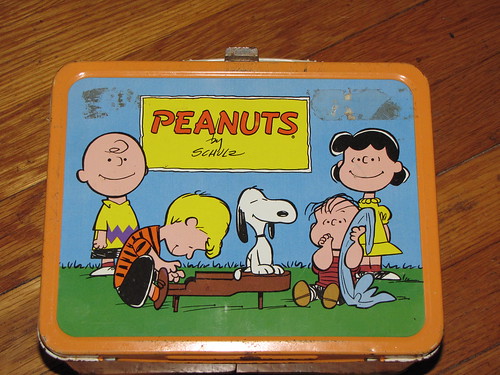
I recently dug out my childhood lunchbox, decorated with Charlie Brown and Lucy (and even the only cartoon character I ever had a crush on, Schroeder the pianist)--and marred with a few dents, a little rust in spots, and some tape that used to secure my name to the lunchbox:

lunchbox

This was a Hanukkah gift for my partner David--not for our son who is homeschooled and therefore only packs a lunch occasionally

I filled the Peanuts lunch box present with cheerful Graze Organic bags, a product my son and I fell in love with when we spotted them on Fake Plastic Fish

For lunch today, I filled the bags with a cheese sandwich, some pretzels left over from our travel snacks, some carrot coins, a little pack of organic raisins leftover from our Halloween stash, and a napkin.  I think a clementine made it in the box as well.

lunchbox inside

The lunch bags are made from unbleached organic cotton, printed with water-based inks, and contain no plastic except for the velcro closure. Of course they aren't the right packages for the leftovers that usually go with David for lunch--but they are fantastic for adding to the retro-schoolkid-lunchbox to hold basic sandwiches, grapes or cherries, cherry tomatoes, carrot or celery sticks, pretzels, or treats like cookies. They can go in the washing machine but usually are fine after a good shake or a bit of spot cleaning in the kitchen sink.

Packing your own lunch is the easiest way to TakeOutWithOut--especially if you are trying to stay out of restaurants...

*  *  *

David happily carried the lunchbox to his work--a federal government office filled with health care professionals.  I can't wait to hear the reaction!

Wednesday, January 20, 2010

School Gardens and the Seeds of Change


Poster uploaded by Joan Thewlis


Have you seen the critique of school gardens published recently in The Atlantic?

Imagine that as a young and desperately poor Mexican man, you had made the dangerous and illegal journey to California to work in the fields with other migrants. There, you performed stoop labor, picking lettuce and bell peppers and table grapes; what made such an existence bearable was the dream of a better life. You met a woman and had a child with her, and because that child was born in the U.S., he was made a citizen of this great country. He will lead a life entirely different from yours; he will be educated. Now that child is about to begin middle school in the American city whose name is synonymous with higher learning, as it is the home of one of the greatest universities in the world: Berkeley. On the first day of sixth grade, the boy walks though the imposing double doors of his new school, stows his backpack, and then heads out to the field, where he stoops under a hot sun and begins to pick lettuce.

The author continues that schools should never be "a venue in which to advance a social agenda." They should not try to teach self-sufficiency in the growing and eating of healthy food. She suggests, although rates of diabetes and heart disease are astoundingly high among inner-city communities and others living in poverty, the "suicidal dietary choices of so many poor people are the result of a problem, not the problem itself." Instead of teaching students about gardening and cooking, "the solution lies in an education that will propel students into a higher economic class, where they will live better and therefore eat better." Therefore, the only question educators should consider is "What are you doing to prepare these kids for college?"

At a certain level, I agree with the author: poverty is the problem at the root of so many of our society's ills. And I also agree that the answer to addressing poverty goes way beyond school gardens.

But honestly, addressing poverty also goes way beyond trying to send all students to college.

Students raised in a family and community with less than they need often struggle in academic settings. Yes--college is absolutely a way out of poverty for exceptionally bright students who can fight against the odds. But poverty also prevents many just reasonably bright students from succeeding in academia, no matter how much their teachers drill them in test-taking skills or even teach them great literature. This is terribly wrong--but it is true none the less. Those of us who grew up middle class with educated parents often have an easy time in the classroom, even if we're NOT reasonably bright.   And honestly, not all students (and this has nothing to do with whether they are poor or rich) should be told that college is their only option for creating a productive life.

While school gardens might not solve the problems of poverty, I do believe that they begin to address far more than just the eating habits of students.

Berkeley's Edible Schoolyard is located at a school with a high number of brand new immigrants who speak little or no English yet. While learning English can happen in a classroom with a textbook, language also gets learned in real life when students of many cultures come together in a more relaxed place to grow, cook, and eat food together. They share their native plants, the recipes of their cultures, and their traditions of hospitality. This makes for a place where people can both appreciate each others' differences and see each others' similarities.

For those students who do struggle in the classrooms, the garden offers a place where learning happens in a different fashion--just as the art classroom and the music rooms can. Should these subjects be offered completely INSTEAD of teaching a skill that (as the author states) clearly "improves a child’s chances of doing well on the state tests that will determine his or her future"? No--but leaving these other subjects completely behind--and suggesting they are not at all valuable as real education--denigrates those who now create their lives in fields like these. And of course denigrating the growing of food means that that farmers will never be paid enough or respected enough. It is a vicious circle.

As our world moves rapidly into a time when we have to confront both climate change and severe resource depletion, it seems likely that farmers will be in great demand and treated with much more respect than they have been recently. All students--those who have grown up in families of farmers and those who have grown up thinking food comes from Wal-Mart, those who are living in poverty and those who are living in McMansions--need to know about how sustainable agriculture works.

Barbara Kingsolver approached these issues long before the author of the Atlantic article wrote her inflammatory attention-seeking piece:

The baby boom psyche embraces a powerful presumption that education is a key to moving away from manual labor, and dirt--two undeniable ingredients in farming.  It's good enough for us that somebody, somewhere, knows food production well enough to serve the rest of us with all we need to eat, each day of our lives.

It is our disconnect from growing food and our disrespect for the manual labor that sustains us that leads Americans to, as Kingsolver says, "consider the food industry to be a thing rather than a person. We obligingly give 85 cents of our every food dollar to that thing, too--the processors, marketers, and transporters." The corporatization of our food supply and the high degree of food processing have made farmers almost invisible. If we were more educated about the process of what farmers do to grow our food, perhaps we would "want to compensate or think about these hardworking people."

* * *

So my family plants a few seeds in our tiny garden--partly to produce a few treats here and there and partly to remind ourselves of the skills and labor of those who grow more. We have a CSA share and we meet the amazing growers who work there. We shop at the farmer's market in order to remind ourselves that the food we grow has been nurtured by human hands.

My homeschooled son jokes that this is our own school garden, our own edible schoolyard.

Tuesday, January 19, 2010

Keeping Warm in the Winter

We keep our house on the chilly side during the winter.  We all wrap up in layers of knitwear to keep warm.  We moved our microwave (which we rarely use) upstairs for the winter so we can heat up cherry-pit warmers.  We keep so many blankets and quilts on our bed that it sometimes feels the weight will crush us.  And I have even been known to sleep in my gloves.

Last year we replaced the windows downstairs with extremely efficient windows, and we plan to replace our upstairs windows this year.  That will make it a little safer to turn the heat up a bit.  Until we do it, I wonder if our heater single-handedly causes global warming whenever we turn up our heat--since every bit seems to seep out into the world and heat the outside as much as the inside.
 
Often during the night I scoot closer to my partner David, a source of both emotional comfort and physical warmth, as I shiver in and out of sleep.  As I was commenting yesterday that when we sleep closer together we're so much warmer, he pointed out that this was not quite true:  "I move closer to you because I love you, but moving closer to you means getting COLDER!"

Monday, January 18, 2010

Peace and Justice

reposted from 2007


"Returning violence for violence multiplies violence, adding deeper darkness to a night already devoid of stars... Hate cannot drive out hate: only love can do that."  
--Martin Luther King

"What difference does it make to the dead, the orphans and the homeless, whether the mad destruction is wrought under the name of totalitarianism or the holy name of liberty or democracy?" 
--Mahatma Gandhi


*  *  *

During the 1950s and 1960s, my parents were involved in the Civil Rights Movement in the town where they were then living. I grew up hearing stories about my father passing out candy bars to protesting African Americans sitting down at the segregated lunch counter at the drugstore. For this, his graduate school took away his fellowship.

I also heard stories of my father's father and his critiques of the Ku Klux Klan. He believed they were cowardly for hiding their faces when they should be proud of what they believed and fought for.

What a long way my father came from how he grew up.

I grew up with images of people wearing their Sunday best, proud and strong, marching peacefully to express their refusal to accept segregation--and images of those same people being sprayed to the ground by fire hoses strong enough to peel bark off trees. The hoses were held by police officers. Whenever people told me that policemen were our friends, I cringed.

I sang with my parents on every long car trip, learning the words to many many freedom songs, including a few turned-around verses written by the few liberal white southerners in the movement: "If you miss me at the front of the bus, I'll be sitting in the back...."

* * *

Yesterday we watched as our community celebrated Martin Luther King day in the way that seems to be becoming the traditional commemoration in the United States: rather than a day committed to justice and nonviolence (which one might expect and want), it is a day of service (which seems less edgy or dangerous, I suppose).

The service projects in the DC area that accepted children as volunteers all seemed to be more about making the kids feel connected and enjoy their experiences than actually get anything substantial done. We went to a Day of Service fair that sometimes just felt like a make-crafts-with-plastic-crap festival. In my cynical mood, I walked around the noisy hotel ballroom, frustrated that the charities represented there were not even allowed to have posters explaining the point of their organizations. Making dice out of recycled boxes or making decorations for a party to thank donors to the Republican party basically cannot help me memorialize Martin Luther King.

And then, as usual, fiber stopped me in my tracks.

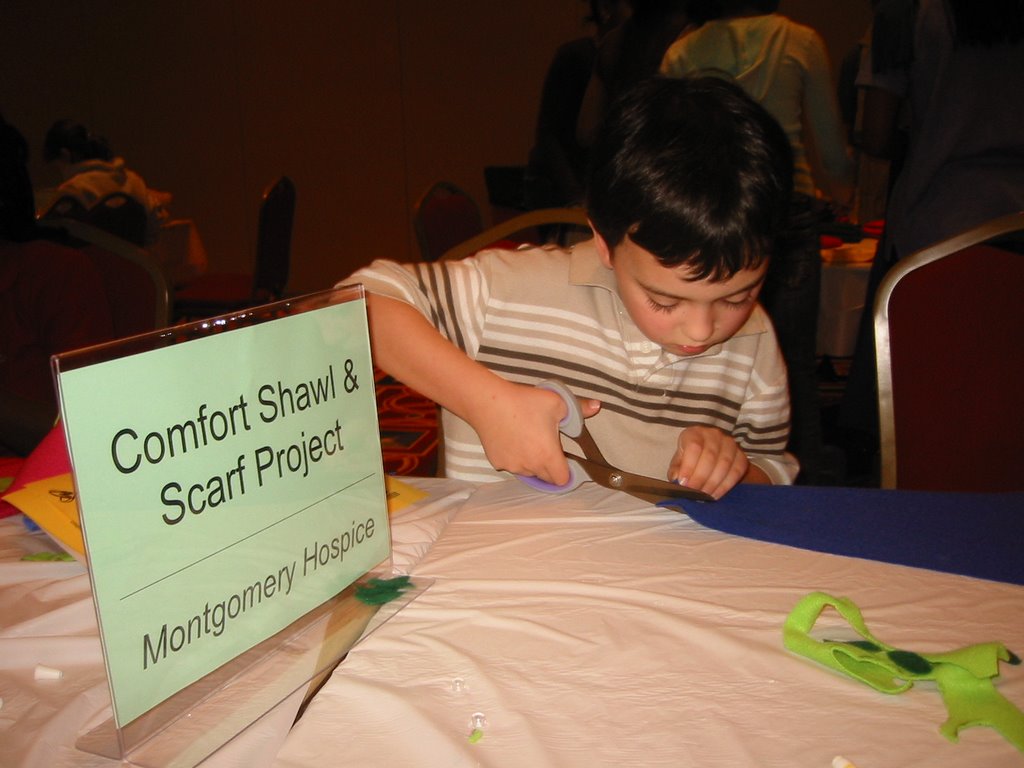
Using the idea of the prayer shawl ministry where volunteers knit shawls for people in need of comfort and prayers, the local hospice program decided to have volunteers decorate fleece shawls to offer to the hospice patients and to their family members "to wrap them in the comfort hospice can provide." I sat down with polar fleece, scissors, Red Heart yarn, and a needle barely sharp enough to pierce the fabric--and started to cry. After I made mine, Son came to start one as well:


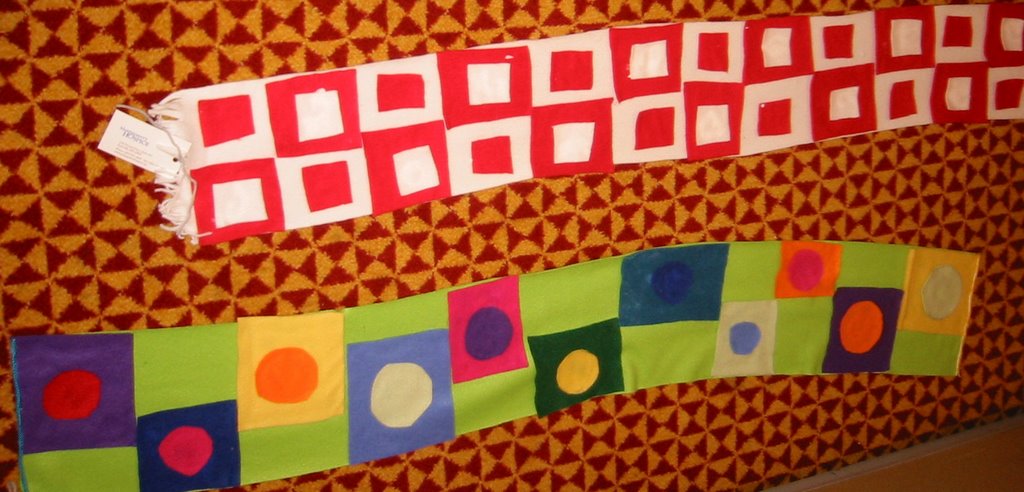
Some people made really elaborate scarves:


I then made a flower from tissue paper for the a local shelter for abused and homeless women including those with families. The flowers would be used by the children there to help them prepare corsages for Mother's Day. Can you imagine what it must be like to be spending your first Mother's Day in a shelter because you were a brave enough and strong enough mother to take yourself and your children away from a batterer?


Do the fleece-and-sequins-and-glue shawls or the tissue paper flowers really do any good in the world? Perhaps not. But despite my reluctance, the process of making them DOES do a lot of good in the world. Making those of us with plenty feel connected to the incredibly deep needs of others may be more important than anything we could actually do for people in need in just an hour or so. It is not their lives we change but our own. (And of course, most of us are both "us" and "them" at various points in our lives.)

And now I am off to finish a scarf for Food and Friends, cast on a scarf for the Orphan Foundation's Red Scarf Project, and finish plans to put together with my family an afghan for Afghans for Afghans. Anybody want to join me?

* * *

After we left the hotel ballroom, we stopped by our favorite movie rental place to pick up an episode or two of Eyes on the Prize, the phenomenal documentary about the Civil Rights Movement. The video store did not have it (and I've now put it on hold at the library) so we went back to one of MLK's roots and checked out Gandhi. Although I know it would be made differently now and has some factual problems as well, we were all overwhelmed with the power of the movie.

The two moral centers of my personal universe are honesty and pacifism--although I constantly fail at my efforts to be an honest person who never relies on violence--even verbal violence--to win my way. (Perhaps the fact that these are weaknesses is why I am so committed to the ideals?) I completely realize that people's ethical commitments can vary tremendously and even completely conflict with each other, and both people can still be very ethical people. So please, if you don't share my pacifist beliefs, understand that I realize that this is my own path and not necessarily that of my readers.

I believe that force can never win true and lasting change. I believe that violence cannot create a world based on respect and peace.

Nonviolence is not just an ethical practice. It is a successful strategy. Ghandi talked a great deal about how the nonviolent soldier had to be just as committed to engagement and just as prepared to lay down his or her life for the cause as any military soldier would be. Instead of accepting domination, fight by refusing it, both in small ways and large, symbolic ways and tangible ones.

Gandhi, resisting the dominance of the British markets, encouraged Indians to reconnect to skills that could insure their independence. When the empire required that salt be bought from Britain, Gandhi marched to the sea and made salt. When the empire required that cloth be bought from Britain, Gandhi mobilized an entire country to spin their own thread and weave and wear homespun garments. (Ah yes, it all comes back to the fiber arts.)

When faced with violence, don't turn back. Violence shows the weakness of those we fight against. When you do nothing but vigorously challenge oppression, the person hitting you may be able to see your humanity. If he or she does not, at least the people across the world learning of the story will be able to understand your side. Yes, there will be pain and death--but will there be more pain and death than there would be in military battle? And will change come about because of force, change that cannot last, or will justice come because we finally see the greater humanity that links us all?

* * *

Imagine a world committed to both justice and nonviolence. What if we had that in the US? Can you even think what the War on Terror would mean if that was our starting point? What if Palestinians and Israelis had moral leaders like Gandhi or MLK?

May we never loose the ability to see such a world.

Friday, January 15, 2010

Carbon Diaries

In the young adult novel The Carbon Diaries, Laura Brown documents the events of the year 2015. As the book begins, the global climate has declined so precipitously that the United Kingdom has made the unilateral decision to cut its carbon emissions by 60 percent. In this modern epistolary novel (a diary format supplemented with few emails to a cousin), 16yo Laura chronicles her own experiences during this year of great change.

Due to an extremely severe European storm, Britain decides to implement carbon rationing. During the course of the following year, incredible drought, extreme cold, riots, forest fires, and serious flooding shape the daily experiences of the central characters.  The UK is the first country in the world to respond to the global-warming crisis by setting strict limits on how much energy people can use. Everyone is given a carbon allowance of 200 Carbon Points per month that can be spent on food, heating, and travel. These ration points came on top of the higher prices people already pay now that the carbon usage of each commodity has been factored into the item's cost.

As Laura's family confronts carbon rationing and the effects of global warming, they each find themselves going in new directions. Unable to withstand the pressures of carbon rationing, Laura's parents decide to separate. Her mother becomes involved with a militant women's commune, while her father develops into an urban homesteader--raising a pig, tearing down neighborhood fences to create a common field with his neighbors and taking a job driving a horse-drawn delivery wagon.

On top of the difficulties Britain faces due to climate chance and rationing, Laura tries to keep her eco-punk band (the Dirty Angels) together, negotiate family tensions, survive the complications of teen friendships, and get the attention of the cute boy next door.

I highly recommend this book, but be aware that the amount of British teen-speak may make you feel both old and foreign.  It is not great literature, but it is compellingly written and endlessly thought provoking.

I can't wait to read the sequel, The Carbon Diaries, 2017!

Thursday, January 14, 2010

Handmade Holidays, pt 2

(continued from this earlier post)

I was sneaky and knit a couple of items without my son or partner catching me:

For David, a subtly striped scarf:

David with scarf

And for our son, this playful death-mask balaclava which he doesn't want me to block:

knight hat in action 3

knight hat side

David knitted this beautiful scarf for my mother:

Handmade Holiday

And our 10yo son designed, cross-stiched, and sewed up this needle case for his Grandmama:

Handmade Holiday

Handmade Holiday

Together, my son and I learned to sew while making tank-top reusable bags, which we gave as gifts:

Handmade Holiday

Tuesday, January 12, 2010

Turning Off Your Brain

Although we do not have a television at home, my entire family gets sucked in by TV when we're staying in hotels. In our travels over the last three weeks, we've fallen in love with the Food Channel.

The fact that it is such a draw and manages to eat up so much time is exactly why we don't have a TV at home!

I especially enjoyed the focus on local and sustainable cooking during the White House Iron Chef show. Did you hear about it?

But last night, as we watched the terrific television personality Alton Brown, I was stunned by the commercials for high fructose corn syrup. Despite all the medical concerns suggesting that its safety is not a given and the agricultural/environmental concerns about monocropping corn, the Corn Refiners Association has put out a set of advertisements designed to get us not to question their product.

Every ad I saw seemed to follow the same basic plot-line. One person would suggest that the other should not eat something because it contained HFCS. The other would dismissively say something like, "Why? Because it is natural, has no more calories than sugar, and is part of a healthy diet when eaten in moderation?" And then person A would reach out his or her grateful hand and scarf down the product containing high fructose corn syrup. In each case, the person trying to avoid the product seems not to have any idea why her or she is avoiding it, and the person who supports us can persuade person A just by saying that it is fine to eat it. There is no real convincing, just Consumer A waiting for permission to eat some forbidden fruit and someone else telling him or her to just do it.

Honestly, even if you read a non-politicized article about the process used to make high fructose corn syrup, I have trouble believing that anyone thinks it is natural. Sweet? Yes, although many complain about the flavor compared to table sugar. Cheap? Yes, thanks to government subsidies. Useful in making processed foods last longer on the shelf, and therefore a boon for corporations? Supposedly yes, although this is totally freaky. But NATURAL?

I am especially amused that on the website the advertisement leads the viewer to, the refiners make the argument that HFCS is natural because it is made from corn--but then argue that it is very unlikely to be allergenic since any corn proteins left in the product are so altered.

The website also states that HFCS has no discernable corn DNA in the product (in the effort to say that using GMO corn to make HFCS is not a problem). If there is no corn DNA in it, doesn't that make it clear that it is not a natural corn product?

I'm not out to convince anybody to avoid HFCS. But I do strongly urge you to watch advertisements critically and realize when the ads are designed to shut down your critical brain.

LinkWithin

Related Posts with Thumbnails