My 10yo son and I are participating in the No Impact Project this week. Although for many years my family has been involved with the environmental movement (as well as committed to lessening our own ecological footprints), the No Impact Project gives us an opportunity to talk about these issues more, learn to take more extensive steps, and make connections with other participants. I certainly felt that way during Crunchy Chicken's Low Impact Week.
Isn't this mass experiment just hype, a stunt? Isn't it in some ways counterproductive since it leads the "consumer" (formerly known as the citizen) to feel responsible for climate change rather than the government and large corporations acknowledging their profound role and responsibility in this problem?
Perhaps so. I will end this week by talking more about the problems of personal versus political action.
But for now, I am taking Bill McKibben's words to heart: "The first step, clearly, is to take personal responsibility--to cut your own impact." He goes on to explain why personal action is not enough. As he writes, "If we want to have as little impact as possible on the planet, we must have as much impact as possible on its politics. At this point we're not going to solve this one lightbulb at a time--we're going to solve it one planet at a time if we're going to solve it at all." He recommends No Impact Week as not only a way to "minimize your personal [impact]" but to form a community of people actively making not only changes in their lives but changes in the culture that will then allow our politicians and other leaders to step up to the plate, that is, to "maximize your political impact." Personal change turns us into actors. When we see ourselves as effective people, we can have much more powerful voices for political change.
In addition to doing right by the planet, going "No Impact" is truly the way to do right by ourselves. By pushing ourselves to live up to what we say we believe, we're asking ourselves to face up to ourselves. Instead of letting ourselves get by with easy rhetoric, we are allowing ourselves to grow, to bloom into more responsible and effective people--on this issue but also on all other issues. It is a way of celebrating the potential of humanity--and the potential of ourselves.
(Check out the reference to this essay on the Huffington Post!)

Showing posts sorted by date for query low impact week. Sort by relevance Show all posts
Showing posts sorted by date for query low impact week. Sort by relevance Show all posts
Monday, October 19, 2009

Friday, June 15, 2007
Cars
Thanks for your patience with this blog's week-long break. Now, in with the magic of blogosphere time, we return to where we were when we left off...
Issue Six of Crunchy Chicken's Low Impact Week

Son and I regularly take the bus. We are a one-car family, not for environmental reasons, but because I feel uncomfortable driving because of personal medical issues. (Here it is a benefit. It is also a negative: I can no longer ride a bike.)

Luckily, our area has terrific public transportation, both by bus and by subway. Rail service will improve when the area builds the Purple Line, opposed by one of my favorite local knitters because it may destroy a beautiful bike path. What irony!
* * *
Our car is a decade-plus-old Honda Civic hatchback. It gets more than 35 miles per gallon on the highway (40 on a recent trip!) and somewhere around 30 or so in the city. We are hoping our car will last until the 2009 3rd generation Prius comes out....
* * *
In addition to taking public transportation and driving a fuel-efficient car, we know that reducing the miles driven on our car is a way we can make a huge difference in our impact on the environment.
The problem is...
...it is not so easy to reduce our miles.
We bought our house near where David used to work. We love our neighborhood--but David's new job is further away. Although it is technically accessible by public transportation, the wildly-out-of-the way public transportation routes mean p.t. takes significantly longer. Given that David wants to get home quickly in order to be as much of an equal parent as possible, prolonging his commute is troubling both for him and for me.
He's been playing with ways to make it work. Could he find people in the large organization who live around here and would like to carpool, at least occasionally? Could he telecommute one day a month (and perhaps take the subway on another day) to save gas AND have a little extra time for family? Telecommuting works perfectly for a few work chores he has, but not most--but saving them up for one or two days a month might work beautifully. Condensing the work week by working longer days 9 out of every 10 days is another possibility.
Although these changes might seem minuscule, realizing that they could easily lead to a 10% drop in driving made us feel great!
Issue Six of Crunchy Chicken's Low Impact Week

Son and I regularly take the bus. We are a one-car family, not for environmental reasons, but because I feel uncomfortable driving because of personal medical issues. (Here it is a benefit. It is also a negative: I can no longer ride a bike.)

Luckily, our area has terrific public transportation, both by bus and by subway. Rail service will improve when the area builds the Purple Line, opposed by one of my favorite local knitters because it may destroy a beautiful bike path. What irony!
* * *
Our car is a decade-plus-old Honda Civic hatchback. It gets more than 35 miles per gallon on the highway (40 on a recent trip!) and somewhere around 30 or so in the city. We are hoping our car will last until the 2009 3rd generation Prius comes out....
* * *
In addition to taking public transportation and driving a fuel-efficient car, we know that reducing the miles driven on our car is a way we can make a huge difference in our impact on the environment.
The problem is...
...it is not so easy to reduce our miles.
We bought our house near where David used to work. We love our neighborhood--but David's new job is further away. Although it is technically accessible by public transportation, the wildly-out-of-the way public transportation routes mean p.t. takes significantly longer. Given that David wants to get home quickly in order to be as much of an equal parent as possible, prolonging his commute is troubling both for him and for me.
He's been playing with ways to make it work. Could he find people in the large organization who live around here and would like to carpool, at least occasionally? Could he telecommute one day a month (and perhaps take the subway on another day) to save gas AND have a little extra time for family? Telecommuting works perfectly for a few work chores he has, but not most--but saving them up for one or two days a month might work beautifully. Condensing the work week by working longer days 9 out of every 10 days is another possibility.
Although these changes might seem minuscule, realizing that they could easily lead to a 10% drop in driving made us feel great!
Tuesday, June 12, 2007
On Hold
The Purloined Letter will return on Friday.
Coming Up:
Finishing Low Impact Week
Knitting from yarn dyed locally
Spinning at the Mannings
and a little mystery, thanks to a knit-night pal...!
Coming Up:
Finishing Low Impact Week
Knitting from yarn dyed locally
Spinning at the Mannings
and a little mystery, thanks to a knit-night pal...!
Friday, June 08, 2007
Trash
Issue Five of Crunchy Chicken's Low Impact Week
After reading a great book about trash , we've been talking recently about ways to reduce what goes in our garbage can:
1. Reuse it yourself. Put dried beans or nuts in old spaghetti jars, dried fruit in jelly jars. Store knitting sundries in an old chocolate tin. You can even knit with old t-shirts.
And try making soup stock from your vegetable trimmings, cheese rinds, and chicken carcasses. Just simmer them in water for an hour or so. You thought those things were trash? Just wait till you taste it!
2. Let someone else reuse it: donate it or sell it. You can share with your friends or take your stuff to the thrift store (ideally one that gives profits to a charity you support). Try Freecycle, or Craig's List or even eBay. Have a yard sale . Even if you can't use it, someone else may be able to.
3. Recycle--and not just the cans and bottles and newspaper. Aluminum foil is recyclable, but we didn't realize it for years. Don't know if you can throw your newspaper bags in the bag recylcing container at the grocery store? Look it up. (We just did--and we can!)
We also think about what can be reused and recycled when we buy our products, too. Try to avoid the overpackaged items and buy in bulk with reusable containers. Likewise, if we are on the road and choose to buy a drink at a gas station, I often buy something stored in aluminum or glass. Although plastic is recyclable, it is not an especially efficient process and recycled plastic is not widely used.
4. Compost. Everything from coffee grounds and egg shells to dead leaves or seedless weeds can turn from trash to gold for the garden with a little stirring and a little time. Keep your organic matter out of the trashcan in a little container until you have enough to take outside. You can even compost your already-made-into-soup-stock vegetable clippings. Meat and dairy should probably not be put in your compost pile--but if you are lucky enough to have your own pigs, you can even take care of that.
5. Reduce. As the old saying goes, "If it's broke, just fix it." OK--that isn't what the saying says, but the original saying comes from an era when where was an assumption that you fixed broken things. Now it is often cheaper (or at least it seems cheaper when we're paying) to replace a computer, a stereo, a toaster, a sewing machine, etc. than get an old one fixed. Try to consider the larger costs. And when you can afford it, buy high-quality items to begin with--ones that won't need replacing in no time.
6. Perhaps the hardest for middle-income Americans is to go against the lessons we get everyday telling us to consume more. Instead of buying every new thing you hear about, try borrowing, buying used, sharing with neighbors, etc. For inspiration, check out Not Buying It: My Year Without Shopping and Consumed: How Markets Corrupt Children, Infantilize Adults, and Swallow Citizens Whole
 . (And, um, check them out of your library or try to buy them used....) Do you really need another "collectible" (that everyone else is probably collecting too) that will just clutter up your house? Although I grew up calling these things "gee-jaws," I have now learned that the proper term is kitsch. Will filling your house with future junk really make you happier?
* * *
Well, my house if full of junk (mostly books, yarn, and spinning fiber). Luckily, there are many great options here. One in the DC area is a great place to donate time, yarn, and knitted items!
After reading a great book about trash
, we've been talking recently about ways to reduce what goes in our garbage can:1. Reuse it yourself. Put dried beans or nuts in old spaghetti jars, dried fruit in jelly jars. Store knitting sundries in an old chocolate tin. You can even knit with old t-shirts.
And try making soup stock from your vegetable trimmings, cheese rinds, and chicken carcasses. Just simmer them in water for an hour or so. You thought those things were trash? Just wait till you taste it!
2. Let someone else reuse it: donate it or sell it. You can share with your friends or take your stuff to the thrift store (ideally one that gives profits to a charity you support). Try Freecycle, or Craig's List or even eBay. Have a yard sale
. Even if you can't use it, someone else may be able to.3. Recycle--and not just the cans and bottles and newspaper. Aluminum foil is recyclable, but we didn't realize it for years. Don't know if you can throw your newspaper bags in the bag recylcing container at the grocery store? Look it up. (We just did--and we can!)
We also think about what can be reused and recycled when we buy our products, too. Try to avoid the overpackaged items and buy in bulk with reusable containers. Likewise, if we are on the road and choose to buy a drink at a gas station, I often buy something stored in aluminum or glass. Although plastic is recyclable, it is not an especially efficient process and recycled plastic is not widely used.
4. Compost. Everything from coffee grounds and egg shells to dead leaves or seedless weeds can turn from trash to gold for the garden with a little stirring and a little time. Keep your organic matter out of the trashcan in a little container until you have enough to take outside. You can even compost your already-made-into-soup-stock vegetable clippings. Meat and dairy should probably not be put in your compost pile--but if you are lucky enough to have your own pigs, you can even take care of that.
5. Reduce. As the old saying goes, "If it's broke, just fix it." OK--that isn't what the saying says, but the original saying comes from an era when where was an assumption that you fixed broken things. Now it is often cheaper (or at least it seems cheaper when we're paying) to replace a computer, a stereo, a toaster, a sewing machine, etc. than get an old one fixed. Try to consider the larger costs. And when you can afford it, buy high-quality items to begin with--ones that won't need replacing in no time.
6. Perhaps the hardest for middle-income Americans is to go against the lessons we get everyday telling us to consume more. Instead of buying every new thing you hear about, try borrowing, buying used, sharing with neighbors, etc. For inspiration, check out Not Buying It: My Year Without Shopping
and Consumed: How Markets Corrupt Children, Infantilize Adults, and Swallow Citizens Whole. (And, um, check them out of your library or try to buy them used....) Do you really need another "collectible" (that everyone else is probably collecting too) that will just clutter up your house? Although I grew up calling these things "gee-jaws," I have now learned that the proper term is kitsch. Will filling your house with future junk really make you happier?* * *
Well, my house if full of junk (mostly books, yarn, and spinning fiber). Luckily, there are many great options here. One in the DC area is a great place to donate time, yarn, and knitted items!
Thursday, June 07, 2007
Paper
Issue Four of Crunchy Chicken's Low Impact Week
Just file this post under "TOO MUCH INFORMATION," please.
* * *
We've used kitchen towels forever, cloth napkins everyday for many years, and cloth hankies occasionally. When we realized how much we loved using cloth diapers for our son when he was a baby, I decided to try cloth pads for myself. Some people make their own, and there are many different companies from whom you can purchase pre-sewn pads. I bought Glad Rags and absolutely love them, but I think if I had it to do over, I'd buy from a WAHM.
My pads are now about seven years old and in wonderful shape. After use, I put them in a small water-proof bag without rinsing, then wash whenever it is convenient. They don't smell, and because I have dark jewel-toned colors, there are no visible stains. Folks who prefer tampons might like a menstrual cup such as the Keeper or the Diva Cup.
With both cloth diapers and cloth pads, I have felt incredibly pampered. Instead of having to touch icky cheap plastic or deal with itchiness and odd chemical smells, I now have gloriously soft cotton next to me.
Almost on a dare, I decided to see if I would be as pleased with cotton for our other big use of a disposable paper product. I intended to use them myself only during the week of my period and wash them with my cloth pads. We had an old navy-blue flannel sheet that had shrunk in the wash enough that it would not fit our mattress--and I cut it up in strips. Wonderful! And not at all disturbing or smelly. The family surprised me a bit by wanting to participate as well.
Although we still use the flannel strips, I augmented our stack with some cloths from Stork Savers. We chose some bug patterns from her marvelous collection of fabrics.

One thing that concerned us was that washing the wipes weekly in hot water would und0 any environmental benefit of not using disposables. But after reading about the incredible amount of water as well as other stuff used in making disposable toilet paper, the water issue seemed to be, well, at least a wash.
* * *
Back to your regularly-scheduled
hesitant-to-say-anything-too-personal
blog....
Just file this post under "TOO MUCH INFORMATION," please.
* * *
We've used kitchen towels forever, cloth napkins everyday for many years, and cloth hankies occasionally. When we realized how much we loved using cloth diapers for our son when he was a baby, I decided to try cloth pads for myself. Some people make their own, and there are many different companies from whom you can purchase pre-sewn pads. I bought Glad Rags and absolutely love them, but I think if I had it to do over, I'd buy from a WAHM.
My pads are now about seven years old and in wonderful shape. After use, I put them in a small water-proof bag without rinsing, then wash whenever it is convenient. They don't smell, and because I have dark jewel-toned colors, there are no visible stains. Folks who prefer tampons might like a menstrual cup such as the Keeper or the Diva Cup.
With both cloth diapers and cloth pads, I have felt incredibly pampered. Instead of having to touch icky cheap plastic or deal with itchiness and odd chemical smells, I now have gloriously soft cotton next to me.
Almost on a dare, I decided to see if I would be as pleased with cotton for our other big use of a disposable paper product. I intended to use them myself only during the week of my period and wash them with my cloth pads. We had an old navy-blue flannel sheet that had shrunk in the wash enough that it would not fit our mattress--and I cut it up in strips. Wonderful! And not at all disturbing or smelly. The family surprised me a bit by wanting to participate as well.
Although we still use the flannel strips, I augmented our stack with some cloths from Stork Savers. We chose some bug patterns from her marvelous collection of fabrics.

One thing that concerned us was that washing the wipes weekly in hot water would und0 any environmental benefit of not using disposables. But after reading about the incredible amount of water as well as other stuff used in making disposable toilet paper, the water issue seemed to be, well, at least a wash.
* * *
Back to your regularly-scheduled
hesitant-to-say-anything-too-personal
blog....
Wednesday, June 06, 2007
Food
Issue Three of Crunchy Chicken's Low Impact Week
I used to laugh at the yuppies ordering their Starbucks half-caf triple-shot double-foam non-fat short caramel lattes.
Now I'm picking out my beans the same way. Make mine shade-grown, organic, fair trade, and locally roasted, please.

You can find this cool rising-sea-level mug (that we do not own but always laugh at) here.
* * *
I talk a lot on this blog about eating locally-grown food, but recently we've been eating even more locally than usual, as my fortune cookie commands:

Our garden broccoli, still small, looked like it might be about to bolt in the heat we've had recently. We harvested it...

...served it steamed in a whole-wheat tortilla with mozzarella cheese...

...and packed it in David's nifty lunch pail:

* * *
Another way to change your food habits in order to lesson your ecological footprint is to answer the "Paper or plastic?" question with, "No thanks; I brought my own bag." In a pinch, I've even used a shawl in progress:
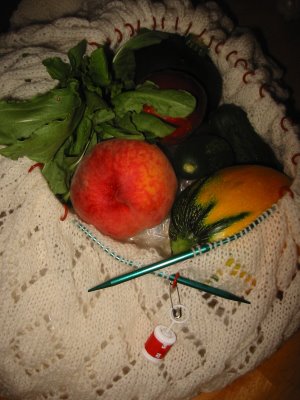
(No knitting was harmed in the taking of this picture.)
* * *
Our goal for the future? To make sure we have some old reusable containers with us for restaurant leftovers when we go out to dinner. (Yep--the backpack-slash-car kit is getting larger: string bags and washed-out produce bags, metal coffee mug, cloth napkins and handkerchiefs, etc. along with the requisite books and knitting for all of us. When will this start to seem ridiculous?)
I used to laugh at the yuppies ordering their Starbucks half-caf triple-shot double-foam non-fat short caramel lattes.
Now I'm picking out my beans the same way. Make mine shade-grown, organic, fair trade, and locally roasted, please.

You can find this cool rising-sea-level mug (that we do not own but always laugh at) here.
* * *
I talk a lot on this blog about eating locally-grown food, but recently we've been eating even more locally than usual, as my fortune cookie commands:

Our garden broccoli, still small, looked like it might be about to bolt in the heat we've had recently. We harvested it...

...served it steamed in a whole-wheat tortilla with mozzarella cheese...

...and packed it in David's nifty lunch pail:

* * *
Another way to change your food habits in order to lesson your ecological footprint is to answer the "Paper or plastic?" question with, "No thanks; I brought my own bag." In a pinch, I've even used a shawl in progress:

(No knitting was harmed in the taking of this picture.)
* * *
Our goal for the future? To make sure we have some old reusable containers with us for restaurant leftovers when we go out to dinner. (Yep--the backpack-slash-car kit is getting larger: string bags and washed-out produce bags, metal coffee mug, cloth napkins and handkerchiefs, etc. along with the requisite books and knitting for all of us. When will this start to seem ridiculous?)
Tuesday, June 05, 2007
Water
Issue Two of Crunchy Chicken's Low Impact Week
Many ways of saving water are simple: take shorter showers, use a water-saving sink attachment, turn off the water while you brush your teeth or shave or wash dishes, only run the dishwasher when it is full, and (even though you may think this is disturbing) use the Ed Koch flush.

We're thinking about constructing a rain barrel in our garden so we can put some of that lovely rain on the garden even when it is bone-dry outside.
Another way to cut down on water use is to xeriscape your yard--that is, use locality-appropriate plantings that do not require additional water and also avoid run-off. Much of our back yard is devoted to growing produce--and while vegetable gardening answers other environmental concerns, it is certainly not a water-saving measure.
Some people even have a greywater system that collects domestic waste water such as that from washing dishes, doing laundry, and showering to recycle for flushing toilets and for irrigation. Very cool!
Many ways of saving water are simple: take shorter showers, use a water-saving sink attachment, turn off the water while you brush your teeth or shave or wash dishes, only run the dishwasher when it is full, and (even though you may think this is disturbing) use the Ed Koch flush.

We're thinking about constructing a rain barrel in our garden so we can put some of that lovely rain on the garden even when it is bone-dry outside.
Another way to cut down on water use is to xeriscape your yard--that is, use locality-appropriate plantings that do not require additional water and also avoid run-off. Much of our back yard is devoted to growing produce--and while vegetable gardening answers other environmental concerns, it is certainly not a water-saving measure.
Some people even have a greywater system that collects domestic waste water such as that from washing dishes, doing laundry, and showering to recycle for flushing toilets and for irrigation. Very cool!
Monday, June 04, 2007
Energy
Issue One of Crunchy Chicken's Low Impact Week

For many years we've tried to keep our energy consumption low--partly for the sake of the environment and party because we are cheap. We've keep our heat at slightly less than 60 degrees during the winter. (Being a knitter and wanting to wear all those heavy wool sweaters certainly helps--as does a delicious pair of silk long underwear.) We air dry in the dishwasher, use cold water in the washing machine, don't have television in our lives, etc.
This week we've been talking about a couple of additional steps we could take. One is a longer-term project--and one we've made a commitment to do regularly.
Amy's example convinced us to try to hang our laundry out rather than use the dryer as much as we do. Hanging a line in our tiny yard was a bit complicated, but we found an alternative line dryer that is like a cross between an indoor rack and a regular outdoor clothesline.

Of course, right after we we found it, the heavens opened and it has been pouring rain since.
* * *
David and I started a much larger conversation--actually, we took an old conversation to a more intense level--about how to green up our house in more substantial ways. Recently we switched to wind power, partly as a result of Lolly's inspirational prodding. But now, even though our electric comes from a clean source, we'd like to reduce our usage further. Should we replace our beautiful but terribly-inefficient ancient windows? During the winter you can hear arctic winds whistling through the house--which is awful for energy efficiency. (On the other hand, we might worry less about VOCs etc. because of our excellent ventilation....)
And then there is the question of a solar water heater. Can we afford it? Do we have the right exposure and the right kind of roof?
We're started our quest for more information. Have any of you had any experience with either solar water heaters or window replacement? I'd love to hear!

For many years we've tried to keep our energy consumption low--partly for the sake of the environment and party because we are cheap. We've keep our heat at slightly less than 60 degrees during the winter. (Being a knitter and wanting to wear all those heavy wool sweaters certainly helps--as does a delicious pair of silk long underwear.) We air dry in the dishwasher, use cold water in the washing machine, don't have television in our lives, etc.
This week we've been talking about a couple of additional steps we could take. One is a longer-term project--and one we've made a commitment to do regularly.
Amy's example convinced us to try to hang our laundry out rather than use the dryer as much as we do. Hanging a line in our tiny yard was a bit complicated, but we found an alternative line dryer that is like a cross between an indoor rack and a regular outdoor clothesline.

Of course, right after we we found it, the heavens opened and it has been pouring rain since.
* * *
David and I started a much larger conversation--actually, we took an old conversation to a more intense level--about how to green up our house in more substantial ways. Recently we switched to wind power, partly as a result of Lolly's inspirational prodding. But now, even though our electric comes from a clean source, we'd like to reduce our usage further. Should we replace our beautiful but terribly-inefficient ancient windows? During the winter you can hear arctic winds whistling through the house--which is awful for energy efficiency. (On the other hand, we might worry less about VOCs etc. because of our excellent ventilation....)
And then there is the question of a solar water heater. Can we afford it? Do we have the right exposure and the right kind of roof?
We're started our quest for more information. Have any of you had any experience with either solar water heaters or window replacement? I'd love to hear!
Friday, June 01, 2007
Low Impact Week
There have been many calls to consider our impact on the earth and challenge ourselves to be more careful of our planet: No Impact Man (and the conservative parody/cheapskate blog Low Impact Man), Judith Levine's Not Buying It: My Year Without Shopping , EnviroWoman's plastic-free pledge, 90% Reduction, The Compact, and even the blog with my favorite non-knitting title: Little Blog in the Big Woods with Greenpa's "Earth Lent".
One challenge I am interested in participating in myself is Crunchy Chicken's Low Impact Week. The founder suggests seven areas to work on.
1. Reduce energy consumption
2. Reduce water usage
3. Change your food habits
4. Reduce your dependence on paper products
5. Reduce your garbage output
6. Reduce Single Occupancy Vehicle usage
7. Do something that lasts more than a week
Under each category, she gives us a list of possibilities for changes in our lives.
My goal for the week is not necessarily to make tremendous changes right now. This is simply a week for contemplating and planning changes that we might be able either to incorporate into our daily lives or try to do occasionally. I hope you'll all join me in a conversation about how and what you've tried to do, how it has worked out, and what you want to change next.
, EnviroWoman's plastic-free pledge, 90% Reduction, The Compact, and even the blog with my favorite non-knitting title: Little Blog in the Big Woods with Greenpa's "Earth Lent". One challenge I am interested in participating in myself is Crunchy Chicken's Low Impact Week. The founder suggests seven areas to work on.
1. Reduce energy consumption
2. Reduce water usage
3. Change your food habits
4. Reduce your dependence on paper products
5. Reduce your garbage output
6. Reduce Single Occupancy Vehicle usage
7. Do something that lasts more than a week
Under each category, she gives us a list of possibilities for changes in our lives.
My goal for the week is not necessarily to make tremendous changes right now. This is simply a week for contemplating and planning changes that we might be able either to incorporate into our daily lives or try to do occasionally. I hope you'll all join me in a conversation about how and what you've tried to do, how it has worked out, and what you want to change next.
Subscribe to:
Posts (Atom)
LinkWithin
