Showing posts with label Passover. Show all posts

Monday, May 19, 2008

Leaving the Narrow Place for the Open Fields


During Passover, Jews are asked to acknowledge the history of slavery. Not only should we "acknowledge" it: we should act as if we were personally enslaved and personally freed.

Many Jews ask what things in our selves and in our surroundings keep us enslaved now. Then we think about ways we might loosen those bonds and step away from our own Mitzrayim, our own narrow place--no matter how safe and cozy it might seem at any given moment. When we are able finally to make that first step, we will begin to see how constrained we have been. Only at that point is an end to freedom--and a start to independence--possible.

I spent a bit of my Passover thinking about how to become ready to make a change, how to be ready to abandon the things that hold us back even if they seem to put us in such a secure place right now.

Many parts of my own personal narrow place are internal personality traits--parts of my self that hold me (and those around me) back from where we could go. One is my sometimes-extreme shyness. Another is my fear of anger, whether it is in myself or in others (anger towards me or towards others). Yet another is my reluctance to do or say anything that could make me stand out too much. And a biggie: I think about big issues until they are fully dissected, get depressed (too often in a too serious way), and do nothing about whatever the issues are.

But here we are, my family, ready to make some big steps out of our narrow place.

* * *

One way out of our Mitzrayim seems to be increasing food security both for us and for our community.

For a long time, my family has sought to eat a diet (and live a life more generally) less dependent on corporate consumerism and more reliant on the local economy of small business and small farmers. We attempt to purchase mostly foods without labels. (Ah--wouldn't the nutrition police fall over dead? No label to read?! Surely that is not healthy....)

This year we've expanded our garden to grow more of our diet in the back yard--our very tiny "postage stamp of native soil" which will really just be a symbolic way to help us understand more about how food is produced. Some of the old pros who do this (on a much larger scale in an only slightly smaller yard) call it the "path to freedom." They've launched the 100 Foot Diet challenge to help us connect with other people doing the same thing. I've mentioned their challenge before.

We've also made a serious commitment to prepare now so we will be able to keep up our non-corporate eating during the winter and early spring. And for this, the brilliant Sharon issued her own challenge:


Sharon asks us to create "food independence" (and to a degree, independence from a fossil-fuel-led society more generally) by regularly trying to, as Sharon lays out:

1. Plant something.
...The idea that you should plant all week and all year is a good reminder to those of us who sometimes don’t get our fall gardens or our succession plantings done regularly. Remember, that beet you harvested left a space - maybe for the next one to get bigger, but maybe for a bit of arugula or a fall crop of peas, or a cover crop to enrich the soil. Independence is the bounty of a single seed that creates an abundance of zucchini, and enough seeds to plant your own garden and your neighbor’s.

2. Harvest something.
From the very first nettles and dandelions to the last leeks and parsnips I drag out of the frozen ground, harvest something from the garden or the wild every day you can. I can’t think of a better way to be aware of the bounty around you to realize that there’s something -- even if it is dandelions for tea or wild garlic for a salad -- to be had every single day. Independence is really appreciating and using the bounty that we have.

3. Preserve something.
Sometimes this will be a big project, but it doesn’t have to be. It doesn’t take long to slice a couple of tomatoes and set them on a screen in the sun, or to hang up a bunch of sage for winter. And it adds up fast. The time you spend now is time you don’t have to spend hauling to the store and cooking later. Independence is eating our own, and cutting the ties we have to agribusiness.

4. Prep something.
Hit a yard sale and pick up an extra blanket. Purchase some extra legumes and oatmeal. Sort out and inventory your pantry. Make a list of tools you need. Find a way to give what you don’t need to someone who does. Fix your bike. Fill that old soda bottle with water with a couple of drops of bleach in it. Plan for next year’s edible landscaping. Make back-road directions to your place and send it to family in case they ever need to come to you - or make ‘em for yourself for where you might have to go.... Independence is being ready for whatever comes.

5. Cook something. Try a new recipe, or an old one with a new ingredient. Sometimes it is hard to know what to do with all that stuff you are growing or making. So experiment now. Can you make a whole meal in your solar oven? How are stir-fried pea shoots? Stuffed squash blossoms? Wild morels in pasta? Independence is being able to eat and enjoy what is given to us.

6. Manage your reserves. Check those apples and take out the ones starting to go bad and make sauce with it. Label those cans. Clean out the freezer. Ration the pickles, so you’ll have enough to last to next season. Use up those lentils before you take the next ones out of the bag. Find some use for that can of whatever it is that’s been in the pantry forever. Sort out what you can donate, and give it to the food pantry. Make sure the squash are holding out. Independence means not wasting the bounty we have.

7. Work on local food systems. This could be as simple as buying something you don’t grow or make from a local grower, or finding a new local source. It could be as complex as starting a coop or a farmer’s market, creating a CSA or a bulk store. You might give seeds or plants or divisions to a neighbor, or solicit donations for your food pantry. Maybe you’ll start a guerilla garden or help a homeschool coop incubate some chicks. Maybe you’ll invite people over to your garden, or your neighbors in for a homegrown meal, or sing the praises of your local CSA. Maybe you can get your town to plant fruit or nut producing street trees or get a manual water pump or a garden put in at your local school. Whatever it is, our Independence days come when our neighbors and the people we love are food secure too.


Participants had lots of creative ideas for tweaking the rules--moving things out of one listing into their own categories in order to emphasize them more--or adding things entirely new. Some of my favorite additions:

8. Store something (edible) you'll need in the future so you won't have to go to the market as often.

9. Reduce waste, Compost.

10. Clean something, Mend something, Make do.

11. Learn a new skill, or practice one you are learning.


Coming soon: how we're taking our first steps along this new road.

Saturday, April 26, 2008

All-Local Seder

Last night we had a Passover seder with David's parents, in town for the Jewish holiday as well as for two family birthdays. For this meal, we decided to make it all locally grown, with only a couple of exceptions. And we couldn't get matzah locally and decided not to make it from scratch this year.

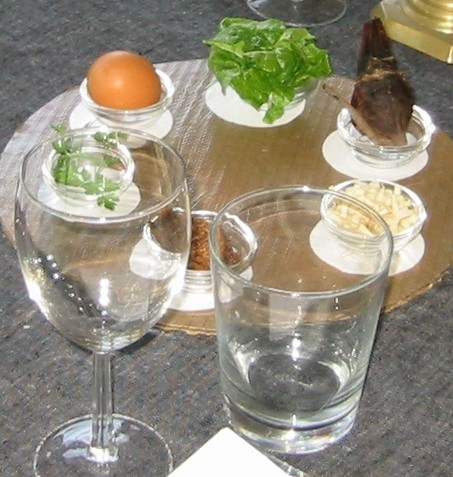
On the seder plate:


--Parsley and lettuce from our garden for the karpas and chazeret, symbols partly of spring
--Charoset made from local apples, walnuts, honey, and a little leftover sweet local wine. Since we could not source local raisins, we just left them out of the recipe and everything turned out just fine.
--Local horseradish for the maror.
--a local egg from our Amish dealer--beitzah
--a non-local beet to stand in the place of the z'roa, or shankbone.

* * *

For our all-local dinner, we had a gorgeous leg of lamb rubbed with garlic and rosemary. Many Ashkenazic Jews do not eat lamb on Passover, and many Sephardic Jews define it as the food of choice during Passover. We, like many American Jews, don't typically serve it the first night but enjoy it later in the holiday.


We also had baked potatoes with fresh sour cream as well as a stir-fried medley of onions, mushrooms, and rapini. (I've always called rapini by its other name, broccoli raab--but my father-in-law does not eat broccoli so it seemed the name switch was in order.)


For dessert: chocolate ice-cream from our Amish dairy supplier made with his milk, cream, and eggs, a neighbor's maple syrup, and non-local chocolate. What a sweet finish!

Sunday, April 20, 2008

Hanging Out

Last night we celebrated the first night of Passover with a fiber friend and some of her adopted family. What a wonderfully creative and peaceful evening!

Although David and I are very shy people who always stammer through meeting new folks, they were all quick to make us feel at home. Spending some time chatting together as well getting to go through their interesting haggadah made for a lovely evening. Thanks, Carol!

* * *

Before we went to the seder, we did a little cooking and cleaning in order to prepare for the holiday and for the guests who are scheduled to arrive in a couple of days. One job we intended to do on this beautifully day was some laundry. I had intended to pull our little line out to the sunshine and observe National Hanging Out Day. While some think of "solar clothes drying" as an inconvenient chore, I enjoy the rhythm of pinning clothes on the cord and I love the smell of the spring breeze in my clothes. But yesterday in our busyness, we forgot to get things started. I thought to myself that we might try today--but we woke up to a long soaking rain and some fairly ominous-looking clouds. Oh well.

Not Our Laundry

* * *

So instead, we just hung out together and made a leisurely almost-all-local classic passover breakfast: matzah brei.

First, we sauteed some farmers market apples in some Amish butter.


While it was caramelizing, we soaked some not-local matzot in apple juice (from Pennsylvania) which we had warmed up. After they were soft, we drained them and crumbled the matzah into local beaten eggs. We added a sprinkling of farmers market maple sugar, then added the egg-and-matzah mixture to the sauteeing apples and cooked it as if we were scrambling eggs.

This is one of my favorite Passover breakfasts, and getting to spend a long Sunday morning enjoying the matzah brei together with my family made it doubly sweet.


* * *

“We must all hang together, or most assuredly we will all hang separately."
-Benjamin Franklin

Saturday, April 07, 2007

Tapuz--The Orange

Matzoh, the cracker-like substance that replaces leavened bread, is a famous food eaten during the 8-day celebration of Passover. During that time, observant Jews do not eat wheat, spelt, barley, rye, or oats. Many of us do not eat corn, rice, or legumes like peanuts or soy or other beans or peas, either. Even things like sunflower seeds and sesame seeds are often avoided. Given that additives of various sorts made from corn and soy are in almost every processed food on the shelf, this proscription can be fairly challenging unless you buy specifically kosher-for-Passover brands--or eat a whole foods diet.

There are other foods associated with Passover. A traditional seder plate holds bitter herbs (usually horseradish), charoset (a paste of sweet fruit and nuts), a roasted egg, a shankbone (or roasted beet for vegetarians), etc. In a traditional haggadah, we point to the foods and say things like, "Why do we eat matzah tonight?" or "Why is there charoset on the seder plate?"--then have a discussion of many different understandings, many different possibilities and ideas. The horseradish reminds us of the bitterness of slavery. The charoset is a way of expressing the sweetness of liberation.

Our seder plate, and the plates of many other progressive Jews, also holds an orange.

Why is there an orange on the seder plate?


The explanation we've read for a dozen years is that after hearing about women becoming rabbis, a man roared, "A woman has no more place leading prayer than an orange has a place on the Seder plate!" So we place an orange on the Seder plate, for it belongs there as a symbol that women belong wherever Jews carry on a sacred life.

Recently I discovered that this story is not the full story.

An early feminist haggadah placed a crust of bread on the seder plate as a sign of solidarity with Jewish lesbians, showing that traditional Judaism offers as little acceptance of lesbians as it does of bread during Passover. One rabbi, Susannah Heschel, believed that this symbol suggested that gays and lesbians were truly out of place in Judaism and violated the meaning of the religion. She wanted to use a different symbol, one that showed that the inclusion of gays and lesbians made Judaism all the more fruitful. The need to spit out a few seeds just reminds us that we need to constantly remove traces of prejudice from ourselves.


Round you are and bright as a newly risen moon.
You are sweet and acid, dessert and medicine.
You carry within your curves the future
of your kind, those pale seeds winking
from the sections, each an embryo tree.

Come into your own and shine,
where the only roundness was the almost
hidden plate bearing up the ritual items.
Be subject as well as object. Sing
in your orangeness of female strength.

Clash if you need to. Roll if you must.
Center the plate about your glow.
We are, we will be, we become: rabbis,
yes, cantors, shapers, prophets, creating
a new Judaism that is yours and ours.

-- Marge Piercy

Friday, April 06, 2007

Freedom

Passover has an inherently political edge. Here is a time to talk about slavery and about liberation. It is a time to think about the changes we must make, to consider the revolts and rebellions that may be necessary to create a world rooted in justice. It is a time to devote ourselves to tikkun olam, the repair of our damaged world.

* * *

On Monday morning, we woke up in Florida at David's parents house and planned our day. After breakfast, we slipped on our bathing suits and headed for the beach. When we first arrived, the clouds were out and there was a strong enough breeze to keep many of the tourists inside. We collected shells, dipped our toes in the water, and enjoyed the peacefulness.

Soon the sun was out and the crowds descended. David and I spread a towel out and sat down for a while. Son waded in for a little wave jumping. I almost cried while watching our 7yo's absolutely uninhibited JOY. How long will he have this unselfconscious ability to live fully? He is about to turn eight--and many of his friends have already lost it. We've chosen to shelter our child from the contemptuous boredom seen in much of today's pop culture. We try not to control or close down his expressions of emotion, be they this kind of happiness or anger or sadness. We make an effort to restrict how much he is quizzed and drilled or forced to compete at this young age, and perhaps this has given our son some extra room to be a child. We've worked hard so he will not feel that he cannot measure up to someone else's expectations--a feeling I think many successful people in our generation struggle against. Whatever allows it, the greatest joy in my life is seeing my child being so open and exuberant and free.

* * *

We returned to D's parent's house where a cleaning service was using strongly-scented products to clean the bathrooms and floors. I'm a bit oversensitive to smells and quickly escaped to the porch with my knitting along with Son, D's brother, and his partner. David went to make copies of our haggadah (explained below) and to pick up some last minute things to prepare for dinner.

I went in to go to the bathroom at some point--and although I felt fine before, found myself vomiting intensely and then lying on the bathroom floor. I thought I must have food poisoning from the place at the beach where we had eaten lunch. Finally I dragged myself into the room where we sleep, turned on the fan, and sort of passed out on the floor. I tried to figure out how to call someone to tell someone, but everybody was some distance away and I couldn't really get sound out.

David walked in about 90 minutes later. He realized that rather than having food poisoning, I might be sick from the chemicals (probably bleach which often makes me ill). After getting me out to their front yard and giving me a glass of water, it was less than ten minutes before I felt like a human being again. I drank an enormous amount of water and a few crackers, sat outside for a while, and was back to myself--albeit a slightly shaky version of myself.

* * *

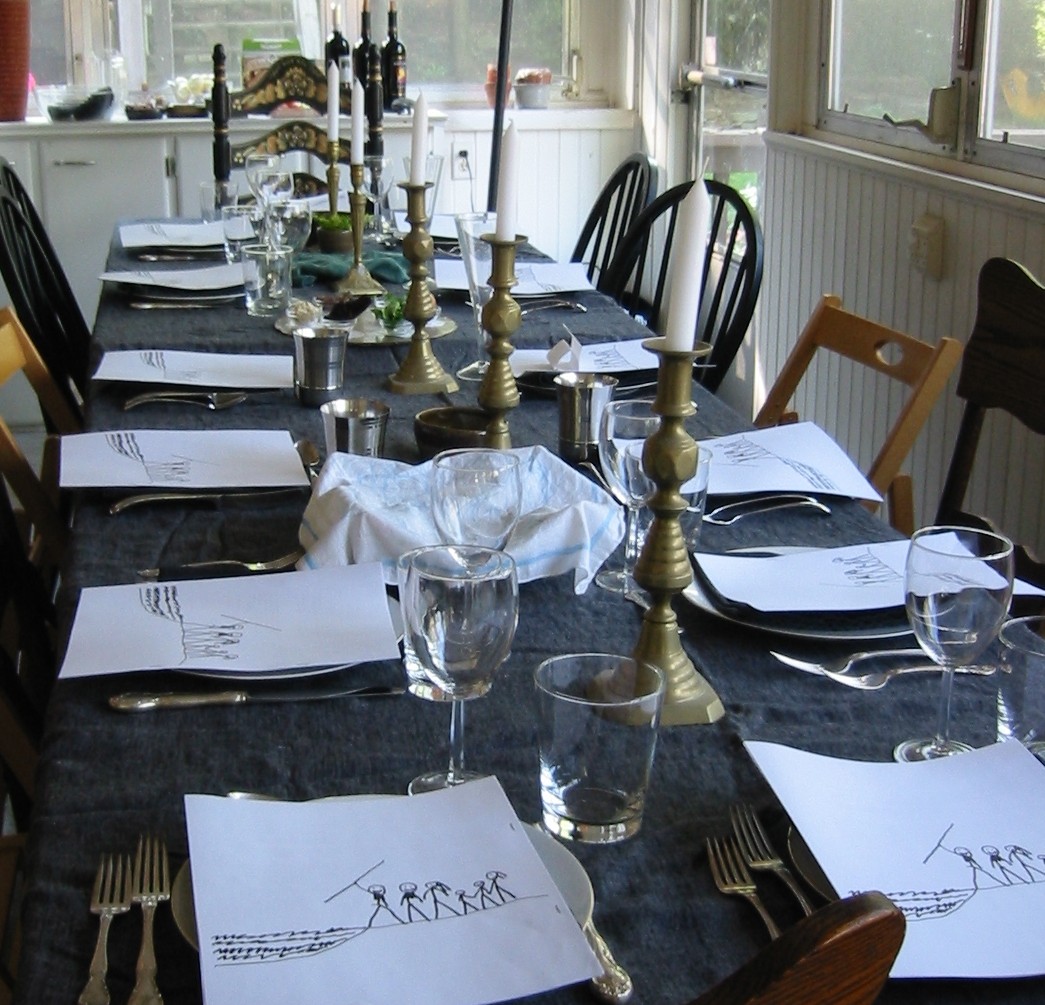
Soon, additional family members arrived and we walked back in to a house that had been airing out for a while. I had a dull headache but was doing fine. We all sat down around the table. Before the meal on Passover, Jews traditionally spend time celebrating the story of the Exodus from Egypt. David and I put together a haggadah (sort of a prayerbook) about fifteen years ago--full of not only traditional texts but also modern ideas that we wrote or found. Each year we read texts from the Bible and the Torah, but we also read feminist texts and other leftist political/ activists texts that have acquired a deep patina of meaning for us.

Unfortunately, one of the guests was troubled by a few of our additions. I certainly would not inflict this haggadah on an Orthodox family--or a Republican for that matter. But I thought this gentleman had used our haggadah before at D's parents' seders and that he would be comfortable with it. Unfortunately, he was not. He expressed his frustration--almost anger--and I felt terrible both that we were forcing something on him that was not appropriate for his needs AND because his unhappiness took away from my deep enjoyment of this annual repetition of texts about justice and freedom that David and I wrote and assembled when we were a new couple.

* * *

Following a discussion about idol-worship from the traditional haggadah, we read this, the offending paragraph:

The anger and fear awakened by feminist attempts to alter the way in which we speak about God bespeaks a profound attachment to an image of God as male. When a metaphor such as "He" is assumed and defended, it has ceased to be an image and becomes an idol. The metaphor in no longer simply a way of pointing to God but is identified with God "himself." The claim that only male language may be used for God leads to the worship of maleness. While Jews are used to thinking of idols as pillars and stones, verbal idols can be every bit as powerful as sculpted ones--indeed, more powerful for being less visible.

* * *

After we completed the first part of the haggadah, we began the feast. The meal was full of wonderful foods and full of memories: David's grandmother's pot roast, tzimmes (sweet potatoes, carrots, and prunes), mandelbrot (Jewish biscotti kosher for Passover). THIS felt like what Passover was all about. Isn't it amazing how food can link us to the past, to the future, to the justice of sustaining the world? As Marge Piercy says in her new Pesach for the Rest of Us: Making the Passover Seder Your Own, "Food sometimes feels like emotion made edible."

* * *

Traditional haggadah text:

A Jewish legend teaches that when the armies of Egypt were dying in the sea, the Heavenly Hosts broke out in jubilation. And God asked, "The works of my hands are drowning, and you sing praises?" And the heavens were silent.

* * *

Tomorrow: our seder plate

Monday, April 24, 2006

Belated Passover

Last night we had a mock Passover seder for some of Son's non-Jewish friends. A lovely evening with a lot of terrific children and fascinating parents. Son liked sharing his traditions with everyone. He certianly learned a lot writing the hagaddah for the evening, too.


As I was cooking, I kept making mistake after stupid mistake. Usually I'm a pretty instinctive cook who has a feel for what is cooking. But Passover cooking often does NOT seem instinctual to me (perhaps especially when it is no longer even Passover?). Finally I had to pull out my knitting and do a couple of rows just to restore my equilibrium. (I sound like a junkie....)

BTW, Kat Knits announced the winners of her contest (and I got an honorable mention!). There were some really hysterical posts submitted. Check them out!

Friday, April 14, 2006

Happy Pesach!

Thanks for all the thought-provoking comments here and and on Knitty about my previous post. I'm sure after a little more thinking and reading, I'll write another entry about the subject.

Around here we've been enjoying our seder-filled breadless life. Passover is one of my favorite holidays, although knitting really has very little place in the proceedings. I think a Knitter's Hagaddah is definitely in order. Certainly a knitted seder plate is on my agenda.

The second front for the green cabled cardigan is up past the start of the armhole decrease. The green shawl is a few rows longer. And yesterday at my knitting playgroup, I knit most of the foot of one of the new socks. I am seriously thinking of casting on a new big project (maybe a Pi shawl?) that is NOT green....

LinkWithin

Related Posts with Thumbnails