My family headed to downtown DC for the 350ppm rally and march on Saturday. We hung out and listened to some traditional DC-style go-go music as well as a few inspiring speeches, including one by Takoma Park hero Mike Tidwell.
At 3:00, rally participants began to line up for the march to the park across from the White House.
And at that moment the skies opened, absolutely completely.
David brought an umbrella and I brought my rain jacket, but our 10yo son had decided not to carry rain gear. After twenty minutes of marching through the pelting rain and splashing through puddles, we were all soaked. Eventually, we peeled off from the crowd and went to a cafe for hot chocolate.
* * *
The three of us took the Metro back to Takoma Park in time for the annual Boy Scouts pancake supper. Although I am not a huge fan of the Boy Scouts (since I'm an atheist and a strong supporter of gay rights), this dinner is a show of community support.
Because of our No Impact experiment this week, we toyed with taking reusable plates with us to the dinner. I finally decided that this minor bit of personal earth-saving might seem like a major bit of holier-than-thou face-slapping. Who was I to be holier when we bagged on the march just because of a little rain?
We confidently decided this would be a time to just use what we were given and be appreciative of togetherness.
Imagine my thrill when I walked in the church gym and saw all the reusable plates, cups, and silverware--along with both organic cream and raw cane sugar to go with the coffee!
And who else was lined up for pancakes? Many other rally participants--including Mike Tidwell, enjoying fellowship and pancakes--dry and warm.
Tuesday, October 27, 2009
Saturday, October 24, 2009
350!

Check out 350.org's list of actions if you don't have something already planned.
Tuesday, October 20, 2009
Local Harvest: Foraging for Acorns
Inspired by Euell Gibbons Stalking The Wild Asparagus, we recently harvested acorns to make delicious acorn pancakes.

See the full post here.

we recently harvested acorns to make delicious acorn pancakes.See the full post here.

Monday, October 19, 2009
Going No Impact
My 10yo son and I are participating in the No Impact Project this week. Although for many years my family has been involved with the environmental movement (as well as committed to lessening our own ecological footprints), the No Impact Project gives us an opportunity to talk about these issues more, learn to take more extensive steps, and make connections with other participants. I certainly felt that way during Crunchy Chicken's Low Impact Week.
Isn't this mass experiment just hype, a stunt? Isn't it in some ways counterproductive since it leads the "consumer" (formerly known as the citizen) to feel responsible for climate change rather than the government and large corporations acknowledging their profound role and responsibility in this problem?
Perhaps so. I will end this week by talking more about the problems of personal versus political action.
But for now, I am taking Bill McKibben's words to heart: "The first step, clearly, is to take personal responsibility--to cut your own impact." He goes on to explain why personal action is not enough. As he writes, "If we want to have as little impact as possible on the planet, we must have as much impact as possible on its politics. At this point we're not going to solve this one lightbulb at a time--we're going to solve it one planet at a time if we're going to solve it at all." He recommends No Impact Week as not only a way to "minimize your personal [impact]" but to form a community of people actively making not only changes in their lives but changes in the culture that will then allow our politicians and other leaders to step up to the plate, that is, to "maximize your political impact." Personal change turns us into actors. When we see ourselves as effective people, we can have much more powerful voices for political change.
In addition to doing right by the planet, going "No Impact" is truly the way to do right by ourselves. By pushing ourselves to live up to what we say we believe, we're asking ourselves to face up to ourselves. Instead of letting ourselves get by with easy rhetoric, we are allowing ourselves to grow, to bloom into more responsible and effective people--on this issue but also on all other issues. It is a way of celebrating the potential of humanity--and the potential of ourselves.
(Check out the reference to this essay on the Huffington Post!)
Isn't this mass experiment just hype, a stunt? Isn't it in some ways counterproductive since it leads the "consumer" (formerly known as the citizen) to feel responsible for climate change rather than the government and large corporations acknowledging their profound role and responsibility in this problem?
Perhaps so. I will end this week by talking more about the problems of personal versus political action.
But for now, I am taking Bill McKibben's words to heart: "The first step, clearly, is to take personal responsibility--to cut your own impact." He goes on to explain why personal action is not enough. As he writes, "If we want to have as little impact as possible on the planet, we must have as much impact as possible on its politics. At this point we're not going to solve this one lightbulb at a time--we're going to solve it one planet at a time if we're going to solve it at all." He recommends No Impact Week as not only a way to "minimize your personal [impact]" but to form a community of people actively making not only changes in their lives but changes in the culture that will then allow our politicians and other leaders to step up to the plate, that is, to "maximize your political impact." Personal change turns us into actors. When we see ourselves as effective people, we can have much more powerful voices for political change.
In addition to doing right by the planet, going "No Impact" is truly the way to do right by ourselves. By pushing ourselves to live up to what we say we believe, we're asking ourselves to face up to ourselves. Instead of letting ourselves get by with easy rhetoric, we are allowing ourselves to grow, to bloom into more responsible and effective people--on this issue but also on all other issues. It is a way of celebrating the potential of humanity--and the potential of ourselves.
(Check out the reference to this essay on the Huffington Post!)
Thursday, October 15, 2009
A Time for Action
During the second week in December, world leaders will meet in Copenhagen, Denmark at the United Nations Climate Change Conference with the goal of putting together a new global climate treaty, replacing 1997's Kyoto Protocol. It is essential for industrialized countries to reduce their greenhouse gas emissions, for major developing countries like China and India to limit the growth of their emissions, and for poorer countries to get financial help adapting to the impacts of climate change which many already feel.
In the run-up to Copenhagen, many individuals and groups have helped set the stage for citizen action.
* * *

Today is Blog Action Day, an annual call for bloggers to discuss one issue of crucial concern to the world. This year's topic is Climate Change. Bloggers across the world, regardless of the normal topics of their blogs, are writing about the crisis facing our environment.
* * *

Coming up on October 24 is the '350' Day of Action.
As 350.org explains, "350 parts per million is what many scientists, climate experts, and progressive national governments are now saying is the safe upper limit for CO2 in our atmosphere." Although for most of human history levels have hovered around 275ppm, we are now at 390ppm–-and this number is rising by about 2 parts per million every year. As NASA's Jim Hansen has pointed out, above 350 we will no longer have a planet "similar to the one on which civilization developed and to which life on earth is adapted."
As long as we stay above the 350ppm border, we risk reaching tipping points and irreversible impacts such as the melting of the Greenland ice sheet and major methane releases from increased permafrost melt.
The brilliant Bill McKibben puts it this way: "It's not as if we have a choice. The most useful thing about having a number is that it forces us to grow up, to realize that the negotiations that will happen later this fall in Copenhagen aren't really about what we want to do, or what the Chinese want to do, or what Exxon Mobil wants to do. They're about what physics and chemistry want to do: the physical world has set its bottom line at 350, and it's not likely to budge."
To help our world leaders understand how essential it is to come up with a climate plan that includes cuts significant enough to reach that 350ppm boundary, 350.org has organized a Day of Action. Groups all over the world will participate, representing their support for this target. As the organization says, "We're calling on people around the world to organize an action on October 24 incorporating the number 350 at an iconic place in their community, and then upload a photo of their event to 350.org website. We'll collect these images from around the world and, with your help, deliver them to the media and world leaders. Together, we can show our world and it's decision-makers just how big, beautiful, and unified the climate movement really is." Check out some of the creative ways people have gotten together before on this issue.
Using this map, you can find a group near you to join on the 24th.
* * *
In the run-up to Copenhagen, many individuals and groups have helped set the stage for citizen action.
* * *
Today is Blog Action Day, an annual call for bloggers to discuss one issue of crucial concern to the world. This year's topic is Climate Change. Bloggers across the world, regardless of the normal topics of their blogs, are writing about the crisis facing our environment.
* * *
Coming up on October 24 is the '350' Day of Action.
As 350.org explains, "350 parts per million is what many scientists, climate experts, and progressive national governments are now saying is the safe upper limit for CO2 in our atmosphere." Although for most of human history levels have hovered around 275ppm, we are now at 390ppm–-and this number is rising by about 2 parts per million every year. As NASA's Jim Hansen has pointed out, above 350 we will no longer have a planet "similar to the one on which civilization developed and to which life on earth is adapted."
As long as we stay above the 350ppm border, we risk reaching tipping points and irreversible impacts such as the melting of the Greenland ice sheet and major methane releases from increased permafrost melt.
The brilliant Bill McKibben puts it this way: "It's not as if we have a choice. The most useful thing about having a number is that it forces us to grow up, to realize that the negotiations that will happen later this fall in Copenhagen aren't really about what we want to do, or what the Chinese want to do, or what Exxon Mobil wants to do. They're about what physics and chemistry want to do: the physical world has set its bottom line at 350, and it's not likely to budge."
To help our world leaders understand how essential it is to come up with a climate plan that includes cuts significant enough to reach that 350ppm boundary, 350.org has organized a Day of Action. Groups all over the world will participate, representing their support for this target. As the organization says, "We're calling on people around the world to organize an action on October 24 incorporating the number 350 at an iconic place in their community, and then upload a photo of their event to 350.org website. We'll collect these images from around the world and, with your help, deliver them to the media and world leaders. Together, we can show our world and it's decision-makers just how big, beautiful, and unified the climate movement really is." Check out some of the creative ways people have gotten together before on this issue.
Using this map, you can find a group near you to join on the 24th.
* * *
Wednesday, October 14, 2009
Eat at Mom's
First there was the 100 Mile Diet.
Then there was the 100 Foot Diet.
And now, the 100 Millimeter Diet!

* * *
As a long-time breastfeeding activist, I am very pleased to see the Green movement beginning to embrace the environmental importance of nursing children. After all, there is nothing more sustainable than breastfeeding. It comes with absolutely no waste in the manufacturing process and no waste in the delivery system. It is free, making it accessible for all people. It is easier by far than filling up with formula (although this may not seem to be true when you're just starting out if you don't find great support). It even leads to lower consumption of medical resources over the entire course of life.
I was thrilled to hear Joel Salatin at the DC Green Festival proclaim these environmental virtues of breastfeeding. I was also pleased to see a vendor in the Green Festival merchant hall selling t-shirts with various green choices--including breastfeeding!
Even Michael Pollen, king of the food movement has spoken about the ecological importance of breastfeeding.
Be sure to click through this fantastic slide show, Infant Feeding Affects Climate Change. Also check out 10 Reasons Breastfeeding is Green.
Then there was the 100 Foot Diet.
And now, the 100 Millimeter Diet!

pic from the Pa Dept of Health
* * *
As a long-time breastfeeding activist, I am very pleased to see the Green movement beginning to embrace the environmental importance of nursing children. After all, there is nothing more sustainable than breastfeeding. It comes with absolutely no waste in the manufacturing process and no waste in the delivery system. It is free, making it accessible for all people. It is easier by far than filling up with formula (although this may not seem to be true when you're just starting out if you don't find great support). It even leads to lower consumption of medical resources over the entire course of life.
I was thrilled to hear Joel Salatin
at the DC Green Festival proclaim these environmental virtues of breastfeeding. I was also pleased to see a vendor in the Green Festival merchant hall selling t-shirts with various green choices--including breastfeeding!Even Michael Pollen, king of the food movement
has spoken about the ecological importance of breastfeeding.Be sure to click through this fantastic slide show, Infant Feeding Affects Climate Change. Also check out 10 Reasons Breastfeeding is Green.
Tuesday, October 13, 2009


Friday, October 09, 2009
Really "Tightening Their Belts"...
In a New York Times article today called "Leaner Times at Harvard," it was reported that due to the critical hit to the university's endowment, the school is making serious cuts: no more bacon will be served at weekday breakfasts for undergraduates, and no more cookies provided at faculty meetings.
I know things are actually much tougher, and the newspaper even admits as much. For example, a significant number of students live in the old Radcliffe dormitories--at the Quad, where I chose to live in the late 1980s. It is a bit of a walk to the main campus. The beautiful library there where I spent most of my evenings studying has been closed. Many staff members have lost their jobs, there is a hiring freeze, and salaries have been frozen as well.
At the same time, Harvard has prioritized their cuts to ensure students have $9 million more in financial aid than they did last year. This move has allowed some students to remain enrolled who otherwise would have been unable to afford it in these difficult times.
I'm feeling awfully torn: really wanting to put Harvard's financial situation into the context of a world hit by true suffering, yes--but also really irritated that the New York Times would not only trivialize the cuts necessary but treat undergrads as if they are all smug rich kids who feel entitled to the best all the time. While I am sure there are students who fit that profile that are enrolled at Harvard, I met precious few of them while I was there.
And yet--here I am, typing into my laptop, uploading pictures from my new camera, and eating a hot breakfast. Maybe we are too educated, too privileged, and too entitled to even notice how overfed our culture is.
I know things are actually much tougher, and the newspaper even admits as much. For example, a significant number of students live in the old Radcliffe dormitories--at the Quad, where I chose to live in the late 1980s. It is a bit of a walk to the main campus. The beautiful library there where I spent most of my evenings studying has been closed. Many staff members have lost their jobs, there is a hiring freeze, and salaries have been frozen as well.
At the same time, Harvard has prioritized their cuts to ensure students have $9 million more in financial aid than they did last year. This move has allowed some students to remain enrolled who otherwise would have been unable to afford it in these difficult times.
I'm feeling awfully torn: really wanting to put Harvard's financial situation into the context of a world hit by true suffering, yes--but also really irritated that the New York Times would not only trivialize the cuts necessary but treat undergrads as if they are all smug rich kids who feel entitled to the best all the time. While I am sure there are students who fit that profile that are enrolled at Harvard, I met precious few of them while I was there.
And yet--here I am, typing into my laptop, uploading pictures from my new camera, and eating a hot breakfast. Maybe we are too educated, too privileged, and too entitled to even notice how overfed our culture is.
Wednesday, October 07, 2009
Are You Game?
We've been having lots of fun and studying homeschool math at the same time with a wonderful game called Equate. It is a game very much like Scrabble but instead of using letters to build words, players use numbers to build equations.
Beginning several years ago, we used the Junior tiles. After using the Junior tiles for a while, players are ready for the regular tiles.
Recently we've started playing with the Advanced tiles which include negative and positive integers, integer exponents, and more fractions.
It took me a while to get in the swing of thinking about negative exponents again...

For those looking for homeschooling mathematics fun and games, we also love ThinkFun Math Dice.
It is a game very much like Scrabble but instead of using letters to build words, players use numbers to build equations. Beginning several years ago, we used the Junior tiles.
After using the Junior tiles for a while, players are ready for the regular tiles.Recently we've started playing with the Advanced tiles
which include negative and positive integers, integer exponents, and more fractions.It took me a while to get in the swing of thinking about negative exponents again...
For those looking for homeschooling mathematics fun and games, we also love ThinkFun Math Dice.
Monday, October 05, 2009
Living in Booths
A repost of an entry I wrote for that marvelous blog Green Phone Booth:

Sukkot is my favorite holiday. For seven to nine days (depending on one's practice), Jews eat and sometimes sleep in a little open hut we build in our backyards. The roof must be made with natural materials such as leaves and branches, and openings must be left in the ceiling so we can see the stars and the light of the moon.
Religiously, Sukkot is a time of remembering when the Hebrew people wandered in the wilderness without a permanent home after being freed from slavery. The famous Jewish philosopher Maimonides proposed that we build sukkahs every fall so we will always be reminded of times of misfortune (of being homeless) during our times of good fortune.
Sukkot is also a celebration of the "ingathering" (ie, the harvest) after a season of hard work in the fields. A holiday with roots which predate Judaism, Sukkot is a kind of Jewish Thanksgiving when we celebrate the reaping of the fruits of the season and our ability to share it with our friends and families.
Although the spiritual meanings of Sukkot mean a lot to many Jews, others of us who reject the religious mandates still find deep symbolism in its celebration. It is hard to miss that the times of misfortune are exactly the moments when we can most appreciate our riches. We relax around the table in our sukkah with all our loved ones seated around us and celebrate how much we have to sustain us: not only our full pantries but our full hearts.
* * *
No time seems more appropriate to me to enjoy my own contemporary family's labor in the field. Our own personal "field" is a tiny urban backyard garden which only produces enough to supplement our diet. But tonight, we've made dinner exclusively from what we grew ourselves.
We recently harvested Tiger Eye beans (which we allowed to dry on the vine)...

...and Mandan Bride corn:

My 9yo son and I had a blast today removing the kernels from the corncobs...

...and cranking them through our little grain mill to make cornmeal.

We then made traditional southern-style cornbread in a cast iron skillet.

Homegrown delicato squash (so sweet!) and a mix of greens including turnip and mustard rounded out our meal.

On the side we served pickles canned from our homegrown lemon cucumbers:

The meal ended with cups of steaming tea made from spearmint, lemon verbena, and stevia, all of which we grew ourselves over the summer and dried.
There is something profound about living so simply yet so well. We built our little shelter with our own hands (and a power drill), we ourselves planted the seeds and watered the garden that fed us tonight, and we sang songs with our voices alone. All of this plain homemade evening was glorious. How fortunate we are!
* * *
It is becoming clear what the lessons of the hoe, the apron, and the sukkah are: gratitude for simple things, yes--but also the responsibility to work for tikkun olam (the healing of the world), and, perhaps most importantly, the awareness that we on this planet are all one family.
Sukkot connects us to the world: both the land which feeds us, and the friends who share that nourishment with us in our sukkahs. We sit in our fragile booths, shivering in the chilly evening breeze and hoping it won't rain--yet we rejoice in the abundance of our harvest.
Times may be hard, and they may become harder--but we have enough to celebrate; we have each other.
At the end of our evenings, we carry the china and the candles back into our warm houses and say goodnight to our friends.
But Sukkot is also the moment when we are called to think of--no, to empathize with--those people who have to live all their days exposed to the elements just as we are this week in our festival booths. This year--when so many people have been kicked out of their homes to live in their cars, crash on a friend's couch, or sleep on the streets--this lesson is more important than ever.
Regardless of our religious or cultural practices, Harvest Time is a moment when we must remember how many people--in this country and around the world--do not ever experience abundance. Instead, struggling people are going hungry every night, shivering as the winter approaches, in their own fragile cardboard booths.
Let us reach out our hands.


Sukkot is my favorite holiday. For seven to nine days (depending on one's practice), Jews eat and sometimes sleep in a little open hut we build in our backyards. The roof must be made with natural materials such as leaves and branches, and openings must be left in the ceiling so we can see the stars and the light of the moon.
Religiously, Sukkot is a time of remembering when the Hebrew people wandered in the wilderness without a permanent home after being freed from slavery. The famous Jewish philosopher Maimonides proposed that we build sukkahs every fall so we will always be reminded of times of misfortune (of being homeless) during our times of good fortune.
Sukkot is also a celebration of the "ingathering" (ie, the harvest) after a season of hard work in the fields. A holiday with roots which predate Judaism, Sukkot is a kind of Jewish Thanksgiving when we celebrate the reaping of the fruits of the season and our ability to share it with our friends and families.
Although the spiritual meanings of Sukkot mean a lot to many Jews, others of us who reject the religious mandates still find deep symbolism in its celebration. It is hard to miss that the times of misfortune are exactly the moments when we can most appreciate our riches. We relax around the table in our sukkah with all our loved ones seated around us and celebrate how much we have to sustain us: not only our full pantries but our full hearts.
* * *
No time seems more appropriate to me to enjoy my own contemporary family's labor in the field. Our own personal "field" is a tiny urban backyard garden which only produces enough to supplement our diet. But tonight, we've made dinner exclusively from what we grew ourselves.
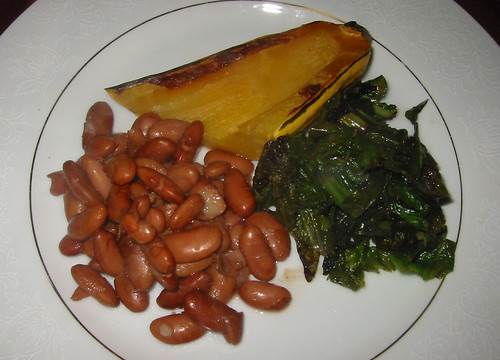
We recently harvested Tiger Eye beans (which we allowed to dry on the vine)...

...and Mandan Bride corn:

My 9yo son and I had a blast today removing the kernels from the corncobs...

...and cranking them through our little grain mill to make cornmeal.
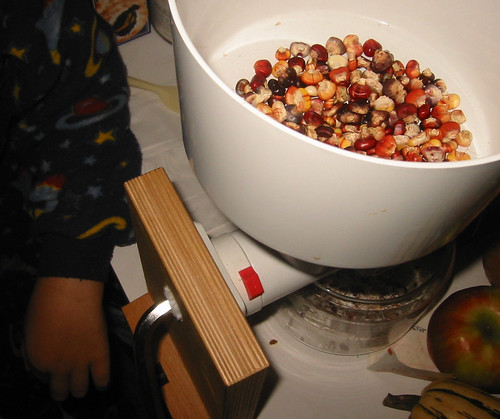
We then made traditional southern-style cornbread in a cast iron skillet.

Homegrown delicato squash (so sweet!) and a mix of greens including turnip and mustard rounded out our meal.
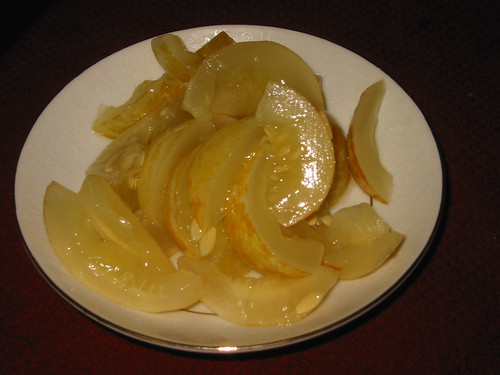
On the side we served pickles canned from our homegrown lemon cucumbers:
The meal ended with cups of steaming tea made from spearmint, lemon verbena, and stevia, all of which we grew ourselves over the summer and dried.
There is something profound about living so simply yet so well. We built our little shelter with our own hands (and a power drill), we ourselves planted the seeds and watered the garden that fed us tonight, and we sang songs with our voices alone. All of this plain homemade evening was glorious. How fortunate we are!
* * *
It is becoming clear what the lessons of the hoe, the apron, and the sukkah are: gratitude for simple things, yes--but also the responsibility to work for tikkun olam (the healing of the world), and, perhaps most importantly, the awareness that we on this planet are all one family.
Sukkot connects us to the world: both the land which feeds us, and the friends who share that nourishment with us in our sukkahs. We sit in our fragile booths, shivering in the chilly evening breeze and hoping it won't rain--yet we rejoice in the abundance of our harvest.
Times may be hard, and they may become harder--but we have enough to celebrate; we have each other.
At the end of our evenings, we carry the china and the candles back into our warm houses and say goodnight to our friends.
But Sukkot is also the moment when we are called to think of--no, to empathize with--those people who have to live all their days exposed to the elements just as we are this week in our festival booths. This year--when so many people have been kicked out of their homes to live in their cars, crash on a friend's couch, or sleep on the streets--this lesson is more important than ever.
Regardless of our religious or cultural practices, Harvest Time is a moment when we must remember how many people--in this country and around the world--do not ever experience abundance. Instead, struggling people are going hungry every night, shivering as the winter approaches, in their own fragile cardboard booths.
Let us reach out our hands.


Wednesday, September 30, 2009
is this fast enough?
As I mentioned at Rosh Hashanah, my family has come together to celebrate a Humanist High Holidays this year. For the last few years, we've spent the Days of Awe partly together and partly going separate ways as we traversed our own roads towards non-Zionist Jewish-inspired humanism.
This year we are ready to chart a new course: a holiday season of family connection. Of course, we know that there will always be time when we feel we are in different places on the journey, but it is a blessing to know that we are rowing together.
Many Jews who have left religious Judaism in every other way continue to refrain from work, go to the day-long synagogue services of the High Holidays, and participate in the 25-hour fast of Yom Kippur. Since both of the adults in the household have fasted for years (whether or not we believed, and whether or not we attended synagogue), we wondered how we would handle this question this year--at this time when we are trying so hard to reshape our traditions into something that feels true, feels honest, to us.
Although my family feels incredibly tied to many ritual aspects of Judaism, it is only through the study of traditional interpretation and (often) the reshaping of tradition to be in line with our own lights, that we practice anything. Some rituals remain almost exactly, with only the words changed. Some leave their echos as we transform the practice slightly, or significantly. Other rituals (such as the prohibition against shellfish, and the practice of infant circumcision) we have discarded almost completely.
I wondered, could the fast ever begin to feel authentic, real, and honest to us nonbelievers?
We tried to understand Talmudic understandings, the interpretations of Maimonides, the take of current orthodox leaders, the practice of the Reform movement, and everything else we could find. Two basic (and related) interpretations kept arising:
1. The fast is a way to make up for our sins of the past year. It is a way to take our dirty selves and purify ourselves. Some interpreters suggest that the purification process is about reconciling with God. Some stress the mild punishment of our bodies.
2. The fast, joined with other practices such as not bathing and not having sex and not brushing our teeth, emphasize separation from our corporal bodies. Yom Kippur is a time to separate from our animal selves and connect with our spiritual Godly selves. In some theorists' views, fasting shows that the nutrients we need come not from the dirty earth but from God. Others suggest that the symbolic flirtation with death which fasting represents forces us to focus on what "truly" matters.
I do not feel comfortable with the idea that our highest selves are somehow removed from our most physical, most HUMAN of selves. I turn away from religion because I believe that being human is, in fact, our highest calling.
After some soul searching, some arguing, and some personal pain, we decided that neither of us would fast this year.
But neither David nor I felt comfortable leaving all of the tradition, all of the meaning and lessons, behind.
We chose to eat the food of poverty instead. Every year as we have sat with our annual day of hunger, we've been acutely aware that others are not nourished as they ought to be. And for the vast majority of the world, even those who are not at all hungry do not consume the wide array of luxuries--and resources--that we do.
We packed lentils and barley for lunch. Throughout the morning as we awaited our picnic, we thought about how we would be reminded of the hardships of many people in this world of ours. We would feel gratitude in ways we don't always.
I was amazed at how delicious I found the grains and legumes, and how deeply fulfilled I was by that lunch. That simple meal goes forward with me into the new year.
This year we are ready to chart a new course: a holiday season of family connection. Of course, we know that there will always be time when we feel we are in different places on the journey, but it is a blessing to know that we are rowing together.
Many Jews who have left religious Judaism in every other way continue to refrain from work, go to the day-long synagogue services of the High Holidays, and participate in the 25-hour fast of Yom Kippur. Since both of the adults in the household have fasted for years (whether or not we believed, and whether or not we attended synagogue), we wondered how we would handle this question this year--at this time when we are trying so hard to reshape our traditions into something that feels true, feels honest, to us.
Although my family feels incredibly tied to many ritual aspects of Judaism, it is only through the study of traditional interpretation and (often) the reshaping of tradition to be in line with our own lights, that we practice anything. Some rituals remain almost exactly, with only the words changed. Some leave their echos as we transform the practice slightly, or significantly. Other rituals (such as the prohibition against shellfish, and the practice of infant circumcision) we have discarded almost completely.
I wondered, could the fast ever begin to feel authentic, real, and honest to us nonbelievers?
We tried to understand Talmudic understandings, the interpretations of Maimonides, the take of current orthodox leaders, the practice of the Reform movement, and everything else we could find. Two basic (and related) interpretations kept arising:
1. The fast is a way to make up for our sins of the past year. It is a way to take our dirty selves and purify ourselves. Some interpreters suggest that the purification process is about reconciling with God. Some stress the mild punishment of our bodies.
2. The fast, joined with other practices such as not bathing and not having sex and not brushing our teeth, emphasize separation from our corporal bodies. Yom Kippur is a time to separate from our animal selves and connect with our spiritual Godly selves. In some theorists' views, fasting shows that the nutrients we need come not from the dirty earth but from God. Others suggest that the symbolic flirtation with death which fasting represents forces us to focus on what "truly" matters.
I do not feel comfortable with the idea that our highest selves are somehow removed from our most physical, most HUMAN of selves. I turn away from religion because I believe that being human is, in fact, our highest calling.
After some soul searching, some arguing, and some personal pain, we decided that neither of us would fast this year.
But neither David nor I felt comfortable leaving all of the tradition, all of the meaning and lessons, behind.
We chose to eat the food of poverty instead. Every year as we have sat with our annual day of hunger, we've been acutely aware that others are not nourished as they ought to be. And for the vast majority of the world, even those who are not at all hungry do not consume the wide array of luxuries--and resources--that we do.
We packed lentils and barley for lunch. Throughout the morning as we awaited our picnic, we thought about how we would be reminded of the hardships of many people in this world of ours. We would feel gratitude in ways we don't always.
I was amazed at how delicious I found the grains and legumes, and how deeply fulfilled I was by that lunch. That simple meal goes forward with me into the new year.
Sunday, September 27, 2009
Recipe for a Date
1. Send Son to a friend's birthday sleepover where they plan to have a cookout, sing around the campfire, and sleep in tents.
2. Cook dinner using the amazing Sephardic-inspired or Mediterranean-inspired kosher cookbook, Levana's Table. We made Chicken with Dried Plums (cough, prunes) and Almonds--an utterly delicious "special" dish that was also very easy to make. Serve with roasted Brussels sprouts.

3. Set table with beautiful thrifted quilt, which will be discussed in detail in a future post.

4. Light a candle in a hollowed out tree limb decorated by Son many years ago.

Fill a vase with the dessicated "flowers" trimmed from a pot of garlic chives.

5. Just as partner pulls into the driveway, turn on Etta James, " one of the soundtracks of our seventeen-year romance.
6. Pour wine--preferably a deep luscious Zinfandel from a winery with a name like Folie a Deux--"a madness shared by two." (Doesn't that sound romantic? Unfortunately, it is actually a psychiatric syndrome in which the symptoms of psychosis are transmitted from one individual to another. I do my best.)
7. Talk leisurely, play no board games, don't remind anyone to practice their instruments,
8. Use beautiful pottery "pie-plate built for two" to make a half-sized rhubarb pie (with this excellent free recipe--which makes a full pie). For the pie crust, use the very much-loved and very earthy whole wheat pie crust in Laurel's Kitchen, my most used cookbook ever, full of healthy everyday possibilities for vegetarian meals. Save some pie for Son when he returns home.


9. Go upstairs with candles...
2. Cook dinner using the amazing Sephardic-inspired or Mediterranean-inspired kosher cookbook, Levana's Table.
We made Chicken with Dried Plums (cough, prunes) and Almonds--an utterly delicious "special" dish that was also very easy to make. Serve with roasted Brussels sprouts.3. Set table with beautiful thrifted quilt, which will be discussed in detail in a future post.
4. Light a candle in a hollowed out tree limb decorated by Son many years ago.
Fill a vase with the dessicated "flowers" trimmed from a pot of garlic chives.
5. Just as partner pulls into the driveway, turn on Etta James,
" one of the soundtracks of our seventeen-year romance.6. Pour wine--preferably a deep luscious Zinfandel from a winery with a name like Folie a Deux--"a madness shared by two." (Doesn't that sound romantic? Unfortunately, it is actually a psychiatric syndrome in which the symptoms of psychosis are transmitted from one individual to another. I do my best.)
7. Talk leisurely, play no board games, don't remind anyone to practice their instruments,
8. Use beautiful pottery "pie-plate built for two" to make a half-sized rhubarb pie (with this excellent free recipe--which makes a full pie). For the pie crust, use the very much-loved and very earthy whole wheat pie crust in Laurel's Kitchen,
my most used cookbook ever, full of healthy everyday possibilities for vegetarian meals. Save some pie for Son when he returns home. 9. Go upstairs with candles...
Friday, September 25, 2009
My 10yo son began taking violin lessons from a Suzuki instructor a few days after his birthday last spring. He is relatively old to begin Suzuki studies.
Sometimes I'm taken aback by the size of some of his peers at lessons! Every time we have a group session--where all of the teacher's students come together both to play together and get to know one another--I can't help but laugh at the absolutely tiny violin cases that the smallest pupils carry.
Suzuki music lessons are predicated on significant involvement by parents. This idea of parental commitment is especially important for the very young children--some of whom are barely 3 years old. For a 10yo student, it is not quite so necessary to have mothers and fathers involved in their practice sessions. However, in a world that de-emphasizes the involvement of parents in their children's learning, the Suzuki expectation is a welcome change.
The Suzuki method also stresses a loving-parent model for the official music teachers as well. As he talks about in his book Nurtured by Love: The Classic Approach to Talent Education, the founder of the Suzuki movement stresses that both parents and teachers should strive to acknowledge the child where they are, to celebrate and accept whatever the child does--instead of having some preconceived notion about progress and timeline.
Suzuki's work is in many ways aligned with attachment parenting principles and his book makes an excellent read even for those without children in music lessons.
I'm always inspired by the combination of intensity and love shown between Suzuki parents and their children as they work together:

Sometimes I'm taken aback by the size of some of his peers at lessons! Every time we have a group session--where all of the teacher's students come together both to play together and get to know one another--I can't help but laugh at the absolutely tiny violin cases that the smallest pupils carry.
Suzuki music lessons are predicated on significant involvement by parents. This idea of parental commitment is especially important for the very young children--some of whom are barely 3 years old. For a 10yo student, it is not quite so necessary to have mothers and fathers involved in their practice sessions. However, in a world that de-emphasizes the involvement of parents in their children's learning, the Suzuki expectation is a welcome change.
The Suzuki method also stresses a loving-parent model for the official music teachers as well. As he talks about in his book Nurtured by Love: The Classic Approach to Talent Education,
the founder of the Suzuki movement stresses that both parents and teachers should strive to acknowledge the child where they are, to celebrate and accept whatever the child does--instead of having some preconceived notion about progress and timeline. Suzuki's work is in many ways aligned with attachment parenting principles and his book makes an excellent read even for those without children in music lessons.
I'm always inspired by the combination of intensity and love shown between Suzuki parents and their children as they work together:
Wednesday, September 23, 2009
Thrifting
Several months ago we enjoyed a weekend full of wonderful meals, much wine, knitting and weaving, games, dancing with dogs, and hikes and drives in the beautiful countryside--along with the inspiring company of our lovely hosts.
I left the weekend with a deep desire for a salt cellar--like the beautiful wooden swivel-jar (which looked kind of like this) which graced their well-dressed table.
Over the months, David and I have searched in antique stores and at woodworking studios with hopes of finding something similar. No luck.
Last week as we parked our car in front of the house we were visiting, we glanced at the yard sale taking place next door.

When I saw this lidded wooden bowl, I immediately thought of Babe: "That'll do!"
I left the weekend with a deep desire for a salt cellar--like the beautiful wooden swivel-jar (which looked kind of like this)
which graced their well-dressed table.Over the months, David and I have searched in antique stores and at woodworking studios with hopes of finding something similar. No luck.
Last week as we parked our car in front of the house we were visiting, we glanced at the yard sale taking place next door.
When I saw this lidded wooden bowl, I immediately thought of Babe:
"That'll do!"
Tuesday, September 22, 2009
Humanist Rosh Hashanah
For quite a while, I've struggled to imagine how our family would celebrate the High Holidays this year.

As I have mentioned on this blog before, I have great difficulties believing in God. I am a pure atheist at heart and by my early rearing, but Judaism has been very important to me for a long time. Many years ago I converted after working closely with a Reconstructionist rabbi who held closely to traditional practice but interpreted that faith within a liberal theology. My partner David, who grew up Reform (a tradition which emphasizes more liberal practice but more conventional faith), soon adjusted to both my requests for more orthodox ritual and more "discussion" about what we actually believed--that is, what we really didn't believe.
* * *
Rosh Hashanah, the Jewish New Year, is a holiday when we are asked to consider what we have done right for the world this year, what we have not done right, and how we want to do better in the upcoming year. This is a holiday ripe for a humanist interpretation. Although I became uncomfortable in any synagogue's religious HiHo service, I have always felt great power in the broad call which Rosh Hashanah sounds--for reconciliation with one's loved ones, with the world community at large, and with oneself.
Yom Kippur, though, is one of those holidays that really does not make sense in that kind of metaphorical way--at least for me. The message is that after you get right with the rest of the world during Rosh Hashanah, you get right with God during Yom Kippur. Because Rosh Hashanah and Yom Kippur are in many ways really only one holiday (or at least one season of thought), my discomfort with the second commemoration has made me uncomfortable by default with the whole damn month.
* * *
This year is the first time my whole family has decided that all of us would not attend formal services at our old synagogue--or anywhere else. We decided instead to spend the day in the world: in nature, and with each other in conversation..
We went to a nature preserve on the Delmarva peninsula--a place where the Delaware Bay meets the Atlantic ocean.
We took a picnic of leftovers from our evening feast in our favorite picnic ware.

It was lovely sitting on the sand, having long and quiet conversations--some related to the holiday, and some unrelated.
David and I watched our son slowly make his way into the water. Although we had dressed for a chilly day, the sun made the day quite inviting.


As the day began to come to a close, we celebrated tashlikh, a ritual where one tosses breadcrumbs into moving water, symbolically casting one's sins away. Acknowledging our misdeeds is an important part of the High Holidays, but equally important is getting past those imperfections and creating a clean slate for the creation of our better selves.
For years we have tossed our breadcrumbs into a stream running near our house. This is the first time we've gone to the ocean.

It is somewhat disconcerting to have your sins come back to you, as the waves return the crumbs to their starting place.
It is even more disconcerting to have the seagulls eat the crumbs. Does them make them ScapeGulls?


As I have mentioned on this blog before, I have great difficulties believing in God. I am a pure atheist at heart and by my early rearing, but Judaism has been very important to me for a long time. Many years ago I converted after working closely with a Reconstructionist rabbi who held closely to traditional practice but interpreted that faith within a liberal theology. My partner David, who grew up Reform (a tradition which emphasizes more liberal practice but more conventional faith), soon adjusted to both my requests for more orthodox ritual and more "discussion" about what we actually believed--that is, what we really didn't believe.
* * *
Rosh Hashanah, the Jewish New Year, is a holiday when we are asked to consider what we have done right for the world this year, what we have not done right, and how we want to do better in the upcoming year. This is a holiday ripe for a humanist interpretation. Although I became uncomfortable in any synagogue's religious HiHo service, I have always felt great power in the broad call which Rosh Hashanah sounds--for reconciliation with one's loved ones, with the world community at large, and with oneself.
Yom Kippur, though, is one of those holidays that really does not make sense in that kind of metaphorical way--at least for me. The message is that after you get right with the rest of the world during Rosh Hashanah, you get right with God during Yom Kippur. Because Rosh Hashanah and Yom Kippur are in many ways really only one holiday (or at least one season of thought), my discomfort with the second commemoration has made me uncomfortable by default with the whole damn month.
* * *
This year is the first time my whole family has decided that all of us would not attend formal services at our old synagogue--or anywhere else. We decided instead to spend the day in the world: in nature, and with each other in conversation..
We went to a nature preserve on the Delmarva peninsula--a place where the Delaware Bay meets the Atlantic ocean.
We took a picnic of leftovers from our evening feast in our favorite picnic ware.
It was lovely sitting on the sand, having long and quiet conversations--some related to the holiday, and some unrelated.
David and I watched our son slowly make his way into the water. Although we had dressed for a chilly day, the sun made the day quite inviting.
As the day began to come to a close, we celebrated tashlikh, a ritual where one tosses breadcrumbs into moving water, symbolically casting one's sins away. Acknowledging our misdeeds is an important part of the High Holidays, but equally important is getting past those imperfections and creating a clean slate for the creation of our better selves.
For years we have tossed our breadcrumbs into a stream running near our house. This is the first time we've gone to the ocean.
It is somewhat disconcerting to have your sins come back to you, as the waves return the crumbs to their starting place.
It is even more disconcerting to have the seagulls eat the crumbs. Does them make them ScapeGulls?
Subscribe to:
Posts (Atom)
LinkWithin
