Wednesday, November 18, 2009

DIY : Green and Thrify Shopping Bag Tutorial

For a while now I've been fascinated with Transition Towns and especially the concept of "reskilling"--and I've been hard at work to learn new things to make our family and community more independent of oil. I've also tried to be active in the environmentalist movement, greening my daily life as we work towards both small individual changes and larger political efforts which can respond to the climate crisis and to environmental degradation.

Of course, many of the things I've tried to learn in the last few years have to do with food and fiber. Everything from fermenting sauerkraut to spinning alpaca, from learning how to can to learning how to weave have been on my agenda.

Today's new skill: basic sewing, using a sewing machine.

Sewing Up Shopping Bags

While I was completely intimated for months by the machine sitting in a corner of our finished basement, when my 10yo son and I pulled it out and pored over the instructions, it suddenly seemed quite straightforward.

Following the diagrams in the manual, we threaded the bobbin and the top needle. And honestly, although it only took us seconds, THAT was the most complicated thing we did.

Last time we went to the local thrift store, everything was on sale for 50% off the usual thrift store prices. In addition to a queen-sized quilt for our bed, assorted dress-up goodies for Halloween costumes (including a pair of very cool women's boots for our son's musketeer get-up), and a metal file box perfect for storing seeds, we picked up a handful of tank tops in a variety of sizes.

When we picked up the shirts, we were thinking about the t-shirt bag my son made at the Green Festival in DC last year. It is just a gray t-shirt with the arms cut off by a 9yo, sewn together on the bottom by the adult coordinator. He then drew a picture of a cornucopia on the front to decorate it:

green festival bag

Every time we use the bag at our local co-op, the grocery store, or at the farmer's market, someone comments on how clever it is. Many people have told us over the year that we should sell them. (Well...that would require actually making them.)

Since last year when my son made the bag, I've seen the idea online everywhere from No Impact Man to Martha Stewart. But I kept staring at the sewing machine in fear. Could I do it by hand, I wondered? Would the seams be strong enough?

Finally, the pile of tank tops hanging on the chair in the dining room pushed me to haul out the machine, steel myself for the task, and finally try it out.

Sewing Up Shopping Bags

And you know what? It was FUN--and incredibly fast and easy, and totally addictive. Within the hour, my son and I had made a huge collection of bags.

Sewing Up Shopping Bags

All we did was turn the t-shirts inside out, then line up the side seams of the tank top. We were very casual and simply used the thread we had on hand rather than trying to match the shirts. We sewed once across the bottom of each tank top with a straight stitch and once across with a zigzag. (I'm sure that sewing twice across with straight stitch would work perfectly, but we wanted to play around with different stitches.) We sewed the lines immediately above the line where the shirt's hem ends. For brand new sewers, this works very well because the seam lump lines up with the side of the sewing foot to keep you going forward in a very straight line. Remember to start and end your lines by stitching backwards just a few stitches in order to anchor the ends. After the sewing is done, clip the end threads and turn the bags right side out.

We chose to use tank tops to avoid having to deal with the top at all--but if you have t-shirts in hand, simply trim the sleeves and scoop the neck enough that you have something to hold onto. No need to sew anything or hem anything. Check out the links of instructions above if you have any additional questions.

Some of the shirts we used were women's petites. Some were men's extra-larges.

Sewing Up Shopping Bags

Some of the shirt we sewed inside out to get a smooth bottom (like the pink bag), and a few we left right side out before sewing (like the blue one):

Sewing Up Shopping Bags

We also played around with a few fancier tops, just for fun.

One is a more delicate stretchy tank which I used to carry my knitting today:

Sewing Up Shopping Bags

I love the lacy camisole! I decided to hem it from the outside in order to let the lacy trim at the bottom remain a design element. (My naughty brain imagines filling it with two huge and juicy cantaloupes.)

Sewing Up Shopping Bags

Some of these bags will become "wrapping paper" (or rather, gift bags) for presents this holiday season. After they do their duty as present holder, recipients can use them again and again as they do their shopping.

These bags are a fabulous way to learn to sew--fast and laid-back enough that if you make a few mistakes, it really won't matter. And at the end of your sewing practice time, you're left with reusable bags great for shopping or gifting.

Monday, November 16, 2009

Here Comes the Sun

After days and days of clouds and rain, the sun has emerged and our neighborhood seems to have escaped from the encroaching fingers of winter for a few more days.

We've been celebrating these moments of sun by cooking meals with with our solar oven:

solar oven

Yesterday we managed to squeeze two meals out of the brief hours we had.

First, a lunch of pita pizza--small pitas left over from a hummos fiesta the other night, some leftover spaghetti sauce, a topping of mozzerella and parmesan cheeses, and a liberal sprinkle of dried oregano.  A very easy lunch that basically just needed to heat up.

solar lunch

For dinner, we cooked some pre-soaked dried limas in the solar oven and served them with spicy sauerkraut we made last year.  A very plain but wonderful meal, meeting the need for non-fussy preparation while "Papa" is away at a conference for almost a week.

Of course, the problem with solar cooking dinner during this season is that it is basically dark by 4pm and therefore the meal has to be finished cooking by then.   Although we held things for a little while, we had finished our leisurely meal by 6pm and really could not imagine anything but reading in bed and going to sleep early.

Today we reheated some chicken for lunch.  My son was eager to bake something sweet in the Sun Oven--cookies or pumpkin bread or something--but the clouds began to roll in a little in the afternoon.

Tomorrow, the two of us are headed to a talk about making school lunches healthier.  My homeschooler laughs as he points out that at HIS school, lunch is almost always fairly healthy for the student, the teacher, and the planet.  Do you think the public school system might be interested in investing in a few Villager Sun Ovens?

Friday, November 13, 2009

The Dinner Diaries

I recently read Betsy Block's wonderfully entertaining book The Dinner Diaries:Raising Whole Wheat Kids in a White Bread World. Although I was initially drawn to the book because I had heard that it was a funny food memoir, I found it to be a much more useful book than I had imagined.  Yes--it is charming and warm--but it also engages food politics on many levels and will make readers think more seriously about the ramifications of our decisions about eating.

Block writes the book as a memoir of her own personal quest to improve her family's diet.  She lets us know her struggles and her families, and she allows us to celebrate with her.  This narrative style allows the author to pass along a great deal of information without it ever seeming the least bit moralizing or preachy.

Block introduces her readers to all sorts of food issues.  Should we cut down and/or elminate meat?  Should we remove dairy from our diets?  What should we do about sugar?  How can we handle our own uncertainties about the answers in the face of social/community resistance to change?

My favorite section is her discussion of fish.  While eating more fish is initially on her list of things to do to improve her family's diet, she then learns more about the mercury content of most fish as well as other pollution issues.  She then discusses overfishing and endangered varietes.  Block winds up with an effort to find sustainably-raised local fish.  It is a tying together of many of the concerns raised throughout the book.
 
The book is not without its problems.

Block tells an absolutely wonderful story about Gandhi--one I had never heard before.  When a mother brought her young sugar-obsessed son to the master in order to have Gadhi himself correct his eating habbits.  Gandhi told the family to come back again in three weeks.  When they did, he told the boy simply not to eat sugar.  When the frustrated mother asked why he couldn't have just told her son those same words three weeks before, Gandhi responded: "Because three weeks ago, I was still eating sugar."

I love this story with its message that we need to live up to all we expect our children to be.  But what Block says after this story is that while it is important that we be role models, her chosen way is to eat candy (fair-trade chocolate) with her husband after the children are in bed.  Her reasoning?  "We're the parents here" and "some things in life should be adult only."  In other words, she chooses to be a good role model to her children's faces but not a good role model after dark.  As she says, "We'd rather lie than argue."  I'm not sure Gandhi would approve.

There are a few other places where I disagree with Block.  For example, I do not believe that our vitamins should be coming from either pills or foods "fortified" with added chemicals.  Real food grown in real soil seems like a better answer for our health as well as for our planet.

I was also a bit irked by the often-contrived efforts to make nutritional advice seem to be riddled with contradiction and conflict.  She paints the nutritionists and the locavores are actively working at cross purposes.  As she writes early on, the two groups are in opposite corners of a boxing ring and what the first group says are fighting words.  For example, the locavores are "telling us to eat locally and in season,, which obviously rules out most of what the nutritionists advised"--which is to eat less meat and more whole grains, fruits, and vegetables.  The Ethical Eaters are in another corner altogether.  While this portrayal of people at odds makes for a great story, it just doesn't work like that very often.  Yes, sometimes you have to choose between a sprayed apple from down the road and an organic one from China.  But that doesn't mean the basic ideas are not in harmony.

Despite these reservations,  The Dinner Diaries is both an entertaining and informative read.  Check it out!

Wednesday, November 11, 2009

Where You Have Been

My father's most significant bookwas published twenty-five years ago. To celebrate, the publishers released a new edition and the professional organization of which he has been active for many years held a special session during its annual conference to honor his contribution.

This particular annual conference has been important to my father for almost fifty years.  He has even served as the organization's president. And as he says, Dad has even given his two children to the profession.  Both my brother and I are in the same field of academic study.  This conference is always a family reunion for us.

Unfortunately, Dad has been quite sick for the last two annual conferences. In the fall of 2006, we wondered if he would be able to attend at all, ever again. After a diagnosis of cancer followed by a complication-ridden treatment period, this year Dad was able to return this year in full and healthy glory.

He participated in several sessions honoring living presidents of the organization and remembering influential historians who died this year. This kind of personal relationship-based story-sharing is definitely one of my father's strongest suits. But he also was active in the academic scholarship side of the conference--something he really has not been able to participate in the same way in recent years. It clearly brought him great joy, but I think it meant even more to his friends.

The meeting was a homecoming--and a goodbye--all wrapped into one.

During the session about his book, Dad laughed and said that one always hopes that any acknowledgment of lifetime achievement is premature.

He also said that after listening to other academics laud the book he wrote and praise the impact his scholarship has had on the field for the past three decades, he felt a bit like Tom Sawyer attending his own funeral.

Dad ended his comments saying he wanted to be able to say, like Tom Sawyer, "I ain't dead yet; I was only off being a pirate!"

And just as Tom's Aunt did, we all laughed and cried and hugged him, hoping to hold on to him for a long time coming.

Tuesday, November 10, 2009

Ma and Pa

ma and pa

On October 30st, 1993, David and I had already been friends for a couple of years and very very close friends for several months. We studied together (he learning anatomy while I read about hegemony) and cooked together, walked to school together and stayed up late together. But we were not dating.

We figured it out the next morning--October 31st.

On Halloween, we attended a party together in costume. I (always a witch) held hands in front of my friends with Paddington Bear. No one said anything. I gloated to some friends that we were now together--and the answer I heard from everyone was a sarcastic, "We've known that for months!"

Ever since, David and I have celebrated our dating anniversary on Halloween. We always love handing out goodies in costume while drinking champagne by candlelight.

This year David and I decided this year to dress as Ma and Pa Ingalls.

In our neverending quest to hand out non-candy, non-plastic goodies, we passed out large jingle bells to trick-or-treaters this year. I filled my apron pockets full so I would be prepared for every knock on the door.

* * *

After the evening revelries ended and our son went up to bed, David and I celebrated together for a few more minutes, dancing in the dining room to Old Crow Medicine Show's "Wagon Wheel."

So rock me momma like a wagon wheel,
Rock me momma any way you feel
Hey... momma rock me
Rock me momma like the wind and the rain,
Rock me momma like a south bound train
Hey... momma rock me


The jingle bells in my apron pockets and our squeaky floor boards combined to punctuate the music.

* * *

Here's the slightly racy video from OCMS, which always instantly transports me back to my childhood in rural North Carolina. (I was always shooed away from booths like this which came to the traveling fair.) Thanks to Sharon for sharing it with me and her other readers.

Sunday, November 01, 2009

Thirsty

jack o lantern

Tuesday, October 27, 2009

coming together

My family headed to downtown DC for the 350ppm rally and march on Saturday. We hung out and listened to some traditional DC-style go-go music as well as a few inspiring speeches, including one by Takoma Park hero Mike Tidwell.

At 3:00, rally participants began to line up for the march to the park across from the White House.

And at that moment the skies opened, absolutely completely.

David brought an umbrella and I brought my rain jacket, but our 10yo son had decided not to carry rain gear. After twenty minutes of marching through the pelting rain and splashing through puddles, we were all soaked. Eventually, we peeled off from the crowd and went to a cafe for hot chocolate.

* * *

The three of us took the Metro back to Takoma Park in time for the annual Boy Scouts pancake supper. Although I am not a huge fan of the Boy Scouts (since I'm an atheist and a strong supporter of gay rights), this dinner is a show of community support.

Because of our No Impact experiment this week, we toyed with taking reusable plates with us to the dinner. I finally decided that this minor bit of personal earth-saving might seem like a major bit of holier-than-thou face-slapping. Who was I to be holier when we bagged on the march just because of a little rain?

We confidently decided this would be a time to just use what we were given and be appreciative of togetherness.

Imagine my thrill when I walked in the church gym and saw all the reusable plates, cups, and silverware--along with both organic cream and raw cane sugar to go with the coffee!

And who else was lined up for pancakes? Many other rally participants--including Mike Tidwell, enjoying fellowship and pancakes--dry and warm.

Saturday, October 24, 2009

350!


We're off to the big march in downtown DC today, braving the rain. Where are you going to mark 350ppm?

Check out 350.org's list of actions if you don't have something already planned.

Tuesday, October 20, 2009

Local Harvest: Foraging for Acorns

Inspired by Euell Gibbons Stalking The Wild Asparagus, we recently harvested acorns to make delicious acorn pancakes.

acorn pile

See the full post here.

acorn pancakes

Monday, October 19, 2009

Going No Impact

My 10yo son and I are participating in the No Impact Project this week. Although for many years my family has been  involved with the environmental movement (as well as committed to lessening our own ecological footprints), the No Impact Project gives us an opportunity to talk about these issues more, learn to take more extensive steps, and make connections with other participants. I certainly felt that way during Crunchy Chicken's Low Impact Week.

Isn't this mass experiment just hype, a stunt?  Isn't it in some ways counterproductive since it leads the "consumer" (formerly known as the citizen) to feel responsible for climate change rather than the government and large corporations acknowledging their profound role and responsibility in this problem?

Perhaps so. I will end this week by talking more about the problems of personal versus political action.

But for now, I am taking Bill McKibben's words to heart: "The first step, clearly, is to take personal responsibility--to cut your own impact." He goes on to explain why personal action is not enough. As he writes, "If we want to have as little impact as possible on the planet, we must have as much impact as possible on its politics. At this point we're not going to solve this one lightbulb at a time--we're going to solve it one planet at a time if we're going to solve it at all." He recommends No Impact Week as not only a way to "minimize your personal [impact]" but to form a community of people actively making not only changes in their lives but changes in the culture that will then allow our politicians and other leaders to step up to the plate, that is, to "maximize your political impact."  Personal change turns us into actors.  When we see ourselves as effective people, we can have much more powerful voices for political change.

In addition to doing right by the planet, going "No Impact" is truly the way to do right by ourselves. By pushing ourselves to live up to what we say we believe, we're asking ourselves to face up to ourselves. Instead of letting ourselves get by with easy rhetoric, we are allowing ourselves to grow, to bloom into more responsible and effective people--on this issue but also on all other issues.  It is a way of celebrating the potential of humanity--and the potential of ourselves.

(Check out the reference to this essay on the Huffington Post!)

Thursday, October 15, 2009

A Time for Action

During the second week in December, world leaders will meet in Copenhagen, Denmark at the United Nations Climate Change Conference with the goal of putting together a new global climate treaty, replacing 1997's Kyoto Protocol. It is essential for industrialized countries to reduce their greenhouse gas emissions, for major developing countries like China and India to limit the growth of their emissions, and for poorer countries to get financial help adapting to the impacts of climate change which many already feel.

In the run-up to Copenhagen, many individuals and groups have helped set the stage for citizen action.

* * *


Today is Blog Action Day, an annual call for bloggers to discuss one issue of crucial concern to the world. This year's topic is Climate Change. Bloggers across the world, regardless of the normal topics of their blogs, are writing about the crisis facing our environment.

* * *

Join me at <a href=

Coming up on October 24 is the '350' Day of Action.

As 350.org explains, "350 parts per million is what many scientists, climate experts, and progressive national governments are now saying is the safe upper limit for CO2 in our atmosphere." Although for most of human history levels have hovered around 275ppm, we are now at 390ppm–-and this number is rising by about 2 parts per million every year. As NASA's Jim Hansen has pointed out, above 350 we will no longer have a planet "similar to the one on which civilization developed and to which life on earth is adapted."

As long as we stay above the 350ppm border, we risk reaching tipping points and irreversible impacts such as the melting of the Greenland ice sheet and major methane releases from increased permafrost melt.

The brilliant Bill McKibben puts it this way: "It's not as if we have a choice. The most useful thing about having a number is that it forces us to grow up, to realize that the negotiations that will happen later this fall in Copenhagen aren't really about what we want to do, or what the Chinese want to do, or what Exxon Mobil wants to do. They're about what physics and chemistry want to do: the physical world has set its bottom line at 350, and it's not likely to budge."

To help our world leaders understand how essential it is to come up with a climate plan that includes cuts significant enough to reach that 350ppm boundary, 350.org has organized a Day of Action. Groups all over the world will participate, representing their support for this target. As the organization says, "We're calling on people around the world to organize an action on October 24 incorporating the number 350 at an iconic place in their community, and then upload a photo of their event to 350.org website. We'll collect these images from around the world and, with your help, deliver them to the media and world leaders. Together, we can show our world and it's decision-makers just how big, beautiful, and unified the climate movement really is." Check out some of the creative ways people have gotten together before on this issue.

Using this map, you can find a group near you to join on the 24th.

* * *

Wednesday, October 14, 2009

Eat at Mom's

First there was the 100 Mile Diet.

Then there was the 100 Foot Diet.

And now, the 100 Millimeter Diet!


pic from the Pa Dept of Health

* * *

As a long-time breastfeeding activist, I am very pleased to see the Green movement beginning to embrace the environmental importance of nursing children. After all, there is nothing more sustainable than breastfeeding. It comes with absolutely no waste in the manufacturing process and no waste in the delivery system. It is free, making it accessible for all people. It is easier by far than filling up with formula (although this may not seem to be true when you're just starting out if you don't find great support). It even leads to lower consumption of medical resources over the entire course of life.

I was thrilled to hear Joel Salatin at the DC Green Festival proclaim these environmental virtues of breastfeeding. I was also pleased to see a vendor in the Green Festival merchant hall selling t-shirts with various green choices--including breastfeeding!

Even Michael Pollen, king of the food movement has spoken about the ecological importance of breastfeeding.

Be sure to click through this fantastic slide show, Infant Feeding Affects Climate Change. Also check out 10 Reasons Breastfeeding is Green.

Tuesday, October 13, 2009

Friday, October 09, 2009

Really "Tightening Their Belts"...

In a New York Times article today called "Leaner Times at Harvard," it was reported that due to the critical hit to the university's endowment, the school is making serious cuts: no more bacon will be served at weekday breakfasts for undergraduates, and no more cookies provided at faculty meetings.

I know things are actually much tougher, and the newspaper even admits as much. For example, a significant number of students live in the old Radcliffe dormitories--at the Quad, where I chose to live in the late 1980s. It is a bit of a walk to the main campus. The beautiful library there where I spent most of my evenings studying has been closed. Many staff members have lost their jobs, there is a hiring freeze, and salaries have been frozen as well.

At the same time, Harvard has prioritized their cuts to ensure students have $9 million more in financial aid than they did last year. This move has allowed some students to remain enrolled who otherwise would have been unable to afford it in these difficult times.

I'm feeling awfully torn: really wanting to put Harvard's financial situation into the context of a world hit by true suffering, yes--but also really irritated that the New York Times would not only trivialize the cuts necessary but treat undergrads as if they are all smug rich kids who feel entitled to the best all the time. While I am sure there are students who fit that profile that are enrolled at Harvard, I met precious few of them while I was there.

And yet--here I am, typing into my laptop, uploading pictures from my new camera, and eating a hot breakfast. Maybe we are too educated, too privileged, and too entitled to even notice how overfed our culture is.

Wednesday, October 07, 2009

Are You Game?

We've been having lots of fun and studying homeschool math at the same time with a wonderful game called Equate.It is a game very much like Scrabble but instead of using letters to build words, players use numbers to build equations.

Beginning several years ago, we used the Junior tiles. After using the Junior tiles for a while, players are ready for the regular tiles.

Recently we've started playing with the Advanced tileswhich include negative and positive integers, integer exponents, and more fractions.

It took me a while to get in the swing of thinking about negative exponents again...

equate

For those looking for homeschooling mathematics fun and games, we also love ThinkFun Math Dice.

Monday, October 05, 2009

Living in Booths

A repost of an entry I wrote for that marvelous blog Green Phone Booth:


Sukkot is my favorite holiday. For seven to nine days (depending on one's practice), Jews eat and sometimes sleep in a little open hut we build in our backyards. The roof must be made with natural materials such as leaves and branches, and openings must be left in the ceiling so we can see the stars and the light of the moon.

Religiously, Sukkot is a time of remembering when the Hebrew people wandered in the wilderness without a permanent home after being freed from slavery. The famous Jewish philosopher Maimonides proposed that we build sukkahs every fall so we will always be reminded of times of misfortune (of being homeless) during our times of good fortune.

Sukkot is also a celebration of the "ingathering" (ie, the harvest) after a season of hard work in the fields. A holiday with roots which predate Judaism, Sukkot is a kind of Jewish Thanksgiving when we celebrate the reaping of the fruits of the season and our ability to share it with our friends and families.

Although the spiritual meanings of Sukkot mean a lot to many Jews, others of us who reject the religious mandates still find deep symbolism in its celebration. It is hard to miss that the times of misfortune are exactly the moments when we can most appreciate our riches. We relax around the table in our sukkah with all our loved ones seated around us and celebrate how much we have to sustain us: not only our full pantries but our full hearts.

* * *

No time seems more appropriate to me to enjoy my own contemporary family's labor in the field. Our own personal "field" is a tiny urban backyard garden which only produces enough to supplement our diet. But tonight, we've made dinner exclusively from what we grew ourselves.

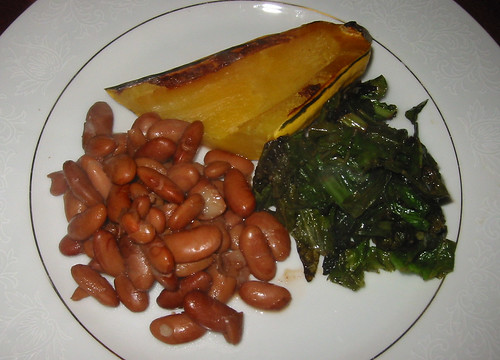
We recently harvested Tiger Eye beans (which we allowed to dry on the vine)...


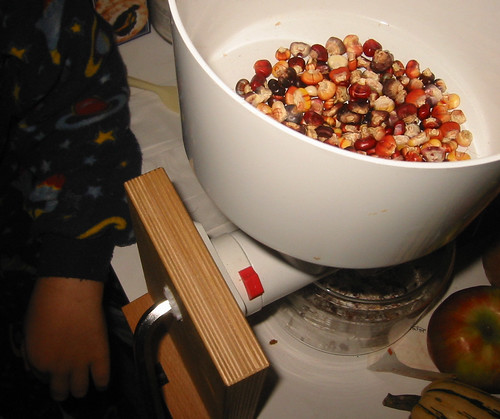
...and Mandan Bride corn:


My 9yo son and I had a blast today removing the kernels from the corncobs...


...and cranking them through our little grain mill to make cornmeal.


We then made traditional southern-style cornbread in a cast iron skillet.


Homegrown delicato squash (so sweet!) and a mix of greens including turnip and mustard rounded out our meal.


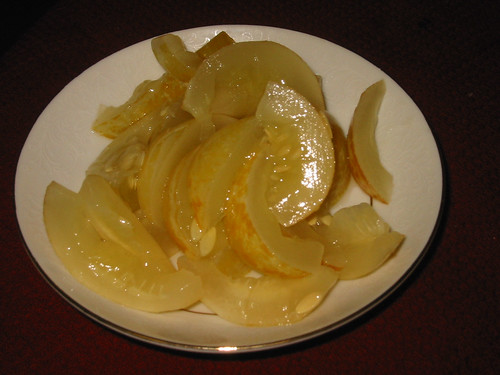
On the side we served pickles canned from our homegrown lemon cucumbers:


The meal ended with cups of steaming tea made from spearmint, lemon verbena, and stevia, all of which we grew ourselves over the summer and dried.

There is something profound about living so simply yet so well. We built our little shelter with our own hands (and a power drill), we ourselves planted the seeds and watered the garden that fed us tonight, and we sang songs with our voices alone. All of this plain homemade evening was glorious. How fortunate we are!

* * *

It is becoming clear what the lessons of the hoe, the apron, and the sukkah are: gratitude for simple things, yes--but also the responsibility to work for tikkun olam (the healing of the world), and, perhaps most importantly, the awareness that we on this planet are all one family.

Sukkot connects us to the world: both the land which feeds us, and the friends who share that nourishment with us in our sukkahs. We sit in our fragile booths, shivering in the chilly evening breeze and hoping it won't rain--yet we rejoice in the abundance of our harvest.

Times may be hard, and they may become harder--but we have enough to celebrate; we have each other.

At the end of our evenings, we carry the china and the candles back into our warm houses and say goodnight to our friends.

But Sukkot is also the moment when we are called to think of--no, to empathize with--those people who have to live all their days exposed to the elements just as we are this week in our festival booths. This year--when so many people have been kicked out of their homes to live in their cars, crash on a friend's couch, or sleep on the streets--this lesson is more important than ever.

Regardless of our religious or cultural practices, Harvest Time is a moment when we must remember how many people--in this country and around the world--do not ever experience abundance. Instead, struggling people are going hungry every night, shivering as the winter approaches, in their own fragile cardboard booths.

Let us reach out our hands.


Wednesday, September 30, 2009

is this fast enough?

As I mentioned at Rosh Hashanah, my family has come together to celebrate a Humanist High Holidays this year. For the last few years, we've spent the Days of Awe partly together and partly going separate ways as we traversed our own roads towards non-Zionist Jewish-inspired humanism.

This year we are ready to chart a new course: a holiday season of family connection. Of course, we know that there will always be time when we feel we are in different places on the journey, but it is a blessing to know that we are rowing together.

Many Jews who have left religious Judaism in every other way continue to refrain from work, go to the day-long synagogue services of the High Holidays, and participate in the 25-hour fast of Yom Kippur. Since both of the adults in the household have fasted for years (whether or not we believed, and whether or not we attended synagogue), we wondered how we would handle this question this year--at this time when we are trying so hard to reshape our traditions into something that feels true, feels honest, to us.

Although my family feels incredibly tied to many ritual aspects of Judaism, it is only through the study of traditional interpretation and (often) the reshaping of tradition to be in line with our own lights, that we practice anything. Some rituals remain almost exactly, with only the words changed. Some leave their echos as we transform the practice slightly, or significantly. Other rituals (such as the prohibition against shellfish, and the practice of infant circumcision) we have discarded almost completely.

I wondered, could the fast ever begin to feel authentic, real, and honest to us nonbelievers?

We tried to understand Talmudic understandings, the interpretations of Maimonides, the take of current orthodox leaders, the practice of the Reform movement, and everything else we could find. Two basic (and related) interpretations kept arising:

1. The fast is a way to make up for our sins of the past year. It is a way to take our dirty selves and purify ourselves. Some interpreters suggest that the purification process is about reconciling with God. Some stress the mild punishment of our bodies.

2. The fast, joined with other practices such as not bathing and not having sex and not brushing our teeth, emphasize separation from our corporal bodies. Yom Kippur is a time to separate from our animal selves and connect with our spiritual Godly selves. In some theorists' views, fasting shows that the nutrients we need come not from the dirty earth but from God.  Others suggest that the symbolic flirtation with death which fasting represents forces us to focus on what "truly" matters.

I do not feel comfortable with the idea that our highest selves are somehow removed from our most physical, most HUMAN of selves. I turn away from religion because I believe that being human is, in fact, our highest calling.

After some soul searching, some arguing, and some personal pain, we decided that neither of us would fast this year.

But neither David nor I felt comfortable leaving all of the tradition, all of the meaning and lessons, behind.

We chose to eat the food of poverty instead. Every year as we have sat with our annual day of hunger, we've been acutely aware that others are not nourished as they ought to be. And for the vast majority of the world, even those who are not at all hungry do not consume the wide array of luxuries--and resources--that we do.

We packed lentils and barley for lunch. Throughout the morning as we awaited our picnic, we thought about how we would be reminded of the hardships of many people in this world of ours. We would feel gratitude in ways we don't always.

I was amazed at how delicious I found the grains and legumes, and how deeply fulfilled I was by that lunch. That simple meal goes forward with me into the new year.

LinkWithin

Related Posts with Thumbnails